THE CLASSIC COLLECTION✦An outlaw’s diary: the CommuneCLASSIC FREE BOOKS
An outlaw’s diary: the Commune
Cécile Tormay
THE CLASSIC COLLECTION · 1879
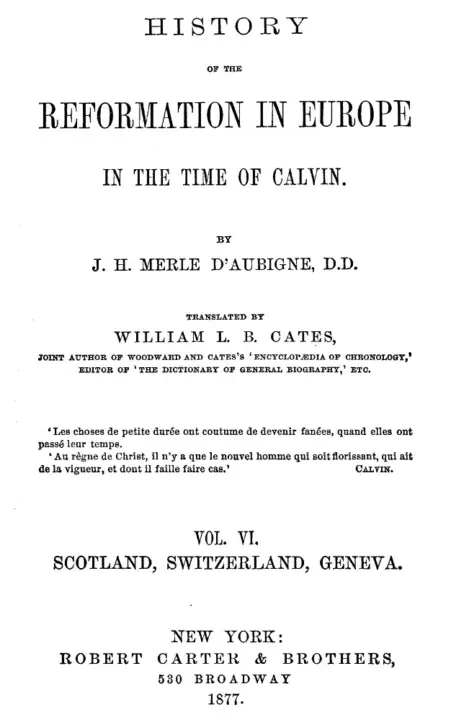
"History of the Reformation in Europe in the Time of Calvin, Vol. 6 (of 8)" by J. H. Merle D’Aubigné is a historical account written in the late 19th century. This volume focuses on the Reformation period in Scotland, Switzerland, and Geneva, emphasizing the theological and sociopolitical developments during Calvin's influence. It likely discusses the struggles for religious reformation and the impact of key figures such as John Knox and Patrick Hamilton on the Protestant movement in Scotland. The opening of the volume sets the stage for the narrative by outlining the historical background and key events leading to the Reformation in Scotland. It introduces the early influencers of the movement, touching on the historical significance of figures such as the Culdees, John Wycliffe's followers, and Patrick Hamilton. The text elegantly describes how the doctrines of the Reformation began to resonate throughout Scotland, highlighting the critical themes of faith, scripture, and the evolving relationship between the Church and Scottish society. It also begins to explore the tumultuous interplay of local nobility and religious authority, which would shape the Reformation's trajectory in the region.
Introduction adapted from the source catalogue; source summaries may be automatically generated.
Free to read · English · 180,014 words · No account needed
MAKE TIME FOR A GOOD BOOK
On by default. Untick to stop anonymous reading totals. Each page counts after 10 seconds in view. How this works.
Anonymous counting is on unless you have switched it off.
As the news spread, however, in foreign lands, very different feelings were aroused. The doctors of Louvain, writing to the clergy of Scotland, said, ‘We are equally delighted with the work which you have done and with the way in which you have done it.’[132] Others showed themselves not so much charmed with such hatred, stratagem, and cruelty. A Christian man in England wrote to the Scottish nobles, ‘Hamilton is now living with Christ whom he confessed before the princes of this world, and the voice of his blood, like the blood of Abel, cries to heaven.’[133] Francis Lambert, especially his friend and companion, was a prey to intense grief: he said to the landgrave, ‘Hamilton has offered up to God and to the Church, as a sacrifice, not only the lustre of his rank, but also his youthful prime.’[134]
[Sidenote: JAMES V. FLIGHT.]
Some days after, the king returned from the north of Scotland, whither the priests had sent him to worship some relics. Hamilton was no more. What were the feelings of James V. when he learnt the death of this noble scion of the royal house? We have no means of ascertaining them. The young prince seemed to be more alive to the humiliation to which the nobles subjected him than to the cruelty of the priests. Fretted by the state of dependence in which Angus kept him, he made complaint of it to Henry VIII.[135] Hunting was his only amusement, and for the sake of enjoying it he had taken up his abode at Falkland Castle. On a sudden, caring no more for hounds, foxes, or deer, he conceived the project of regaining his freedom and his authority. This might be fraught with grave consequences for the Reformation. If at a time when the nobles kept a tight hand over the priestly party Hamilton had been put to death, what might happen in Scotland when the priests, on whom James leaned for support, should have once more seized the chief power? The deliverance of the young king, however, was no easy matter. A hundred men, selected by Angus, were about him night and day; and the captain of his guards, the minister of the royal house and the lord treasurer of the kingdom, had orders to keep their eyes constantly upon him. He determined to resort to stratagem. He said one evening to his courtiers, ‘We will rise very early to-morrow to go stag-hunting; be ready.’ Everyone retired early to rest; but no sooner had the prince entered his chamber than he called one of his pages in whom he had full confidence. ‘Jockie,’ said he to him; ‘dost thou love me?’ ‘Better than myself, Sire.’--‘Wilt thou run some risk for my sake?’ ‘Risk my life, Sire.’ James explained to him his design; and then, disguising himself as a groom, he went into his stables with the page and a valet. ‘We are come to get the horses ready for the hunt to-morrow,’ said the three grooms. Some moments elapsed; they went noiselessly out of the castle, and set off at a gallop for Stirling Castle, where the queen-mother was residing. The king arrived there in the early morning. ‘Draw up the bridges,’ said he, so fearful was he of his pursuers. ‘Let down the portcullises, set sentinels at all points.’ He was worn out with fatigue, having been on horseback all night; but he refused to lie down until the keys of all the gates had been placed under his pillow; then he laid down his head upon them and went to sleep. On the morning after this flight, Sir George Douglas, the king’s guardian, rose without suspicion, thinking only of the hunt which James had appointed. While he was taking certain precautions against the escape of the prince, a stranger arrived and asked to speak to Sir George. It was the bailiff of Abernethy. He entered the apartment of the royal gaoler, and announced to him that in the course of the night the king had crossed the bridge at Stirling. Sir George, startled at this unlooked-for news, ran to the apartment of the king; he knocked, and as no one answered, he had the door burst open. He looked round on all sides and exclaimed, ‘Treachery! the king is fled!’ He gave instant notice to his brother, the earl of Angus, and sent messengers in all directions with orders to arrest the king wheresoever he might be found. All was useless. The tidings of this event being spread abroad, the enemies of the Douglases hastened in crowds to Stirling. Without loss of time the king called together the parliament and got a decree of banishment issued against Angus. The latter, cast down suddenly from the height of greatness, made his escape into England, passing safely through many difficulties and dangers.
Your reading position is saved on this browser. Take it to another device with a library code. Reading pages adapt to text, rather than matching a printed edition.
BEHIND THE BOOK
This eBook is for the use of anyone anywhere in the United States and most other parts of the world at no cost and with almost no restrictions whatsoever. You may copy it, give it away or re-use it under the terms of the Project Gutenberg License included with this eBook or online at www.gutenberg.org. If you are not located in the United States, you will have to check the laws of the country where you are located before using this eBook. Read the source licence.
The original source file, including credits and licence, is retained by this library. Request an original-format copy at no charge. Please include the book title and Project Gutenberg identifier #65984.
KEEP YOUR CURIOSITY GOING
Cécile Tormay

Moritz Busch
John L. Ransom
Frances Wright
Cécile Tormay

Mabel Potter Daggett