THE CLASSIC COLLECTION✦An outlaw’s diary: the CommuneCLASSIC FREE BOOKS
An outlaw’s diary: the Commune
Cécile Tormay
THE CLASSIC COLLECTION · 1879
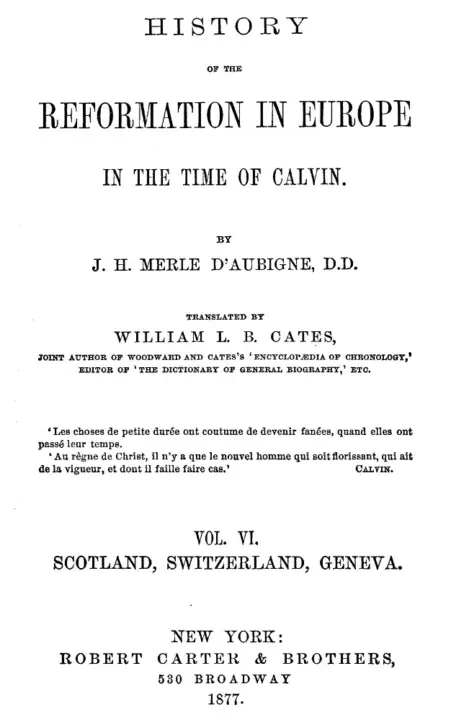
"History of the Reformation in Europe in the Time of Calvin, Vol. 6 (of 8)" by J. H. Merle D’Aubigné is a historical account written in the late 19th century. This volume focuses on the Reformation period in Scotland, Switzerland, and Geneva, emphasizing the theological and sociopolitical developments during Calvin's influence. It likely discusses the struggles for religious reformation and the impact of key figures such as John Knox and Patrick Hamilton on the Protestant movement in Scotland. The opening of the volume sets the stage for the narrative by outlining the historical background and key events leading to the Reformation in Scotland. It introduces the early influencers of the movement, touching on the historical significance of figures such as the Culdees, John Wycliffe's followers, and Patrick Hamilton. The text elegantly describes how the doctrines of the Reformation began to resonate throughout Scotland, highlighting the critical themes of faith, scripture, and the evolving relationship between the Church and Scottish society. It also begins to explore the tumultuous interplay of local nobility and religious authority, which would shape the Reformation's trajectory in the region.
Introduction adapted from the source catalogue; source summaries may be automatically generated.
Free to read · English · 180,014 words · No account needed
MAKE TIME FOR A GOOD BOOK
On by default. Untick to stop anonymous reading totals. Each page counts after 10 seconds in view. How this works.
Anonymous counting is on unless you have switched it off.
[668] Kirchhofer, Das Leben Farels, p. 244.
[669] ‘Cupimus a Bernatibus impetratum ut fractionem panis nobiscum accipiant’ (Articuli ipsa manu Calvini scripti, Conventu Tigurino proposito).--Calv. Opp. x. p. 190. See Matt. xxvi. 26; Luke xxiv. 30; 1 Cor. x. 16; xi. 24; Acts xx. 7.
[670] ‘Non tamen fenestram ardemus aperire tot turbis, quas jam prospicimus, si aliter fiat.’--Calv. Opp. x. p. 190.
[671] ‘Barbaries enim et inhumanitas non ferenda!’--Calv. Opp. x. p.
190.
[672] ‘Continuing daily with one accord in the temple, and breaking bread from house to house.’--Acts ii. 46. ‘Ut frequentior cœnæ usus restituatur; si non secundum veteris ecclesiæ consuetudinem, at saltem singulis quibusque mensibus semel.’--Ibid.
[673] ‘Quum in lascivis et obscœnis cantilenis ac choreis ... e sua ditione tales spurcitias eliminent.’--Calv. Opp. x. p. 190.
[674] Ibid. p. 204.
[675] ‘Humiliemur ergo nisi Deo inhumiliationem nostram tendenti velimus obluctari.’--Calvin to Farel, Basel, Aug. 4, 1538. Bibl. de Genève.--Calv. Opp. x. p. 229.
[676] Calvin to Farel, Strasburg, Sept. 1538.--Ibid. p. 246.
[677] ‘Dass sie in etlicher Dingen hatten vielleicht zu streng gewesen, und erklärten sich gern weisen zu lassen.’--Abschied des Tages zu Zurich gehalten. Kirchhofer, Farel’s Leben, i. p. 244.
[678] ‘Bey diesem unerbauenen Volk christliche
Sanftmüthigkeit.’--Ibid.
[679] ‘Otiosam enim functionem quidam tueri malunt quam fructuosam, quidam licentiam pro Christi libertate induxerunt.’--Calv. Opp. p. 226. Capito to Farel.
[680] ‘Quod vos duo semel tantam urbem reformare non
potueritis.’--Calv. Opp. x. p. 227.
[681] Rozet, Chron. MS. de Genève, iv. ch. 20.
[682] Farel and Calvin to Bullinger; mid. June 1538. Calv. Opp. x. p.
20.
[683] Hundeshagen, Conflikte, p. 70.
[684] ‘Octavo demum die, postquam Bernam appuleramus, Cunzenum eo se recepisse.’--Calvin to Bullinger, June, 1538; Henry, Beylage, p. 48. Calv. Opp. x. p. 203.
[685] ‘Fides ecclesiæ Christi solenniter data.’--Ibid. p. 53. Calv.
Opp. x. p. 207.
[686] ‘Exorsus est Cunzenus longas expostulationes, a quibus ad gravissimas contumelias prosiliit.’--Ibid. p. 49. Calv. Opp. p. 203.
[687] ‘Insanientem in extremam rabiem.’--Ibid.
[688] ‘Nulla pæne syllaba erat, de qua non litigarent.’--Calv. Opp.
x. p. 204.
[689] ‘Ille nullis rationibus auscultare, sed crudelius semper debacchari.’--Calv. Opp. x. p. 204.
[690] ‘Ex abaco se proripuit; ac toto corpore sic ebulliebat, ut injecta etiam manu retineri a collegis non posset.’--Calv. Opp. x. p. 50. Calv. Opp. x. p. 204.
[691] Farel to Calvin, Sept. 6, 1540.
[692] Calvin to Bullinger. Berne, May 28, 1538.--Archives of Zurich.
Calvin, x. p. 201.
[693] ‘Ac ter una hora revocati.’--Calvin to Bucer. Henry, Beylage, p. 51. Calv. Opp. x. p. 205.
[694] ‘Recepta autem fuerat a paucis seditiosis eodem decreto, quo in Rhodanum præcipitari nos oportebat.’--Calv. Opp. x. p. 205.
[695] Calvin to Bullinger, Berne, May 20, 1538. Calv. Opp. x. p. 201.
[696] ‘Constitit non procul mœnibus collocatas fuisse insidias; in ipsa autem porta considebant armati viginti gladiatores.’--Calvin to Bucer; Henry, Beylage, p. 52. Calv. Opp. x. p. 206.
Your reading position is saved on this browser. Take it to another device with a library code. Reading pages adapt to text, rather than matching a printed edition.
BEHIND THE BOOK
This eBook is for the use of anyone anywhere in the United States and most other parts of the world at no cost and with almost no restrictions whatsoever. You may copy it, give it away or re-use it under the terms of the Project Gutenberg License included with this eBook or online at www.gutenberg.org. If you are not located in the United States, you will have to check the laws of the country where you are located before using this eBook. Read the source licence.
The original source file, including credits and licence, is retained by this library. Request an original-format copy at no charge. Please include the book title and Project Gutenberg identifier #65984.
KEEP YOUR CURIOSITY GOING
Cécile Tormay

Moritz Busch
John L. Ransom
Frances Wright
Cécile Tormay

Mabel Potter Daggett