THE CLASSIC COLLECTION✦An outlaw’s diary: the CommuneCLASSIC FREE BOOKS
An outlaw’s diary: the Commune
Cécile Tormay
THE CLASSIC COLLECTION · 1879
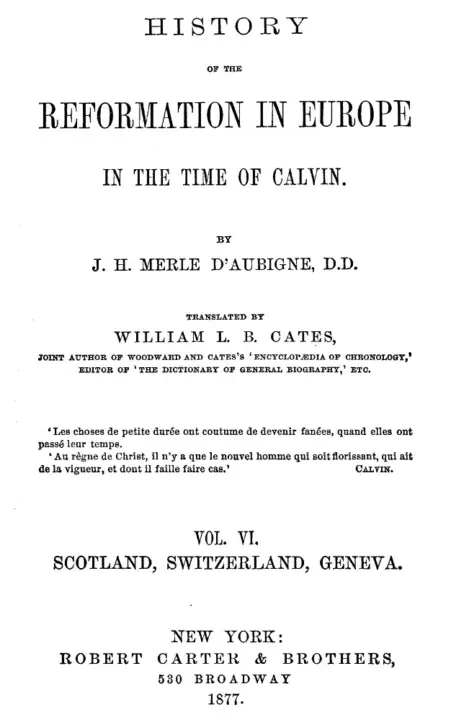
"History of the Reformation in Europe in the Time of Calvin, Vol. 6 (of 8)" by J. H. Merle D’Aubigné is a historical account written in the late 19th century. This volume focuses on the Reformation period in Scotland, Switzerland, and Geneva, emphasizing the theological and sociopolitical developments during Calvin's influence. It likely discusses the struggles for religious reformation and the impact of key figures such as John Knox and Patrick Hamilton on the Protestant movement in Scotland. The opening of the volume sets the stage for the narrative by outlining the historical background and key events leading to the Reformation in Scotland. It introduces the early influencers of the movement, touching on the historical significance of figures such as the Culdees, John Wycliffe's followers, and Patrick Hamilton. The text elegantly describes how the doctrines of the Reformation began to resonate throughout Scotland, highlighting the critical themes of faith, scripture, and the evolving relationship between the Church and Scottish society. It also begins to explore the tumultuous interplay of local nobility and religious authority, which would shape the Reformation's trajectory in the region.
Introduction adapted from the source catalogue; source summaries may be automatically generated.
Free to read · English · 180,014 words · No account needed
MAKE TIME FOR A GOOD BOOK
On by default. Untick to stop anonymous reading totals. Each page counts after 10 seconds in view. How this works.
Anonymous counting is on unless you have switched it off.
[559] Roget, L’Église et l’État de Genève du vivant de Calvin.
[560] Registers, Jan. 3. Gautier, Hist. MS. de Genève, book vi.
[561] Racine.
[562] This order prevails in the United States of America. In each flock distinction is made between the church, composed of communicants, and the congregation, which consists of all those who, having religious convictions, take part in all the service except the supper. From the congregation the church is regularly recruited; and these two bodies, united in charity together, contribute to the wants of the flock. [This statement is equally true of the orthodox Dissenting churches of Great Britain.--Translator.]
[563] Registers, Jan. 3 and 4, 1538.
[564] Registers, Jan. 16. Chron. MS. de Rozet, book iv. ch. 10.
[565] Letters of Calvin and Tillet, published by the pastor Crottet. p.
38, etc.
[566] Lettres françaises, i. p. 2. Cal. Op., x. p. 147.
[567] Lettres françaises, i. pp. 1-7.
[568] Rozet, Chron. MS. de Genève, book iv. ch. 12.
[569] Registers, Feb. 1.
[570] Rozet, Chron. MS. de Genève, book iv. ch. 10.
[571] Registers, Feb. 12, 1538.
[572] Roget, Peuple de Genève, p. 72.
[573] Registers, Feb. 15 et seq. Chron. MS. de Rozet, book iv. ch.
14.
[574] Registers, March 11. Chron. MS. de Rozet, book iv. ch. 14.
[575] Calvin to Bullinger, Feb. 21, 1538 (Archives of Zurich). Calv.
Opp. x. p. 153.
[576] Actes du Chap. de Brugg. Stettler, Berner Chronik. Hunderhagen,
Conflikte, p. 91.
[577] ‘In summa hierum zanggten wir ein gut wyl.’--Actes originaux de la Classe de Brugg. Hunderhagen, Conflikte, p. 101.
[578] ‘Die praedikanten von der Statt assend mit uns,’ etc.--Ibid. p.
103.
[579] Luther, Epp. v. p. 83.
[580] Kirchhofer, B. Haller, p. 203. Iselin, Hist. Lexicon. Hunderhagen, Conflikte, p. 105. Hagenbach, Gesch. d. ersten Baseler Conf. p. 90.
[581] ‘Quo nuntio perinde perculsi fuimus, ac si Bernensem ecclesiam majore ex parte collapsam audissemus’--Calvin to Bucer. Henry, Beylage, 6, p. 36. Calv. Opp. x. p. 138.
[582] ‘Sed quid ille aliud potest, quam suis deliramentis invertere Evangelii puritatem?’--Henry, Beylage, p. 39. Calv. Opp. x. p. 140.
[583] ‘Vultus, gestus, verba, color ipse furias, ut inquit, spirabant.’--Calv. Opp. x, p. 141.
[584] ‘Nos ita capitaliter odit.’--Cal. Opp. x. p. 141.
[585] ‘Quos ad verbi ministerium erigit, dignos esse judicamus, qui in patibulum tollantur.’--Ibid.
[586] ‘Bonos viros, qui a nobis probati sunt, non audet coöptare, nisi a tota ejus regionis cui destinantur classe, sint explorati.’--Ibid.
[587] See J. Calvins Leben, by Paul Henry, Th. D., pastor at Berlin, vol. i. Bevlage, 6, p. 40.
[588] Rozet, Chron. MS. de Genève, book iv. ch. 16.
[589] ‘Omnibus ministris qui vicinis ecclesiis præsunt interdictum fuit ne quid haberent negotii nobiscum aut ullo modo commnunicarent.’--Calvin to Bucer, Jan. 12. Calv. Opp. x. p. 144.
[590] ‘Reddat Dominus Cunzeno juxta id quod meritus est. Qui perdere pergunt ecclesiam, perdat eos Dominus.’--Farel’s Letter to Fabri, Jan. 14, 1538. Calv. Opp. x. p. 145.
Your reading position is saved on this browser. Take it to another device with a library code. Reading pages adapt to text, rather than matching a printed edition.
BEHIND THE BOOK
This eBook is for the use of anyone anywhere in the United States and most other parts of the world at no cost and with almost no restrictions whatsoever. You may copy it, give it away or re-use it under the terms of the Project Gutenberg License included with this eBook or online at www.gutenberg.org. If you are not located in the United States, you will have to check the laws of the country where you are located before using this eBook. Read the source licence.
The original source file, including credits and licence, is retained by this library. Request an original-format copy at no charge. Please include the book title and Project Gutenberg identifier #65984.
KEEP YOUR CURIOSITY GOING
Cécile Tormay

Moritz Busch
John L. Ransom
Frances Wright
Cécile Tormay

Mabel Potter Daggett