THE CLASSIC COLLECTION✦An outlaw’s diary: the CommuneCLASSIC FREE BOOKS
An outlaw’s diary: the Commune
Cécile Tormay
THE CLASSIC COLLECTION · 1879
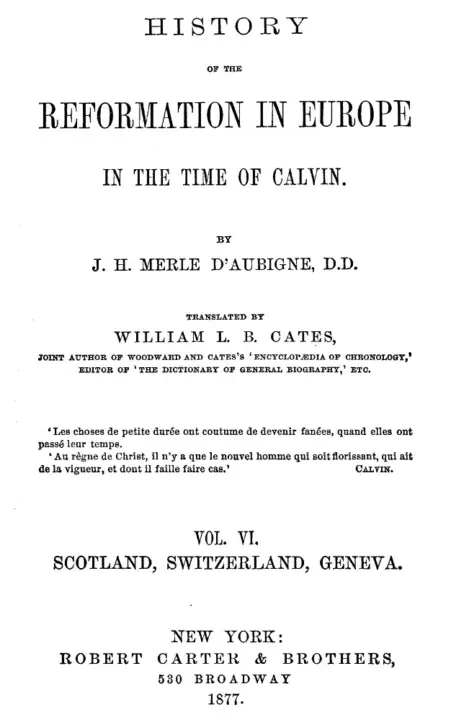
"History of the Reformation in Europe in the Time of Calvin, Vol. 6 (of 8)" by J. H. Merle D’Aubigné is a historical account written in the late 19th century. This volume focuses on the Reformation period in Scotland, Switzerland, and Geneva, emphasizing the theological and sociopolitical developments during Calvin's influence. It likely discusses the struggles for religious reformation and the impact of key figures such as John Knox and Patrick Hamilton on the Protestant movement in Scotland. The opening of the volume sets the stage for the narrative by outlining the historical background and key events leading to the Reformation in Scotland. It introduces the early influencers of the movement, touching on the historical significance of figures such as the Culdees, John Wycliffe's followers, and Patrick Hamilton. The text elegantly describes how the doctrines of the Reformation began to resonate throughout Scotland, highlighting the critical themes of faith, scripture, and the evolving relationship between the Church and Scottish society. It also begins to explore the tumultuous interplay of local nobility and religious authority, which would shape the Reformation's trajectory in the region.
Introduction adapted from the source catalogue; source summaries may be automatically generated.
Free to read · English · 180,014 words · No account needed
MAKE TIME FOR A GOOD BOOK
On by default. Untick to stop anonymous reading totals. Each page counts after 10 seconds in view. How this works.
Anonymous counting is on unless you have switched it off.
[480] Froment, Gestes de Genève, p. 239.
[481] Hist. of the Reform. in the Time of Calvin, iii. book 4, ch. 8.
[482] Chronique de Rozet, book iv. ch. 4.
[483] Registers, Mar. 9.
[484] Calv. Opp. v. p. 176.
[485] Ibid. pp. 179 and 180.
[486] Registers, Mar. 13.
[487] Ibid. Mar. 14.
[488] See ‘Briève instruction pour armer tous bons fidèles,’ etc.--Calv. Opp. vi. pp. 49-112; and ‘Contre la secte phantastique et furieuse des Libertins qui se nomment Spirituels.’--Ibid. pp. 149-248.
[489] Beza, Vita Calvini. Vie de Calvin (in French), p. 31. Paris,
1864.
[490] Vie de Calvin, by Beza-Colladon, p. 31.
[491] Johann Calvin, by Kampschulte, i. p. 295.
[492] ‘Alter ecclesiæ turbator majores et diuturniores turbas dedit.’--Beza, Vita Calv., 1575. p. 5.
[493] Vol. v. book ix. ch. 3 and 4.
[494] ‘Ut quocumque venisset, certa suæ turpitudinis impressa vestigia relinqueret.’--Beza, p. 5.
[495] Calvin’s Letter to Megander, probably of Mar. 1537.--Library of Geneva. Calv. Opp. x. p. 85. Herminjard, iv. p. 187.
[496] Herminjard, iv. p. 187.
[497] ‘Voluit Carolus ecclesiam catholicam ... semper orare ut resurgant, vitamque futuri seculi corpora defunctorum consequantur.’--Megander to Bullinger, Mar. 8, 1537. Calv. Opp. x. p. 89.
[498] Ruchat, v. p. 21. Calv. Opp. p. 89.
[499] Vie de Calvin, Beza-Colladon, p. 31.
[500] Ruchat, Hist. de la Réf. v. p. 22.--Calvin’s Letter to Megander. Calv. Opp. x. p. 85.
[501] ‘Serveti Hispani pessimum errorem confirmare.’--Calv. Opp. x.
p. 103.
[502] ‘Quod id ne timere quidem unquam in mentem venerit.’--Calvin to Grynæus. Calv. Opp. x. p. 108.
[503] ‘In simplicissima Dei unitate, et Scriptura et ipsa pietatis experientia, Deum patrem, ejus Filium et Spiritum nobis ostendunt.’--Calv. Opp. v. p. 337, and x. p. 83.
[504] Luther, Kirchenpostill (Walch, xi.) am Trinität.
[505] ‘Ii quibus tam pietas cordi erat (the opponents of Arius and Sabellius) affirmarunt vere immo Deo tres personas subsistere, seu (quod idem erat) in Dei unitate subsistere personarum trinitatem.’--Calv. Opp. i. p. 61. Afterwards, Calvin said, ‘Christus ut quatenus Deus est, sit unus cum patre Deus ejusdem naturæ seu substantiæ seu essentiæ, non aliter quam persona distinctus.’--Ibid. p. 61.
[506] Calvin to Megander.--Ruchat, v. p. 25.
[507] Calvin’s Letters to Megander and Grynæus.--Ruchat, Hist. de la
Réf. v. pp. 22, 23.
[508] Calvin to Megander.
[509] Calvin to Megander.
[510] ‘Quam ob causam Calvinus Bernam veniens obnixe petit ut synodus cogeretur, quod abnegatum est homini usque post Paschatis.’--Fueslin, Epp. Ref. Eccl. Helvet. p. 173.
[511] Calvin, Opp. x. p. 95.
[512] Calvin to Grynæus, Opp. x. p. 106.
[513] Registers of Council of Geneva, May 5 and 11. The florin was rather less than half a franc.
[514] The synod met, not in March, as has been said (Kampschulte, Johann Calvin, i. p. 296), but two months later. See preceding note.
[515] ‘Quomodo jurisconsulti præcipiunt nempe cum sacco paratior.’--Calvin, Epp. x. p. 107.
[516] The Apostles’, Nicene, and so-called Athanasian Creeds.--Ruchat,
v. p. 25.
[517] Matt. vii. 6.
[518] Ruchat, v. pp. 27, 28.
Your reading position is saved on this browser. Take it to another device with a library code. Reading pages adapt to text, rather than matching a printed edition.
BEHIND THE BOOK
This eBook is for the use of anyone anywhere in the United States and most other parts of the world at no cost and with almost no restrictions whatsoever. You may copy it, give it away or re-use it under the terms of the Project Gutenberg License included with this eBook or online at www.gutenberg.org. If you are not located in the United States, you will have to check the laws of the country where you are located before using this eBook. Read the source licence.
The original source file, including credits and licence, is retained by this library. Request an original-format copy at no charge. Please include the book title and Project Gutenberg identifier #65984.
KEEP YOUR CURIOSITY GOING
Cécile Tormay

Moritz Busch
John L. Ransom
Frances Wright
Cécile Tormay

Mabel Potter Daggett