THE CLASSIC COLLECTION✦An outlaw’s diary: the CommuneCLASSIC FREE BOOKS
An outlaw’s diary: the Commune
Cécile Tormay
THE CLASSIC COLLECTION · 1879
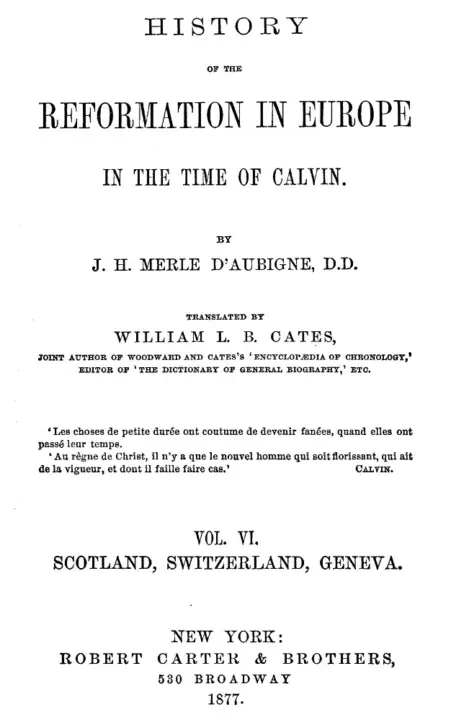
"History of the Reformation in Europe in the Time of Calvin, Vol. 6 (of 8)" by J. H. Merle D’Aubigné is a historical account written in the late 19th century. This volume focuses on the Reformation period in Scotland, Switzerland, and Geneva, emphasizing the theological and sociopolitical developments during Calvin's influence. It likely discusses the struggles for religious reformation and the impact of key figures such as John Knox and Patrick Hamilton on the Protestant movement in Scotland. The opening of the volume sets the stage for the narrative by outlining the historical background and key events leading to the Reformation in Scotland. It introduces the early influencers of the movement, touching on the historical significance of figures such as the Culdees, John Wycliffe's followers, and Patrick Hamilton. The text elegantly describes how the doctrines of the Reformation began to resonate throughout Scotland, highlighting the critical themes of faith, scripture, and the evolving relationship between the Church and Scottish society. It also begins to explore the tumultuous interplay of local nobility and religious authority, which would shape the Reformation's trajectory in the region.
Introduction adapted from the source catalogue; source summaries may be automatically generated.
Free to read · English · 180,014 words · No account needed
MAKE TIME FOR A GOOD BOOK
On by default. Untick to stop anonymous reading totals. Each page counts after 10 seconds in view. How this works.
Anonymous counting is on unless you have switched it off.
[322] Knox, Ref., p. 119. Spotswood, p. 76.
[323] Knox, Ref., p. 119.
[324] Knox, Ref., p. 119.
[325] ‘Urbe spoliata ac deinde incensa ... multos pagos arcesque nonnullas et villas hominum nobilium ferro flammaque vestarunt.’--Buchanan, p. 525.
[326] State Papers, v. pp. 361-366.
[327] Emery Tylney’s Account.--Fox, Acts, v. p. 626.
[328] Knox, Ref., p. 127. Scots’ Worthies, p. 28. Spotswood, p. 76.
[329] Or Leifnorris. See Laing’s note, Knox, Ref., p. 127.
[330] Ibid.
[331] Knox, Ref., p. 44. Scots’ Worthies, p. 20. Hist., p. 129.
[332] Knox, Ref., p. 130.
[333] Knox, Ref., p. 131.
[334] Knox, Ref., p. 131.
[335] Ibid. Scots’ Worthies, pp. 29, 30. Spotswood, p. 77.
[336] Knox, Ref., p. 133. Some MSS. read ‘copestone,’ ‘keapestone,’--‘keepestone.’ Spotswood, p. 77.
[337] Knox, Ref., p. 134. Scots’ Worthies, p. 31.
[338] Knox, Ref., p. 135. Scots’ Worthies, p. 31.
[339] This is the first time that Knox speaks of himself in his History
(p. 137).
[340] Knox, Ref., p. 138. Scots’ Worthies. Spotswood.
[341] Knox, Ref., p. 143. Diurnall of Occurrents, p. 41. Spotswood,
p. 78.
[342] Knox, Ref., p. 143. Spotswood, p. 79.
[343] Knox, Ref., p. 144. Buchanan, p. 556. Spotswood, p. 79. Fox, Acts, v. 626. Scots’ Worthies, p. 33.
[344] Fox. In Scots’ Worthies, p. 34, the name is written, ‘Winram.’ In Buchanan, ‘Viniramus.’ In Knox, ‘Winram.’
[345] Fox, Acts, v. p. 627.
[346] Fox, Acts, v p. 628. Knox, Ref., p. 152.
[347] Knox, Ref., p. 154.
[348] Fox, Acts, v. p. 630.
[349] ‘He wanteth the instrument by which he bindeth or looseth, that is to say, the Word of God.’--Fox, Acts, v. p. 631.
[350] Fox, Acts, v. p. 633.
[351] ‘Nulla judicii aut liberæ disceptationis ibi forma fuit: accusator enim ... cum summa verborum acerbitate detonabat.’--Buchanan, p. 538. Spotswood, pp. 80, 81.
[352] ‘Non videri æquum ut pertinax hereticus ... ullis ecclesiæ beneficiis frueretur.’--Buchanan, p. 538.
[353] Scots’ Worthies, pp. 35, 36. ‘Viros vos esse bonos et in eodem Christi corpore mecum esse sociatos.’--Buchanan, p. 539.
[354] ‘Fenestra ... tapetibus, stragulis sericis et pulvinis
ornabatur.’--Buchanan, p. 559.
[355] Fox, Acts, p. 635.
[356] ‘At qui nos tam superbe despicit, intra paucos dies non minus ignominiose jacebit quam nunc arroganter cubat.’--Buchanan, p. 540.
[357] ‘Velut pecus ex hara suæ libidini mactaret.’--Buchanan, p. 540.
[358] ‘Domi cum scortis volutetur; foris in cæde innoxiorum et sanguine hæreticorum debaccharetur.’--Ibid.
[359] ‘Discesserunt utrimque animis infensissimis.’--Buchanan p. 541.
[360] ‘Leslius ad suos rediit, intolerandam cardinalis superbiam iis exposuit; facile omnes in cædem ejus conjurarunt.’--Buchanan, p. 541. Knox, Ref., pp. 172, 173.
[361] ‘Cardinalis arcem suam in usum belli communiebat.’--Buchanan, p.
542.
[362] Knox, Ref., p. 74.
[363] ‘Eos quum semisomnes sigillatim evocassent mortem præsentem si quisquam mutiret, comminati.’--Buchanan, xv. p. 545.
[364] Knox, Ref., p. 177.
[365] Numbers, ch. xxxv.
[366] Knox, Ref., p. 177.
[367] ‘Cadaver exanimatum oculis omnium exponunt, in illo ipso loco unde ipse non multo ante Georgii [Wishart] supplicium tam lætus spectaverat.’--Buchanan, p. 542.
[368] Spotswood, p. 84.
[369] Spotswood, p. 88. The last of July. Knox, Ref., p. 205. Buchanan assigns the capture of the castle or the capitulation to the month of August 1547. ‘Hæc in mensem Augusti anni MDXLVII. inciderunt,’ p. 543.
[370] Melville’s Diary, pp. 276-278. M’Crie, Andrew Melville, ii.
p. 66.
Your reading position is saved on this browser. Take it to another device with a library code. Reading pages adapt to text, rather than matching a printed edition.
BEHIND THE BOOK
This eBook is for the use of anyone anywhere in the United States and most other parts of the world at no cost and with almost no restrictions whatsoever. You may copy it, give it away or re-use it under the terms of the Project Gutenberg License included with this eBook or online at www.gutenberg.org. If you are not located in the United States, you will have to check the laws of the country where you are located before using this eBook. Read the source licence.
The original source file, including credits and licence, is retained by this library. Request an original-format copy at no charge. Please include the book title and Project Gutenberg identifier #65984.
KEEP YOUR CURIOSITY GOING
Cécile Tormay

Moritz Busch
John L. Ransom
Frances Wright
Cécile Tormay

Mabel Potter Daggett