THE CLASSIC COLLECTION✦An outlaw’s diary: the CommuneCLASSIC FREE BOOKS
An outlaw’s diary: the Commune
Cécile Tormay
THE CLASSIC COLLECTION · 1879
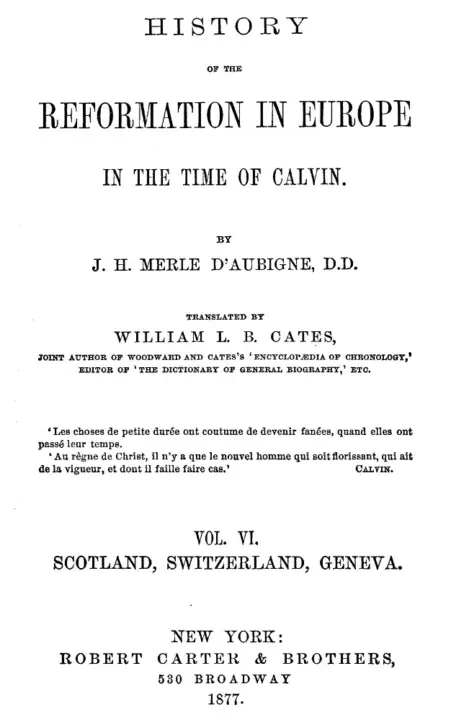
"History of the Reformation in Europe in the Time of Calvin, Vol. 6 (of 8)" by J. H. Merle D’Aubigné is a historical account written in the late 19th century. This volume focuses on the Reformation period in Scotland, Switzerland, and Geneva, emphasizing the theological and sociopolitical developments during Calvin's influence. It likely discusses the struggles for religious reformation and the impact of key figures such as John Knox and Patrick Hamilton on the Protestant movement in Scotland. The opening of the volume sets the stage for the narrative by outlining the historical background and key events leading to the Reformation in Scotland. It introduces the early influencers of the movement, touching on the historical significance of figures such as the Culdees, John Wycliffe's followers, and Patrick Hamilton. The text elegantly describes how the doctrines of the Reformation began to resonate throughout Scotland, highlighting the critical themes of faith, scripture, and the evolving relationship between the Church and Scottish society. It also begins to explore the tumultuous interplay of local nobility and religious authority, which would shape the Reformation's trajectory in the region.
Introduction adapted from the source catalogue; source summaries may be automatically generated.
Free to read · English · 180,014 words · No account needed
MAKE TIME FOR A GOOD BOOK
On by default. Untick to stop anonymous reading totals. Each page counts after 10 seconds in view. How this works.
Anonymous counting is on unless you have switched it off.
[196] State Papers, v. p. 38.
[197] See the Letter from the Queen-mother to Henry VIII.--State
Papers.
[198] Howard and Barlow to Henry VIII.--State Papers, pp. 46, 48.
[199] Unpublished Letters of Margaret of Angoulême, p. 349.
[200] Sutchyll’s Letters to the Lord Admiral.--State Papers, v. p. 59.
[201] ‘Sub amitæ reginæ Navarræ disciplina educata.’--Buchanan, lib. xiv. ad an. 1537. See also Unpublished Letters of the Queen of Navarre, p. 77.
Regia eram conjux, et regia filia, neptis
Regia, spe et votis regia mater eram ... etc.
Buchanan, Opera, p. 81.
[203] ‘Rex, id quod evenit, de exitu uxoris veritus, in illam oculos conjecerat.’--Buchanan, lib. xiv.
[204] Kirkton, True History of the Church of Scotland, p. 7.
[205] ‘The great part of the sermon was in extolling of the Richess of Rome authority.’--State Papers, v. p. 154.
[206] ‘Most vicious prince we shall call, for he neither spared manis wieff, nor madyn, no more after his marriage than he did before.’--Knox, Ref. in Scotland, Works, 1846, i. p. 66.
[207] ‘His velut machinis admotis, quum regis animum superstitionibus obnoxium labefactassent.’--Buchanan, lib. xiv. an. 1535.
[208] Spotswood, Church of Scotland, p. 67.
[209] Criminal Trials. Anderson, Bible Annals, p. 498.
[210] Norfolk to Cromwell, March 29, 1539.--State Papers, v. p. 154.
[211] ‘Daily commeth unto me some gentlemen and some clerks.’--State
Papers, v. p. 154.
[212] Ibid.
[213] ‘The verray sempill people understood that as the preastis and pharisyes....’--Knox, Ref. in Scotland, i. p. 62
[214] ‘Because they were at the bridal and marriage of a priest.’--Fox,
Acts, v. p. 623.
[215] ‘Mars 1, 1539, accusatio hereticorum et eorum combustio.’--Archæologia, xxii. p. 7. ‘The last day of February.’--Knox, Ref. in Scotland, p. 63.
[216] Anderson, Annals of the English Bible, ii. 500, 501.
[217] ‘Eorum combustio apud Edinburgh rege presente.’--Archæologia,
xxii. p. 7.
[218] ‘Lutheranismo suspecti complures capti sunt, quinque cremati.’--Buchanan, Res Scoticæ, p. 309.
[219] Lord Treasurer’s Accounts.
[220] ‘Sopitis custodibus.’--Lord Treasurer’s Accounts.
[221] ‘Per cubiculi fenestram evaserat.’
[222] Knox, Ref. in Scotland, p. 71.
[223] Knox, Ref. in Scotland, p. 71.
[224] Ibid. p. 63.
[225] ‘One frere Jerome, a well learned man, lyeth in sore yerons.’--State Papers, v. p. 141.
[226] Scots’ Worthies, p. 24.
[227] Knox, Ref., p. 65. Spotswood, p. 67. Petrie, History of the
Church, p. 180.
[228] ‘For many of his minions were pensioners to priests.’--Knox, Ref. in Scotland, p. 67.
[229] State Papers, v. p. 174.
[230] State Papers, v. p. 170.
[231] State Papers, v. p. 170.
[232] Spotswood, p. 70. Petrie, p. 180.
[233] State Papers, v. p. 177.
[234] ‘Rex provisus jam hæredibus de sua salute securior.’--Buchanan,
p. 510.
[235] State Papers, v. p. 178.
[236] Knox, Ref., p. 82. It is difficult to say what this word jefwellis exactly means. Another manuscript has josrellis; another jeffels; and a fourth, Jesuits. The last reading is improbable. The Jesuits had only been confirmed by the pope the year before, and their name had not yet become a term of reproach.
Your reading position is saved on this browser. Take it to another device with a library code. Reading pages adapt to text, rather than matching a printed edition.
BEHIND THE BOOK
This eBook is for the use of anyone anywhere in the United States and most other parts of the world at no cost and with almost no restrictions whatsoever. You may copy it, give it away or re-use it under the terms of the Project Gutenberg License included with this eBook or online at www.gutenberg.org. If you are not located in the United States, you will have to check the laws of the country where you are located before using this eBook. Read the source licence.
The original source file, including credits and licence, is retained by this library. Request an original-format copy at no charge. Please include the book title and Project Gutenberg identifier #65984.
KEEP YOUR CURIOSITY GOING
Cécile Tormay

Moritz Busch
John L. Ransom
Frances Wright
Cécile Tormay

Mabel Potter Daggett