THE CLASSIC COLLECTION✦An outlaw’s diary: the CommuneCLASSIC FREE BOOKS
An outlaw’s diary: the Commune
Cécile Tormay
THE CLASSIC COLLECTION · 1879
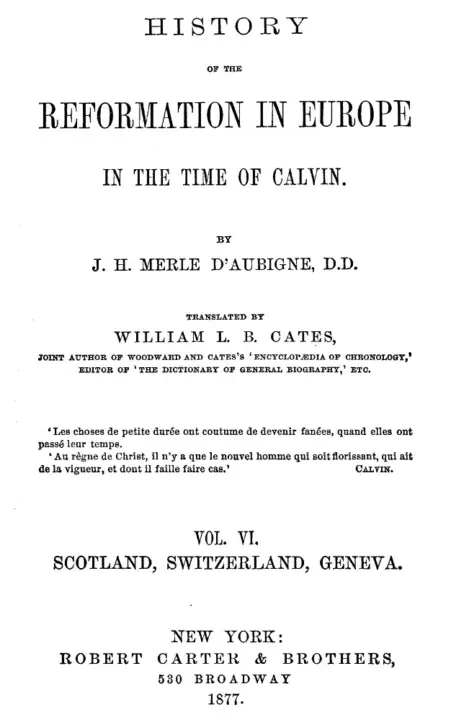
"History of the Reformation in Europe in the Time of Calvin, Vol. 6 (of 8)" by J. H. Merle D’Aubigné is a historical account written in the late 19th century. This volume focuses on the Reformation period in Scotland, Switzerland, and Geneva, emphasizing the theological and sociopolitical developments during Calvin's influence. It likely discusses the struggles for religious reformation and the impact of key figures such as John Knox and Patrick Hamilton on the Protestant movement in Scotland. The opening of the volume sets the stage for the narrative by outlining the historical background and key events leading to the Reformation in Scotland. It introduces the early influencers of the movement, touching on the historical significance of figures such as the Culdees, John Wycliffe's followers, and Patrick Hamilton. The text elegantly describes how the doctrines of the Reformation began to resonate throughout Scotland, highlighting the critical themes of faith, scripture, and the evolving relationship between the Church and Scottish society. It also begins to explore the tumultuous interplay of local nobility and religious authority, which would shape the Reformation's trajectory in the region.
Introduction adapted from the source catalogue; source summaries may be automatically generated.
Free to read · English · 180,014 words · No account needed
MAKE TIME FOR A GOOD BOOK
On by default. Untick to stop anonymous reading totals. Each page counts after 10 seconds in view. How this works.
Anonymous counting is on unless you have switched it off.
[15] The inscription sought and found in the Acta rectoria of the University of Paris by Professor Rosseeuw Saint-Hilaire, at the request of Professor Lorimer, proves that Hamilton studied at Paris.
[16] ‘My great-grandfather, gudeschir, and father have served your Lordship’s predecessors, and some of them have dyed under their standartis’.--John Knox, Hist. of the Reformation, edited by D. Laing, ii. p. 323.
[17] Not to the university of St. Andrews, as was formerly supposed. ‘The name occurs ... in the year 1522.... He was seventeen years of age.’--M’Crie, Life of Knox, Note B.
[18] ‘Velut seditionis fax, volitaret armatus.’--Buchanan.
‘.... At tu, beata Gallia,
Salve, bonarum blanda nutrix artium,’ &c.
--Buchanani Poemata. Adventus in Galliam.
[20] ‘Potes hunc tyrannum occidere.’--Major, Sentent., fol. 139.
[21] ‘Reges legitimos ab initio creavimus, leges et nobis et illis æquas imposuimus.’--De Jure Regni apud Scotos, p. 24.
[22] ‘Juvenis ingenio summo et eruditione singulari.’--Buchanan, Scot.
Hist., p. 494.
[23] Margaret to Henry VIII.--State Papers, iv. p. 17.
[24] State Papers, pp. 51, 52, 70, 71.--‘Albany embarked probably on May 31.’--Ibid., p. 77.
[25] Acta parl. Scot., vol. ii. p. 255.--State Papers, vol. iv. p.
387.
[26] ‘The young king cannot by himself rede an English letter.’--State
Papers, iv. p. 368.
[27] ‘They are at all times of contrary opinion.’--Ibid., iv. p. 362.
[28] ‘May destroy the king, my son, and me.’--Ibid., iv. pp. 81, 169,
188, 227, 237.
[29] ‘We may have your supplications direct for us unto His Holyness.’--Margaret to Wolsey, State Papers, iv. p. 452.
[30] State Papers, iv. pp. 457-458.--Scott, Hist. of Scotland, i. ch. xxv.--Lindsay, Chronicles.
[31] ‘I went suddenly thitherward, thinking that I would cause to make a good fire of them.’--MS. Cotton, Galba B., vi. fol. 4.
[32] State Papers, iv. p. 561.
[33] ‘Most part to the town of St. Andrews.’--Cotton, MS. Calig. ii. 77.
[34] ‘Disputing, holding, and maintaining divers heresies of Martin Luther.’--Sentence Pronounced against Hamilton. Fox, Acts, iv. p. 560.
[35] Certain articles preached by him (ibid.) It is clear that these articles were preached as early as 1527, before Hamilton had quitted Scotland. The sentence states: ‘Faithful inquisition being made in Lent last past.’ It is of Lent last past that it speaks. Now the sentence was of the last February. The Lent of 1528 was hardly begun. Besides, the sentence states that Hamilton, after having preached, passed forth of the realm to other parts; which decides the question.
[36] Luther, Ep. to the Galatians.
[37] See ‘The Sentence against P. Hamilton.’--Fox, Acts, iv. p. 560.
[38] Fox, Acts, iv. p. 560.
[39] ‘Unicus et pietatis et literarum vindex.’--Registers of the University of Marburg, A. D. 1527.
[40] ‘Ad instaurandas liberales disciplinas.’--Ibid.
[41] ‘Conference and familiarity.’--Fox, Acts, iv. p. 558.
[42] Paradoxa Lamberti, in Schultetus, Annales Evangel.
[43] ‘Cautelæ impiæ.’--Baum, Lambert d’Avignon, p. 152.
Your reading position is saved on this browser. Take it to another device with a library code. Reading pages adapt to text, rather than matching a printed edition.
BEHIND THE BOOK
This eBook is for the use of anyone anywhere in the United States and most other parts of the world at no cost and with almost no restrictions whatsoever. You may copy it, give it away or re-use it under the terms of the Project Gutenberg License included with this eBook or online at www.gutenberg.org. If you are not located in the United States, you will have to check the laws of the country where you are located before using this eBook. Read the source licence.
The original source file, including credits and licence, is retained by this library. Request an original-format copy at no charge. Please include the book title and Project Gutenberg identifier #65984.
KEEP YOUR CURIOSITY GOING
Cécile Tormay

Moritz Busch
John L. Ransom
Frances Wright
Cécile Tormay

Mabel Potter Daggett