THE CLASSIC COLLECTION✦An outlaw’s diary: the CommuneCLASSIC FREE BOOKS
An outlaw’s diary: the Commune
Cécile Tormay
THE CLASSIC COLLECTION · 1879
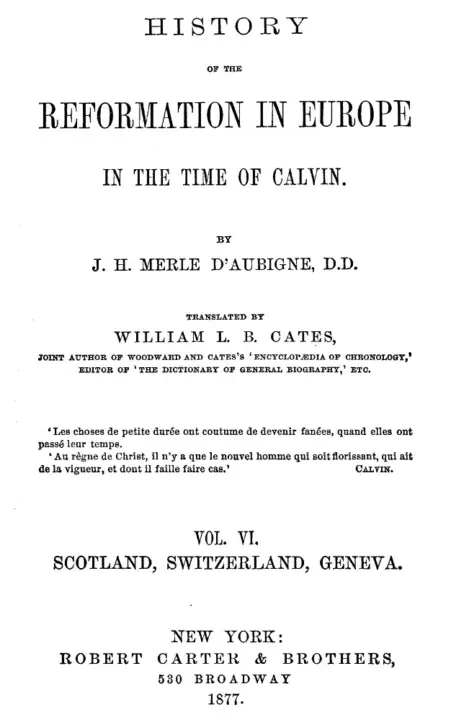
"History of the Reformation in Europe in the Time of Calvin, Vol. 6 (of 8)" by J. H. Merle D’Aubigné is a historical account written in the late 19th century. This volume focuses on the Reformation period in Scotland, Switzerland, and Geneva, emphasizing the theological and sociopolitical developments during Calvin's influence. It likely discusses the struggles for religious reformation and the impact of key figures such as John Knox and Patrick Hamilton on the Protestant movement in Scotland. The opening of the volume sets the stage for the narrative by outlining the historical background and key events leading to the Reformation in Scotland. It introduces the early influencers of the movement, touching on the historical significance of figures such as the Culdees, John Wycliffe's followers, and Patrick Hamilton. The text elegantly describes how the doctrines of the Reformation began to resonate throughout Scotland, highlighting the critical themes of faith, scripture, and the evolving relationship between the Church and Scottish society. It also begins to explore the tumultuous interplay of local nobility and religious authority, which would shape the Reformation's trajectory in the region.
Introduction adapted from the source catalogue; source summaries may be automatically generated.
Free to read · English · 180,014 words · No account needed
MAKE TIME FOR A GOOD BOOK
On by default. Untick to stop anonymous reading totals. Each page counts after 10 seconds in view. How this works.
Anonymous counting is on unless you have switched it off.
At the time when magistrates who were better disposed towards Calvin were called to the government of the republic, a door was opened on another side which revealed to the reformer a new world, Germany with her doctors and her princes. Calvin was living on the banks of the Rhine at the period when the emperor was convoking frequent and important assemblies, which were attended by the princes either in person or by their delegates, and in which they discussed the deepest questions of theology with as much eagerness as diplomatists in congress discuss the interests of their respective governments. From the year 1535 to 1539 Protestantism had been gaining in strength; it had made many conquests in North Germany, and appeared to be on the point of winning the decisive victory. The Catholics were beginning to lose heart, and the successive congresses at which they required the Protestants to come to terms with them might well lead one to call them a weakened army which desired only favorable conditions for lowering its flag. Calvin watched with his keen eye this astonishing process. He continually asserted in his letters that it was not the existence of one Church (that of Geneva), but of all Churches, that was at stake. There were moments when he thought that he had a glimpse of the triumph of the Gospel in Europe; at other times he was seized with great despondency. There was a conflict within him. His natural timidity led him to shrink from appearing in the Germanic assemblies; but his faith and his zeal for the kingdom of God made him long to take part in them.
[Sidenote: CONFERENCE AT FRANKFORT.]
Charles V., after making peace with Francis I., had convoked, at Frankfort, for the month of February 1539, a conference of evangelical and Roman Catholic theologians, who were to endeavor to find a basis of agreement. We have not to devote our attention to all the work done at the German assemblies which Calvin attended, but only to that which concerns him personally. Deputies from Strasburg went to Frankfort, but the young French doctor did not accompany them. He contented himself with earnestly commending to Bucer the cause of the persecuted Protestants. But shortly after, having received a letter from Bucer, informing him that he found it was impossible for him to do anything for his co-religionists, and hearing at the same time that Melanchthon was present at the conferences, his spiritual earnestness overcame the timidity of his nature. He was seized with a strong desire to go to Frankfort and to converse with the friend of Luther on religion and the affairs of the Church. He set out in great haste the next day. At Frankfort he met some of the most prominent characters of the Reformation. Here were the pious John Frederick, elector of Saxony; young Maurice of Saxony, who was one day to prove so formidable to Charles V.; the famous landgrave Philip of Hesse, the Duke of Luneburg, and many other princes, whose acquaintance could not be a matter of indifference to the young reformer. Several of these young princes were accompanied by a great number of knights and soldiers, and all appeared to be full of courage for the defence of the Gospel. Calvin, in long letters to Farel, gave an account of all that he saw and thought. He formed a most just conception of the Protestant question in Germany, of the disposition of the princes, of the policy of Charles V., and of the various matters under discussion. But one man was there whose society he coveted more than that of all the princes. Calvin’s sojourn at Frankfort is especially marked by the conversations which he had with Melanchthon ‘on many subjects.’[773] Several of the most influential men of the Reformation, in Switzerland and in France, were not well informed as to the opinions of this celebrated doctor. Calvin wished to be able to bear testimony to them with certitude. The great idea of the French doctor was agreement between all evangelical Christians. He was convinced that it was necessary, not only for the sake of obedience to the commandments of Jesus Christ, but further to promote the triumph of the evangelical cause. He wished for union, not only of the various parties in Germany, but of Germany and Switzerland. Now Melanchthon appeared to him the fittest man to bring about agreement among the Protestants. No sooner had these two great doctors met and exchanged the most kindly greetings, than Calvin opened the question. He had communicated to Melanchthon some articles in which his view of the supper was set forth in a way to terminate dissension. ‘There is no room for controversy between you and me,’ said Melanchthon, immediately; ‘I accept your articles.’[774] This was a great pleasure to Calvin. It was however soon disturbed. ‘But,’ continued the friend of Luther, ‘I must confess to you that we have some among us who demand something more material, and this so obstinately, not to say so despotically,[775] that I have found myself for a long time exposed to danger because they know that I differ from them on this subject. I do not believe that a solid agreement is attainable. But I desire that we should abide by the present agreement, such as it is, until the Lord lead us by one way or another into union in the truth.’ Calvin perfectly satisfied, hastened to write to Farel--‘Entertain no more any doubt about him, but consider him as holding altogether the same views as we do.’ Farel and Calvin found in Melanchthon an important ally.
Your reading position is saved on this browser. Take it to another device with a library code. Reading pages adapt to text, rather than matching a printed edition.
BEHIND THE BOOK
This eBook is for the use of anyone anywhere in the United States and most other parts of the world at no cost and with almost no restrictions whatsoever. You may copy it, give it away or re-use it under the terms of the Project Gutenberg License included with this eBook or online at www.gutenberg.org. If you are not located in the United States, you will have to check the laws of the country where you are located before using this eBook. Read the source licence.
The original source file, including credits and licence, is retained by this library. Request an original-format copy at no charge. Please include the book title and Project Gutenberg identifier #65984.
KEEP YOUR CURIOSITY GOING
Cécile Tormay

Moritz Busch
John L. Ransom
Frances Wright
Cécile Tormay

Mabel Potter Daggett