THE CLASSIC COLLECTION✦An outlaw’s diary: the CommuneCLASSIC FREE BOOKS
An outlaw’s diary: the Commune
Cécile Tormay
THE CLASSIC COLLECTION · 1879
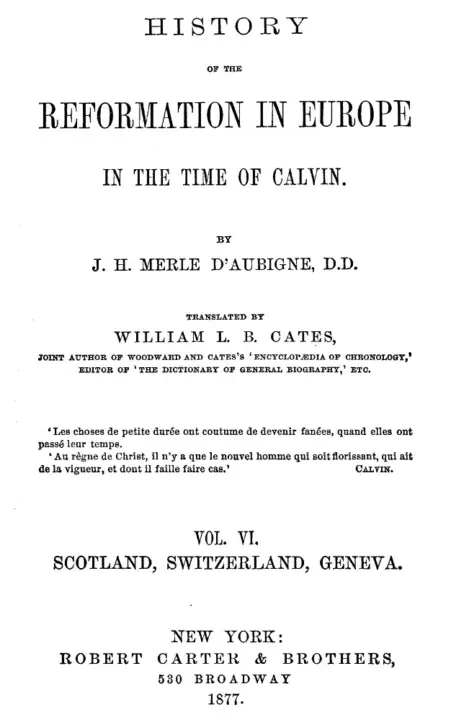
"History of the Reformation in Europe in the Time of Calvin, Vol. 6 (of 8)" by J. H. Merle D’Aubigné is a historical account written in the late 19th century. This volume focuses on the Reformation period in Scotland, Switzerland, and Geneva, emphasizing the theological and sociopolitical developments during Calvin's influence. It likely discusses the struggles for religious reformation and the impact of key figures such as John Knox and Patrick Hamilton on the Protestant movement in Scotland. The opening of the volume sets the stage for the narrative by outlining the historical background and key events leading to the Reformation in Scotland. It introduces the early influencers of the movement, touching on the historical significance of figures such as the Culdees, John Wycliffe's followers, and Patrick Hamilton. The text elegantly describes how the doctrines of the Reformation began to resonate throughout Scotland, highlighting the critical themes of faith, scripture, and the evolving relationship between the Church and Scottish society. It also begins to explore the tumultuous interplay of local nobility and religious authority, which would shape the Reformation's trajectory in the region.
Introduction adapted from the source catalogue; source summaries may be automatically generated.
Free to read · English · 180,014 words · No account needed
MAKE TIME FOR A GOOD BOOK
On by default. Untick to stop anonymous reading totals. Each page counts after 10 seconds in view. How this works.
Anonymous counting is on unless you have switched it off.
The theological and Christian circle which he entered at Strasburg was in more than one way in sympathy with him. He was convinced, as the doctors of this town were, that it was necessary not to stick at trifling differences, but to consider Christianity in its great facts, its great doctrines, the new life which it creates, in the great whole on which all the reformers were agreed. All those who took their stand on the same rock, Jesus Christ, no matter whether a little higher up or a little lower down, ought in his view to join hand in hand. Calvin and the theologians of Strasburg were disgusted with the theological subtilties and the scholastic nomenclature beneath which the living doctrine of the Gospel, especially as to the supper, was stifled. ‘Can I in very deed believe that I receive in the holy supper the body and the blood of the Lord, substantialiter, essentialiter, realiter, naturaliter, præsentialiter, localiter, corporaliter, quantitative, qualitative, ubiqualiter, carnaliter? The devil has brought us all these terms from the abyss of hell. Christ said simply, This is my body. If all these fantastic expressions had been necessary, he would certainly have employed them.’ Calvin, like Zell, the author of the above passage, found in that heap of qualifying terms a mass of rubbish and confusion. There was, however, one difference between the doctors of Strasburg and the doctor of Geneva. Bucer and Capito were willing to bring union by the way of accommodation, perhaps by the use of phrases in a double sense. The eagle of Geneva, soaring in the higher regions, called on Christians to have but one thought in contemplating one and the same sun, and in attaching themselves to one and the same truth.[749]
[Sidenote: HIS SPIRITUAL JOYS.]
Another happiness awaited Calvin at Strasburg. His greatest sufferings at Geneva had their source in that state-church, that people-church, that shapeless community which comprised the whole nation, believers and unbelievers, righteous men and profligates. In its place at Strasburg he found some Christians exiled on account of their faith, purified by their trial like gold, who had given up all for Christ, their righteousness and their life. The mass of professing Christians at Geneva had as it were suffocated him. Now at Strasburg he was in the midst of brethren and sisters, and almost all of them belonged to his own country, France. He breathed freely. The evangelical order intended by the apostles prevailed in his Church.[750] He preached four times a week. He met his elders and deacons once a week for the study of the Holy Scriptures and for prayer; and some of those lay friends well endowed by God were soon qualified to take the place of their pastor in case of his absence, and to edify their brethren. The first supper was celebrated in September, and it was repeated every month. How wide the difference for Calvin between that repast at Geneva, to which men came who drank, gamed, quarrelled, and sang indecent songs, and whom, for all that, he had to admit to the communion of the body and the blood of the Redeemer, and this brotherly supper at Strasburg, celebrated in company with pious Christians, persecuted for righteousness’ sake, whose names were written in heaven, and who drew nigh to the Lord with devotion, as members of his family! Calvin gave all his attention to the cure of souls. If there were any Christians who had not an adequate acquaintance with the doctrine of salvation, he instructed them; if any were reproached by their own conscience, cast down and in distress, he consoled and lifted them up; if any had gone astray from the path of righteousness, he rebuked them. He certainly met with some opposition, especially on the part of the younger folk; but he held his ground. While he required a pure faith and life, he protested against the tyranny exercised by the priests in auricular confession, and declared that no man had the right to bind the conscience of his brethren. Thus he saw his flock thriving from day to day under his direction.[751] ‘It was at Strasburg that the first Church was organized to serve as a model to others,’ says Raemond. A remarkable conversion distinguished its early days. Herman of Liége, who had engaged in discussion with Calvin at Geneva, was converted by him and joined his Church. He embraced the doctrines which Calvin found in the Holy Scriptures, on free will, the divinity and humanity of Christ, regeneration, and baptism. He was in doubt only as to predestination. Calvin gained other victories besides.
Your reading position is saved on this browser. Take it to another device with a library code. Reading pages adapt to text, rather than matching a printed edition.
BEHIND THE BOOK
This eBook is for the use of anyone anywhere in the United States and most other parts of the world at no cost and with almost no restrictions whatsoever. You may copy it, give it away or re-use it under the terms of the Project Gutenberg License included with this eBook or online at www.gutenberg.org. If you are not located in the United States, you will have to check the laws of the country where you are located before using this eBook. Read the source licence.
The original source file, including credits and licence, is retained by this library. Request an original-format copy at no charge. Please include the book title and Project Gutenberg identifier #65984.
KEEP YOUR CURIOSITY GOING
Cécile Tormay

Moritz Busch
John L. Ransom
Frances Wright
Cécile Tormay

Mabel Potter Daggett