THE CLASSIC COLLECTION✦An outlaw’s diary: the CommuneCLASSIC FREE BOOKS
An outlaw’s diary: the Commune
Cécile Tormay
THE CLASSIC COLLECTION · 1879
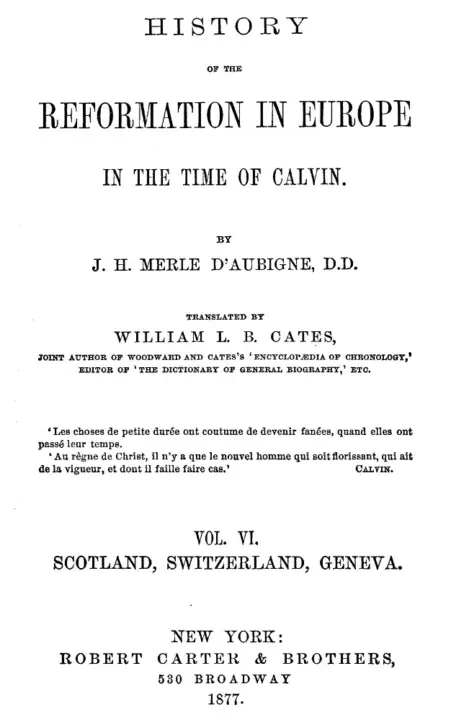
"History of the Reformation in Europe in the Time of Calvin, Vol. 6 (of 8)" by J. H. Merle D’Aubigné is a historical account written in the late 19th century. This volume focuses on the Reformation period in Scotland, Switzerland, and Geneva, emphasizing the theological and sociopolitical developments during Calvin's influence. It likely discusses the struggles for religious reformation and the impact of key figures such as John Knox and Patrick Hamilton on the Protestant movement in Scotland. The opening of the volume sets the stage for the narrative by outlining the historical background and key events leading to the Reformation in Scotland. It introduces the early influencers of the movement, touching on the historical significance of figures such as the Culdees, John Wycliffe's followers, and Patrick Hamilton. The text elegantly describes how the doctrines of the Reformation began to resonate throughout Scotland, highlighting the critical themes of faith, scripture, and the evolving relationship between the Church and Scottish society. It also begins to explore the tumultuous interplay of local nobility and religious authority, which would shape the Reformation's trajectory in the region.
Introduction adapted from the source catalogue; source summaries may be automatically generated.
Free to read · English · 180,014 words · No account needed
MAKE TIME FOR A GOOD BOOK
On by default. Untick to stop anonymous reading totals. Each page counts after 10 seconds in view. How this works.
Anonymous counting is on unless you have switched it off.
The complaints made both at Geneva and in other places were well grounded. This is proved by the proceedings of the magistrates, who, although they were hostile to the reformers, perceived that their own honor required them not to authorize licentiousness. It is quite certain that people ‘went about the streets at night, uttering cries and singing indecent songs;’ that ‘gaming, lewdness, haunting of taverns, and drunkenness,’ were common offences; for a decree of July 19 prohibited them under a penalty of sixty sous for the first time; and, as the evil continued, other decisions of a similar character were taken on August 20 and October 22. It is certain that, as was said in Switzerland, some citizens went to mass, for according to the intolerant customs of the age, they were ordered ‘to leave the town.’ The councils were seen to be as much opposed to religious liberty as Calvin had been. Perhaps they went even further than he would have gone; for, on August 20, they ordered the priests who were still on Genevese soil to go to sermon if they wished to remain there.
[Sidenote: CALVIN’S LETTER TO THE GENEVESE.]
Calvin, at Strasburg, was watching attentively what was passing at Geneva. He heard that a certain number of Genevese kept faithfully to the path which they had taken under his direction. Some of his adherents cried out rather loudly, but the majority led a quiet life, and the most decided of the latter displayed their opposition in no other way than by absenting themselves from a form of worship which they did not consider to be in conformity with the principles of the Gospel. Calvin had not written to them during the first months of his exile. He was not willing to lay himself open to the charge of attempting to draw them over to himself. But he felt keenly that the trials of his friends at Geneva proceeded from their supineness in adhering to the Word of God, and that the remedy for them was in humbling themselves before God and waiting upon Him for the remedy. ‘However the affection which he always cherished for them’ did not permit him to remain longer silent, and on October 1 he wrote to them a letter remarkable for the pacific, discreet, charitable, and elevated spirit which it breathed. He addressed it, not to all the Genevese, but to those who had received into their hearts the seed of the divine Word, and who were still deeply affected by the blow which had struck them in the punishment of their pastor. He named them his brethren, the relics of the dispersion of the Genevese church. He spoke of the love which he bore them. ‘I cannot refrain from writing to you,’ said he, ‘to assure you of the affection which I always cherish for you. Our conscience is fully persuaded before God that it is by his call that we were at one time associated with you, and it ought not to be in the power of men to break such a bond.’ He begs them to forget themselves and their sufferings, to forget even the hostility of their adversaries. ‘If we lose our time in fighting against men,’ he said, ‘thinking only of taking vengeance and getting indemnified for the injuries which they have done us, it is doubtful whether we can overcome them, but it is certain that we shall be overcome by the devil. If on the contrary we resist the devices of that spiritual enemy, there is no fear then of our not coming off conquerors. Cast away every evil affection, be led only by zeal for God, controlled by his Spirit and the rule of his Word.’ Calvin went further. He showed himself severe to his friends. ‘It is easy for you to justify yourselves before men, but your conscience will feel burdened before God.’ He did himself what he required of others. ‘I doubt not,’ he said, ‘that God has humbled us in order to make us acquainted with our ignorance, our imprudence, and our other infirmities, of which I for my part have been fully conscious, and which I have no hesitation in confessing before the Church. However,’ he adds, ‘we did faithfully administer our office. The Lord will cause our innocence to come forth like the morning-star, and our righteousness to shine like the sun.’ But he endeavors chiefly to console the believers of Geneva. ‘Be not cast down because it hath pleased the Lord to humble you for a time, for he lifts up the humble out of the dust and takes the poor from the dunghill. He gives the manna of joy to those who are in tears; he gives back light to them that sit in darkness, and he restores to life them that walk in the shadow of death. Be of good courage then, and endure with patience the chastening of his hand, until the time that he reveal his grace to you.’[744] It is impossible not to recognize the wisdom and the Christian charity which have left their impress on this letter. It is indeed a pastor that speaks. Calvin was so far from the excessive strictness imputed to him that he wrote at the same time to Farel--‘If we find in any Church the ministry of the Word and the sacraments, it is better not to separate from it. It is not right even to do so on the ground that some doctrines are not purely taught in it; for there is hardly a Church in existence which does not retain some traces of its former ignorance. It is sufficient for us if the doctrine on which the Church is founded has its place there and keeps it.’[745] Calvin held that there are some doctrines fundamental and vital, essential to salvation; but he acknowledged that there are others on which difference is permissible.
Your reading position is saved on this browser. Take it to another device with a library code. Reading pages adapt to text, rather than matching a printed edition.
BEHIND THE BOOK
This eBook is for the use of anyone anywhere in the United States and most other parts of the world at no cost and with almost no restrictions whatsoever. You may copy it, give it away or re-use it under the terms of the Project Gutenberg License included with this eBook or online at www.gutenberg.org. If you are not located in the United States, you will have to check the laws of the country where you are located before using this eBook. Read the source licence.
The original source file, including credits and licence, is retained by this library. Request an original-format copy at no charge. Please include the book title and Project Gutenberg identifier #65984.
KEEP YOUR CURIOSITY GOING
Cécile Tormay

Moritz Busch
John L. Ransom
Frances Wright
Cécile Tormay

Mabel Potter Daggett