THE CLASSIC COLLECTION✦An outlaw’s diary: the CommuneCLASSIC FREE BOOKS
An outlaw’s diary: the Commune
Cécile Tormay
THE CLASSIC COLLECTION · 1879
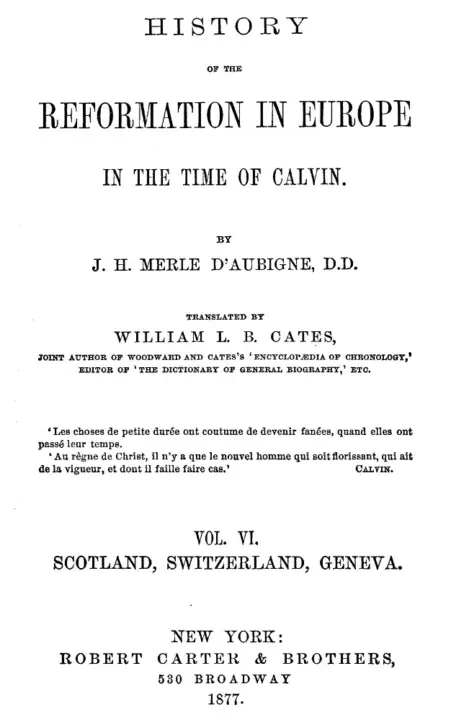
"History of the Reformation in Europe in the Time of Calvin, Vol. 6 (of 8)" by J. H. Merle D’Aubigné is a historical account written in the late 19th century. This volume focuses on the Reformation period in Scotland, Switzerland, and Geneva, emphasizing the theological and sociopolitical developments during Calvin's influence. It likely discusses the struggles for religious reformation and the impact of key figures such as John Knox and Patrick Hamilton on the Protestant movement in Scotland. The opening of the volume sets the stage for the narrative by outlining the historical background and key events leading to the Reformation in Scotland. It introduces the early influencers of the movement, touching on the historical significance of figures such as the Culdees, John Wycliffe's followers, and Patrick Hamilton. The text elegantly describes how the doctrines of the Reformation began to resonate throughout Scotland, highlighting the critical themes of faith, scripture, and the evolving relationship between the Church and Scottish society. It also begins to explore the tumultuous interplay of local nobility and religious authority, which would shape the Reformation's trajectory in the region.
Introduction adapted from the source catalogue; source summaries may be automatically generated.
Free to read · English · 180,014 words · No account needed
MAKE TIME FOR A GOOD BOOK
On by default. Untick to stop anonymous reading totals. Each page counts after 10 seconds in view. How this works.
Anonymous counting is on unless you have switched it off.
[Sidenote: JOY AND GRIEF.]
Thus was fulfilled a prophecy of Bonivard, uttered ten years before. It will be remembered that in 1528 some of the Genevese, who were desirous of the Reformation only that they might get rid of the priests, with their vices and their superstitions, having declared to the prior of the depraved ecclesiastics of St. Victor that they wished to put in their place ministers of the Gospel who would introduce a true Christian Reformation, Bonivard replied to them, ‘If you wish to reform others, ought you not in the first place to reform yourselves? Animals that live on the same meat naturally hate one another. It is just the same with us. We are unchaste; so are you. We are drunkards; you are the same. We are swearers, blasphemers; so are you. You want to drive us away, you say, to put Lutheran ministers in our place.... Gentlemen, take great care what you undertake to do. According to their doctrine, a man will be prohibited from gaming and from giving himself up to debauchery, and that under a heavy penalty. How that will vex you! You will not have had them for two years before you will regret us.’[653] Bonivard spoke candidly and even rudely, but his words fully confirm the testimony and the complaints of Calvin, of Farel, and of Rozet. It is all true, even to the time fixed by the prior--not two years. Farel and Calvin undoubtedly showed themselves in this business subject to human weaknesses. As they were both men of strong character, they easily stimulated each other to an inflexibility to which they were naturally inclined. Calvin himself tells us that the prudent Bucer, at a later period, wished that they should not live together, lest the influence which they had over each other should be hurtful to them.[654] They have said themselves that they might have displayed more gentleness. But it is impossible not to acknowledge that they did what fidelity to the Gospel demanded of them. The question about the bread was a little pennant raised by the councils, in opposition to the great evangelical banner courageously borne by Calvin and Farel. The two classes of combatants in this warm affair were representatives of two systems which not only bore no resemblance to each other but were diametrically opposed. If the reformers had given way, the great cause of religion and of morals would have been injured, the dignity of their ministry lowered, and their activity for the extension of the kingdom of God in Geneva fettered, perhaps rendered impossible. Their compliance in such a case would have been not only blameworthy, it would have been blamed. It was for them the question of ‘To be or not to be.’ They were bound to strive to win the victory; and if they failed to conquer, then they were bound to suffer as witnesses to the rejected truth. They had neglected no means of scaling the citadel, and of planting on it their noble flag. They had failed, and it only remained for them to retreat, conquered and yet in reality conquerors; for they had not drawn back one step in the battle, and had thus prepared the day of triumph. Leaving behind them the city, with its tumult, its menaces, insults, and deeds of violence, Farel and Calvin set out for Berne. It was at the end of April. As they passed along the shores of the lake in the midst of the beautiful and peaceful scenes of nature, they felt greatly relieved. Escaped from those narrow walls within which their hearts had been torn with grief and broken with sadness, they once more breathed freely. A pure and keen air was around them instead of that heavy and thick atmosphere, and it gave them new life. ‘When, on occasion of certain troubles, I was driven away,’ said Calvin, ‘I did not find in myself such magnanimity as not to rejoice more than was meet--that then and by that means I was at liberty.’[655] There was in him, however, no murmuring, no bitterness. He had learnt many lessons in the midst of that agitation, especially that of self-renunciation. ‘As soon as one becomes a self-seeker,’ he said at that period, ‘contests begin: the true principle of action for a soldier is to lay aside all pride, and to depend entirely on the will of his chief.’[656] The will of his chief was that he should quit Geneva, and he quitted it; in this very dependence realizing the highest independence. Stripped and wounded, like the man who went down to Jericho, he felt the Lord near him, who bound up his wounds and poured in oil and wine. ‘Let us remember,’ said he further, ‘that declaration of Jesus Christ, that no one can inflict a wound on one of his little ones but he regards it as inflicted on himself.’[657] Then glancing towards the friends to whom they were going, ‘We have turned towards you, brethren,’ said he, ‘towards you who have been set to feed the churches of Christ, under the influence of the Holy Spirit. Ah! if it be under the guidance of the same prince, against the same enemy, in the same war, and in the same camp that we fight, shall we not be greatly stimulated in our endeavor after agreement and harmony?’[658] He did not lose courage even with respect to the Reformation. ‘The Church,’ he said, ‘is not wearied, distressed, or overthrown by these struggles and fightings; on the contrary, she derives strength from them, she begins to flourish, she is consolidated by new developments.’[659] Such, indeed, was the fruit borne by this great trial. ‘Events have shown,’ said Theodore Beza, ‘that the providence of God appointed these dispensations, to the end that his servant, by means of various experience, might be fitted for greater things; and that while seditious men destroy themselves by their own violence, the Church of Geneva might be purified from all stains.’[660]
Your reading position is saved on this browser. Take it to another device with a library code. Reading pages adapt to text, rather than matching a printed edition.
BEHIND THE BOOK
This eBook is for the use of anyone anywhere in the United States and most other parts of the world at no cost and with almost no restrictions whatsoever. You may copy it, give it away or re-use it under the terms of the Project Gutenberg License included with this eBook or online at www.gutenberg.org. If you are not located in the United States, you will have to check the laws of the country where you are located before using this eBook. Read the source licence.
The original source file, including credits and licence, is retained by this library. Request an original-format copy at no charge. Please include the book title and Project Gutenberg identifier #65984.
KEEP YOUR CURIOSITY GOING
Cécile Tormay

Moritz Busch
John L. Ransom
Frances Wright
Cécile Tormay

Mabel Potter Daggett