THE CLASSIC COLLECTION✦An outlaw’s diary: the CommuneCLASSIC FREE BOOKS
An outlaw’s diary: the Commune
Cécile Tormay
THE CLASSIC COLLECTION · 1879
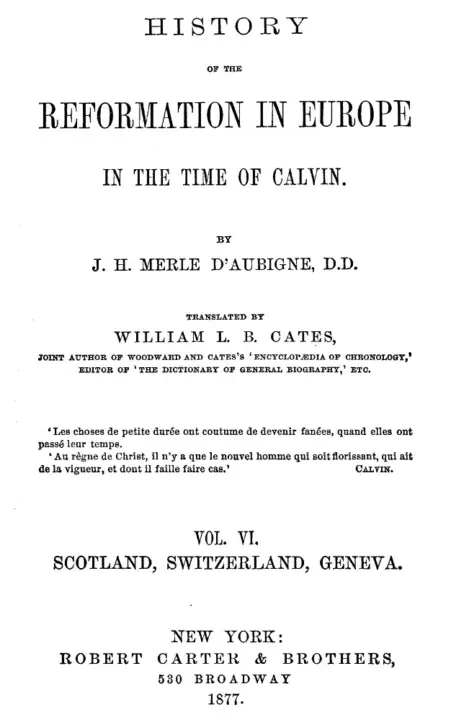
"History of the Reformation in Europe in the Time of Calvin, Vol. 6 (of 8)" by J. H. Merle D’Aubigné is a historical account written in the late 19th century. This volume focuses on the Reformation period in Scotland, Switzerland, and Geneva, emphasizing the theological and sociopolitical developments during Calvin's influence. It likely discusses the struggles for religious reformation and the impact of key figures such as John Knox and Patrick Hamilton on the Protestant movement in Scotland. The opening of the volume sets the stage for the narrative by outlining the historical background and key events leading to the Reformation in Scotland. It introduces the early influencers of the movement, touching on the historical significance of figures such as the Culdees, John Wycliffe's followers, and Patrick Hamilton. The text elegantly describes how the doctrines of the Reformation began to resonate throughout Scotland, highlighting the critical themes of faith, scripture, and the evolving relationship between the Church and Scottish society. It also begins to explore the tumultuous interplay of local nobility and religious authority, which would shape the Reformation's trajectory in the region.
Introduction adapted from the source catalogue; source summaries may be automatically generated.
Free to read · English · 180,014 words · No account needed
MAKE TIME FOR A GOOD BOOK
On by default. Untick to stop anonymous reading totals. Each page counts after 10 seconds in view. How this works.
Anonymous counting is on unless you have switched it off.
These disorderly deeds had lamentable consequences. Neither Farel nor Calvin complained of them. They had now at heart interests more important than their own, more precious even than their lives. They did not return evil for evil. But the former preacher to the Queen of Navarre, the blind and aged Courault, was not so forbearing. He likewise had heard these insults. A man of integrity and devoted to duty, he had at the same time a heart easily wounded, and he knew how to speak hard words. The night between Friday and Saturday, during which these cries had resounded in the city, was not a pleasant or a peaceful one for him. He was more irritated, perhaps, on account of the indignities which were heaped upon Calvin and Farel than for what concerned himself. Chagrin, disquietude, and anger kept him sleepless. His blood was heated, his heart was incensed, his imagination inflamed.
‘Je me tourne et m’agite et ne peux nulle part Trouver que l’insomnie, amère, impatiente, Qu’un malaise inquiet et qu’une fièvre ardente.’[602]
The state of poor old Courault seems to be described in these lines. To him these disorders were intolerable, and he said that if men should hold their peace the very stones would cry aloud. He would cry out, and cry out in the pulpit. True, that was forbidden him; but no matter, in spite of the prohibition of men he would preach. He rose very early and went to St. Peter’s church to perform the service of six o’clock A.M., with no other preparation, alas! than the distress and bitterness which had preyed on his mind through the night. The character of his preaching was not such as was wanted for a people so sensitive as the Genevese. His eloquence somewhat resembled that of the monks to whose order he had belonged, which consisted, for the most part, in making a noise and in shouting.[603] His mind was not cultivated, but he had a glowing imagination, which animated his discourse and enabled him to hit hard blows. Although he was of a more serious turn, he shared, to some extent, the faults of the most illustrious orators of the preceding period, Barletta, Maillard, and Menot; and he sometimes attacked, as they did, the vices of his hearers by satire occasionally delicate and occasionally coarse, but always prompted by a good and grave intention. He would now discharge his conscience. Let them put him in prison, banish him, or beat him soundly; his soul, wearied with grief, must burst its bonds. He uttered, doubtless, some excellent things, some true and pious words; but, agitated as he was, he allowed himself to indulge in that intemperate mode of speech which was then so common. With his spirit still disturbed by those noisy and tumultuous crowds collected under the windows of the reformers, from the midst of which came redoubled shouts, jesting songs, insults, accusations, and menaces, he likened them to the ‘kingdom of the frogs,’ that from the bosom of the marshes croak and make a loud noise. Then recalling a vulgar phrase, the old Frenchman, hardly escaped from the rough life of persecution, inquired of the Genevese what they complained of,--they who were ‘like rats in straw,’ that is to say, were folk greatly at their ease, possessing everything they could wish and in want of nothing.[604] In another passage, rising to a higher strain, and recalling the image of Nebuchadnezzar, with its head of gold and its feet part of iron and part of clay, fragile and broken by a little stone, he predicted to the syndics and councils that as intrigue had placed them in office they would not long retain their power. ‘You, gentlemen of the government,’ said he, ‘you have feet of wax.’ These feet, in his opinion, would soon melt in the sunshine of their victory and prosperity. This comparison, imitative of Biblical style, was not unbefitting to a preacher, and the prophecy which it contained did not fail of accomplishment. At the news of this minister preaching in defiance of the prohibition, and at the report of his sayings, which were most likely misrepresented, the government felt that they were insulted, and determined to act rigorously. Officers of state went to the old man’s house, arrested and took him to prison. It was the eve of Easter Day. It was customary to make presents at that period; and this was the present which was bestowed on the aged, noble, but free-spoken minister and confessor of Christ, who had already experienced treatment too rough at the hands of the adherents of the pope in the kingdom of France.[605]
Your reading position is saved on this browser. Take it to another device with a library code. Reading pages adapt to text, rather than matching a printed edition.
BEHIND THE BOOK
This eBook is for the use of anyone anywhere in the United States and most other parts of the world at no cost and with almost no restrictions whatsoever. You may copy it, give it away or re-use it under the terms of the Project Gutenberg License included with this eBook or online at www.gutenberg.org. If you are not located in the United States, you will have to check the laws of the country where you are located before using this eBook. Read the source licence.
The original source file, including credits and licence, is retained by this library. Request an original-format copy at no charge. Please include the book title and Project Gutenberg identifier #65984.
KEEP YOUR CURIOSITY GOING
Cécile Tormay

Moritz Busch
John L. Ransom
Frances Wright
Cécile Tormay

Mabel Potter Daggett