THE CLASSIC COLLECTION✦An outlaw’s diary: the CommuneCLASSIC FREE BOOKS
An outlaw’s diary: the Commune
Cécile Tormay
THE CLASSIC COLLECTION · 1879
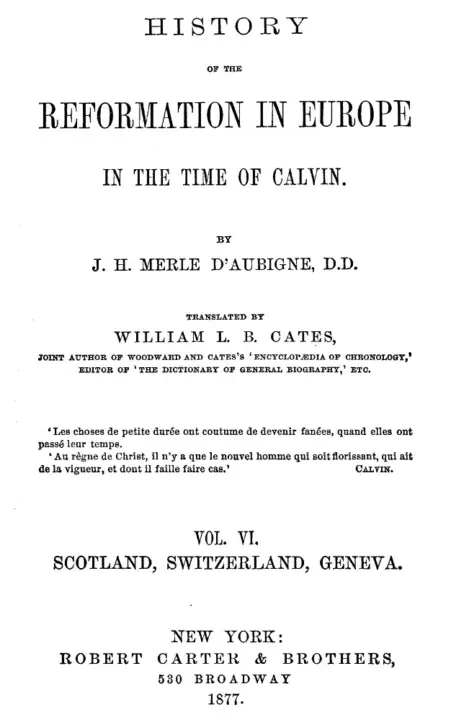
"History of the Reformation in Europe in the Time of Calvin, Vol. 6 (of 8)" by J. H. Merle D’Aubigné is a historical account written in the late 19th century. This volume focuses on the Reformation period in Scotland, Switzerland, and Geneva, emphasizing the theological and sociopolitical developments during Calvin's influence. It likely discusses the struggles for religious reformation and the impact of key figures such as John Knox and Patrick Hamilton on the Protestant movement in Scotland. The opening of the volume sets the stage for the narrative by outlining the historical background and key events leading to the Reformation in Scotland. It introduces the early influencers of the movement, touching on the historical significance of figures such as the Culdees, John Wycliffe's followers, and Patrick Hamilton. The text elegantly describes how the doctrines of the Reformation began to resonate throughout Scotland, highlighting the critical themes of faith, scripture, and the evolving relationship between the Church and Scottish society. It also begins to explore the tumultuous interplay of local nobility and religious authority, which would shape the Reformation's trajectory in the region.
Introduction adapted from the source catalogue; source summaries may be automatically generated.
Free to read · English · 180,014 words · No account needed
MAKE TIME FOR A GOOD BOOK
On by default. Untick to stop anonymous reading totals. Each page counts after 10 seconds in view. How this works.
Anonymous counting is on unless you have switched it off.
‘We ought to pray God to send us well-instructed and Godfearing men to administer justice. But if we will treat them with contempt, we shall by-and-by find no one to serve us. Well may the heart of a citizen ache when, after laying aside his private affairs to serve the community, he gets for his reward the censure of those who dread correction and will not obey the lawful authorities.
‘Come then, gentlemen, one after the other, peaceably to give your opinion, yes or no, in order that all things may be done well and orderly, to the glory of God and our own great benefit.’[546]
One might have expected that, after this declaration, the leaders of the opposition, De Chapeaurouge and his adherents, would state in due form their alleged grievances. They remained silent. This was an acknowledgment that their accusation was unfounded. They would have found it difficult to assert that the election of the magistrates had been due to the intrigues of a few individuals, in the presence of the people who had themselves made that election freely and honorably. Moreover, ten weeks only had to elapse before the regular renewal of the council; and the opposition did not think that they ought to unmask their batteries so long beforehand. It would be better to employ the time in preparing the change which they wished to bring about. Thus, therefore, after the address of the syndics there was a long silence. After some time De Chapeaurouge rose; but instead of speaking as a tribune who seeks to draw the people after him, he made a remark on acoustics; ‘We cannot hear well,’ said he, ‘the place gives a dull sound.’ There are none so deaf as those who will not hear. In fact, the chief of the opposition pretended that the challenge and invitation of the council had not reached his ears, and that this excused his making a reply. ‘Is a second reading desired?’ said the first syndic; no one demanded it. As the leaders were silent, the youngest and most blustering of their followers began to speak. The opportunity was too tempting not to cry out, and instead of the great piece which was looked for, a little one was produced. Men destitute of culture and acquirements attacked the chief magistrates. One man, who had just come out of prison, flung in the face of the reformers the most absurd accusations. There was an ebullition in the assembly; a tempest in a teacup. The young people caused this first outbreak of excitement, which they show in their pursuit of pleasure and which they easily transfer to public affairs. Claude Sérais, a tailor, one of those who in February had played at Picca-Porral, came forward and laid a complaint against Ami Perrin, who enjoyed great respect. It was he who had accompanied Farel the first time that he preached (in 1534) in the convent of Rive. He had not heartily embraced the Reformation, but he was still associated with the reformers. ‘Perrin,’ said Sérais, ‘said that there are traitors at Geneva, people who speak ill of the preachers. He said that Porral was a good man.’ As Porral was a great friend of the Reformation, he was at least as hateful to these people as Farel and Calvin. ‘I replied to him,’ said Sérais, ‘that if he were so, he had no occasion to bring Farel to the prison, to preach to us as if we were thieves who were to be prepared for death.’ ‘Yes,’ cried one of those who had been in prison with Sérais, Jacques Pattu, ‘yes, they brought Farel to prison and he told us that he would sooner drink a glass of blood than drink with us.’ Scarcely had he let fall these strange words, when Pierre Butini mounted on a bench and cried out, ‘The franchise has been taken from us by the Porrets (Porral’s friends), for we were seized, many good men, without informations and without plaintiffs.’--‘I complain,’ resumed Pattu, ‘that they gave me the halter without cause,’--‘I complain,’ said Sérais, further, ‘that Claude Bernard told me that I would not go to hear Farel preach.’--‘Let the others speak now!’ cried Baudichon de la Maisonneuve, annoyed at Sérais beginning over again. But the friends of Sérais cried, ‘And we, we will have Baudichon hold his tongue.’ Then Etienne Dadaz, resuming the series of grievances, said, ‘I complain that I have been sent to prison and accused of meaning to sell the town.’--‘Thou oughtest to be silent,’ said the syndic Goutaz, ‘for thou hast brought from France articles designed to make us subjects of the king.’ On which Dadaz replied, ‘It is not I who made them, it is M. de Langey who gave them me.’ This was certainly not justifying himself, for Langey was a minister to the king.[547]
Your reading position is saved on this browser. Take it to another device with a library code. Reading pages adapt to text, rather than matching a printed edition.
BEHIND THE BOOK
This eBook is for the use of anyone anywhere in the United States and most other parts of the world at no cost and with almost no restrictions whatsoever. You may copy it, give it away or re-use it under the terms of the Project Gutenberg License included with this eBook or online at www.gutenberg.org. If you are not located in the United States, you will have to check the laws of the country where you are located before using this eBook. Read the source licence.
The original source file, including credits and licence, is retained by this library. Request an original-format copy at no charge. Please include the book title and Project Gutenberg identifier #65984.
KEEP YOUR CURIOSITY GOING
Cécile Tormay

Moritz Busch
John L. Ransom
Frances Wright
Cécile Tormay

Mabel Potter Daggett