THE CLASSIC COLLECTION✦An outlaw’s diary: the CommuneCLASSIC FREE BOOKS
An outlaw’s diary: the Commune
Cécile Tormay
THE CLASSIC COLLECTION · 1879
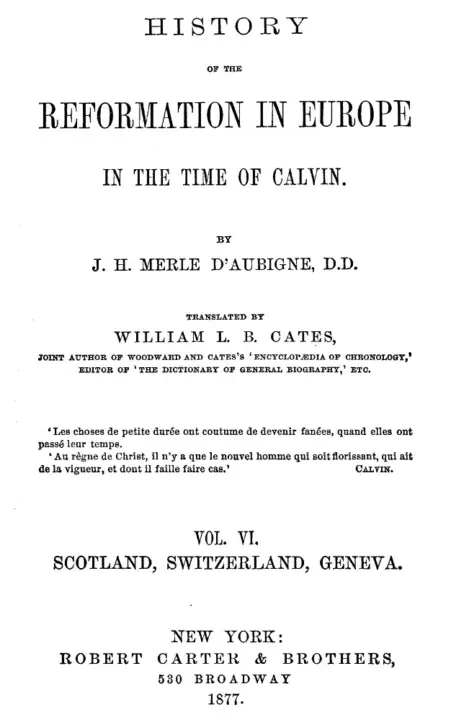
"History of the Reformation in Europe in the Time of Calvin, Vol. 6 (of 8)" by J. H. Merle D’Aubigné is a historical account written in the late 19th century. This volume focuses on the Reformation period in Scotland, Switzerland, and Geneva, emphasizing the theological and sociopolitical developments during Calvin's influence. It likely discusses the struggles for religious reformation and the impact of key figures such as John Knox and Patrick Hamilton on the Protestant movement in Scotland. The opening of the volume sets the stage for the narrative by outlining the historical background and key events leading to the Reformation in Scotland. It introduces the early influencers of the movement, touching on the historical significance of figures such as the Culdees, John Wycliffe's followers, and Patrick Hamilton. The text elegantly describes how the doctrines of the Reformation began to resonate throughout Scotland, highlighting the critical themes of faith, scripture, and the evolving relationship between the Church and Scottish society. It also begins to explore the tumultuous interplay of local nobility and religious authority, which would shape the Reformation's trajectory in the region.
Introduction adapted from the source catalogue; source summaries may be automatically generated.
Free to read · English · 180,014 words · No account needed
MAKE TIME FOR A GOOD BOOK
On by default. Untick to stop anonymous reading totals. Each page counts after 10 seconds in view. How this works.
Anonymous counting is on unless you have switched it off.
But Calvin did not stop there. He did not mean that people should be able to say that the ministers were not cleared of the charges brought against them. He therefore made a confession which had been beforehand approved by his colleagues. ‘When we distinguish the Father, his eternal Word, and his Spirit,’ said he, ‘we believe, in common with ecclesiastical writers, that in the simple unity of God there are three hypostases or substances, which, although they be one sole and identical essence, are nevertheless not confounded with each other. With respect to Jesus Christ,’ he added, ‘before taking on himself our flesh, he was the eternal Word, begotten of the Father before time was, very God, of one same essence, power, and majesty with the Father, Jehovah himself, who has ever existed of himself, and gives to others the property of existing.’[518]
[Sidenote: CALVIN AND THE EARLY CREEDS.]
This declaration baffled Caroli; and now, after having very strongly asserted that Calvin was not orthodox enough, he began to cry out that he was too much so. ‘What,’ said he, ‘you attribute to Jesus Christ the name and the nature of Jehovah; you say that he has of himself the divine essence!’ Calvin replied, ‘If we attentively consider the difference between the Father and the Word, we must acknowledge that the Word proceeds from the Father. But if we concern ourselves with the essence itself of the Word, so far as the Word is God with the Father, all that is said of the one must likewise be said of the other.’[519] Caroli, giving up the matter, took refuge in the words. ‘In your confession,’ said he, ‘there is not the word Trinity, there is not the word person.’ Then, wishing to compel Calvin and the other ministers to adopt the confessions made by men,--‘I demand,’ said he, ‘that you sign the three ancient creeds.’ Calvin and the ministers who were with him would have given their signature under other circumstances, but they now refused it for very wise reasons. ‘Caroli,’ they said, ‘by compelling us to sign, wishes to throw suspicion on our faith. We do not consider it fitting to show him so much deference. Moreover, we will not, by our example, promote the introduction into the Church of a tyranny which would brand every man as a heretic who will not express himself in terms dictated by another.’[520] Herein Calvin gave proof at the same time of a magnanimity and a fidelity which do him honor. Every Church, in his opinion, ought to confess its doctrine, but he would rather that the confession should be the product of the life and the faith of those who make it; and not a mere return to ten or twelve centuries back, in order to seek the truth in the antiquated phrases of another age. He professed with all his heart the doctrine enunciated in the early creeds, the Nicene and the so-called Athanasian, which set forth, perhaps with superfluity of words, but nevertheless with much force, a faith which is dear to Christian men. But he felt that these writings were wanting in evangelical simplicity. The phrases ‘God of God, Light of Light’ (Θεὸς ἐκ Θεοῦ, Φῶς ἐκ Φωτὸς), used in the Nicene creed, appeared to him less apostolic than Oriental in their character. It shocked him that the Quicunque, better known under the name of the Athanasian creed, just at the time when it is going to make subtle distinctions, such as the faith of a simple Christian man cannot comprehend, should begin by asserting--‘Whosoever will be saved, before all things it is necessary that he hold the Catholic faith (that of the creed). Which faith, except every one do keep whole and undefiled, without doubt he shall perish everlastingly.’ Caroli’s ignorance as to this profession of faith was so great that he believed it was drawn up at Nicæa in A.D. 325, and by Athanasius. This was startling to Calvin. The creed appears, in fact, to have been formed gradually in the African church, some of its formulæ being met with towards the close of the seventh century; but it did not exist as a whole until the age of Charlemagne, nearly five centuries after the council of Nicæa. That was an age in which, if the doctrine of the divine nature was truly stated, the doctrines of justification by grace and of the new birth by the Spirit were obscured. Semi-Pelagianism was more and more invading the Church; literary and scientific culture, decried by the monks as belonging to paganism, was becoming rare; the state, not content with deciding on the exterior relations of the Church, published edicts on the articles of faith or of doctrine; miracles were alleged to be wrought by relics; the bishops of Rome assumed the title of universal bishop, a title branded by Gregory the Great as antichristian; the controversy about images was especially agitating men’s minds; both the Church and the state were in the utmost confusion; the bishops took up arms against the lords; the clergy, both regular and secular, were without culture and without discipline; and, in one word, Christianity had lost the life which was peculiarly its own. It was, doubtless, the existence of this melancholy condition of society at the period in which the Quicunque was formed that induced Calvin to make reservations, and to declare that it was to the belief in one only God that he made oath, and not to the belief of Athanasius, whose creed no genuine Church would have accepted.[521]
Your reading position is saved on this browser. Take it to another device with a library code. Reading pages adapt to text, rather than matching a printed edition.
BEHIND THE BOOK
This eBook is for the use of anyone anywhere in the United States and most other parts of the world at no cost and with almost no restrictions whatsoever. You may copy it, give it away or re-use it under the terms of the Project Gutenberg License included with this eBook or online at www.gutenberg.org. If you are not located in the United States, you will have to check the laws of the country where you are located before using this eBook. Read the source licence.
The original source file, including credits and licence, is retained by this library. Request an original-format copy at no charge. Please include the book title and Project Gutenberg identifier #65984.
KEEP YOUR CURIOSITY GOING
Cécile Tormay

Moritz Busch
John L. Ransom
Frances Wright
Cécile Tormay

Mabel Potter Daggett