THE CLASSIC COLLECTION✦An outlaw’s diary: the CommuneCLASSIC FREE BOOKS
An outlaw’s diary: the Commune
Cécile Tormay
THE CLASSIC COLLECTION · 1879
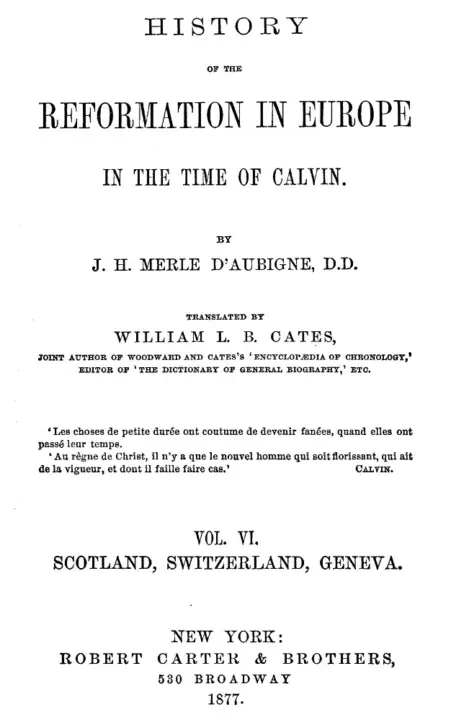
"History of the Reformation in Europe in the Time of Calvin, Vol. 6 (of 8)" by J. H. Merle D’Aubigné is a historical account written in the late 19th century. This volume focuses on the Reformation period in Scotland, Switzerland, and Geneva, emphasizing the theological and sociopolitical developments during Calvin's influence. It likely discusses the struggles for religious reformation and the impact of key figures such as John Knox and Patrick Hamilton on the Protestant movement in Scotland. The opening of the volume sets the stage for the narrative by outlining the historical background and key events leading to the Reformation in Scotland. It introduces the early influencers of the movement, touching on the historical significance of figures such as the Culdees, John Wycliffe's followers, and Patrick Hamilton. The text elegantly describes how the doctrines of the Reformation began to resonate throughout Scotland, highlighting the critical themes of faith, scripture, and the evolving relationship between the Church and Scottish society. It also begins to explore the tumultuous interplay of local nobility and religious authority, which would shape the Reformation's trajectory in the region.
Introduction adapted from the source catalogue; source summaries may be automatically generated.
Free to read · English · 180,014 words · No account needed
MAKE TIME FOR A GOOD BOOK
On by default. Untick to stop anonymous reading totals. Each page counts after 10 seconds in view. How this works.
Anonymous counting is on unless you have switched it off.
Those of the Genevese who had taken them from the time of their coming for good evangelical Christians had called them brethren. But these foreigners had shown themselves very quarrelsome; and having refused even to pray with the Christians of Geneva--an offensive sign of their sectarian spirit--they were no longer called by the name of brethren. However, no penalty was at that time imposed on them, in the hope that they might be brought to more Christian sentiments. But that was indulging in a mere illusion. It was therefore decreed, according to the custom of the age, that these doctors, and every member of their sect, should be banished for ever from Geneva, under pain of death. ‘The most admirable feature of this business,’ said the early biographers of Calvin, ‘is, that if some churches of Germany have been delivered from these doctors, they were so by mere rigor of justice; while at Geneva the magistrate had no hand in it.’[490] Certainly, he did not employ against them either imprisonment or torture; Calvin endeavored only to convince them by argument. But banishment, under pain of death, is nevertheless a very palpable act of the magistrate. On the other hand, it is also a mistake to say that the Registers knew nothing of Calvin’s victory.[491] On the contrary, the decree of the council was expressly based on the fact that the doctors had been unable to prove the truth of their propositions by Holy Scripture.
These were not the only attacks which the reformers had to sustain at the outset of their career. There were certain restless spirits who saw with vexation Calvin, Farel, and Viret at the head of the Reformation in French-speaking lands, and who wished to deprive them of their position, that they might occupy it themselves. These new troubles, caused by jealousy and ambition, were of a sharper kind, and lasted longer.[492] Their originator was that doctor of the Sorbonne, Caroli, whom we saw arrive from France at Geneva at the time of the great disputation of 1535.[493] Caroli was a sort of theological adventurer. He did not at heart care for the sacred end which the Reformation had in view. An incurable levity, which would not allow him to adhere to any party, a liking for anything which seemed to him new and fashionable, a burning thirst for glory and for fortune, a craving for liberty to satisfy his vicious inclinations, these were the feelings which actuated him, and threw him into a camp which he soon abandoned to seek in another the gratification of the same evil desires. Vain, proud, cringing, and inconsistent, he appeared as an assailant of the monks when a sort of reformation was in vogue in France. Next, when the era of persecution had begun, he made his escape to Geneva. The object of his dreams was to become a sort of bishop, to govern the reformed churches in French Switzerland; and he proposed to establish a doctrine which should hold a middle place between the Gospel and the pope. He had made acquaintance with the principal cities of his future diocese. From Geneva he had gone to Neuchâtel, and there he had become pastor, and had married. We have seen him appointed first pastor at Lausanne. ‘In every place that he visited he left some traces of his baseness.’[494] He tacked before every breeze. In a little while he passed from the Romish camp into the Protestant; then, because the reformers remonstrated with him, he returned to his vomit, according to the Scripture phrase; quitted the papal hierarchy a second time, to associate with the evangelicals; and finally ended his roving and wretched life at Rome. Caroli is one of the most despicable characters of that epoch--one of those ecclesiastical Don Quixotes who boast of smiting all their enemies. Besides vainglory, he had another passion quite as intense--hatred. He detested Farel, who had known him at Paris and had rebuked him for his vices. He detested Viret, who had once preached on impurity before him; a sermon which Caroli, convicted by his own conscience, thought was meant for him. In vain Viret assured him that he had preached for everybody: Caroli never forgave him. And lastly, the high esteem in which Calvin was held filled this Parisian doctor with envy and jealousy. He was hardly settled at Lausanne when, eager to realize his dreams, he demanded at Berne the oversight of a certain number of pastors and of churches. The Bernese refused this, and at the same time begged Viret to aid with his advice a foreigner who did not perfectly know the country, and decreed that no innovation should be introduced among the people by any pastor without a preliminary deliberation of all the brethren.[495]
Your reading position is saved on this browser. Take it to another device with a library code. Reading pages adapt to text, rather than matching a printed edition.
BEHIND THE BOOK
This eBook is for the use of anyone anywhere in the United States and most other parts of the world at no cost and with almost no restrictions whatsoever. You may copy it, give it away or re-use it under the terms of the Project Gutenberg License included with this eBook or online at www.gutenberg.org. If you are not located in the United States, you will have to check the laws of the country where you are located before using this eBook. Read the source licence.
The original source file, including credits and licence, is retained by this library. Request an original-format copy at no charge. Please include the book title and Project Gutenberg identifier #65984.
KEEP YOUR CURIOSITY GOING
Cécile Tormay

Moritz Busch
John L. Ransom
Frances Wright
Cécile Tormay

Mabel Potter Daggett