THE CLASSIC COLLECTION✦An outlaw’s diary: the CommuneCLASSIC FREE BOOKS
An outlaw’s diary: the Commune
Cécile Tormay
THE CLASSIC COLLECTION · 1879
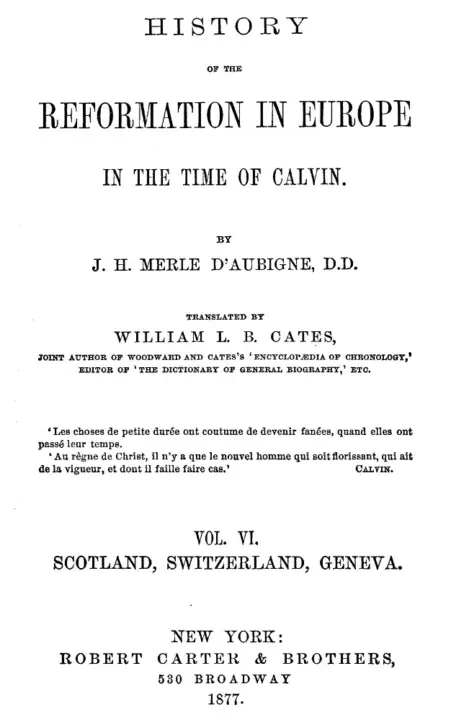
"History of the Reformation in Europe in the Time of Calvin, Vol. 6 (of 8)" by J. H. Merle D’Aubigné is a historical account written in the late 19th century. This volume focuses on the Reformation period in Scotland, Switzerland, and Geneva, emphasizing the theological and sociopolitical developments during Calvin's influence. It likely discusses the struggles for religious reformation and the impact of key figures such as John Knox and Patrick Hamilton on the Protestant movement in Scotland. The opening of the volume sets the stage for the narrative by outlining the historical background and key events leading to the Reformation in Scotland. It introduces the early influencers of the movement, touching on the historical significance of figures such as the Culdees, John Wycliffe's followers, and Patrick Hamilton. The text elegantly describes how the doctrines of the Reformation began to resonate throughout Scotland, highlighting the critical themes of faith, scripture, and the evolving relationship between the Church and Scottish society. It also begins to explore the tumultuous interplay of local nobility and religious authority, which would shape the Reformation's trajectory in the region.
Introduction adapted from the source catalogue; source summaries may be automatically generated.
Free to read · English · 180,014 words · No account needed
MAKE TIME FOR A GOOD BOOK
On by default. Untick to stop anonymous reading totals. Each page counts after 10 seconds in view. How this works.
Anonymous counting is on unless you have switched it off.
These important acts met with no opposition even from the citizens who subsequently so sturdily resisted the rules of discipline. There was however a certain show of opposition, but it was in mere sport. The high-spirited youth of the town, easily excited, indulged in laughter and sarcasm. They were especially annoyed at the zeal of the syndic Porral, which crossed them in their pastimes; and when new syndics had been elected, February 4, and Porral went out of office, these youngsters began the next day to play at Picca-Porral. They wore in the hat, as a badge, a leek (porreau), and served at their feasts a dish of leeks. Each of them would prick the porral with abundance of jests. ‘Légier Beschaut and some other young men of the town’ were imprisoned, February 5, for this sport.[462] Porral requested Farel to accompany him to the prison, for the purpose of admonishing them. But the young folk did not profit by it. Some have called them frolicsome, others dissolute. We think that the former term is the most fitting. As the council saw in the proceedings of the young culprits, says a contemporary,[463] more of youth and foolishness than of malicious intention, they set them at liberty four days after their arrest, under promise to appear again when required. It is very likely that Porral had acted with a little too much rigor in this affair.
[Sidenote: CALVIN’S REQUIREMENTS.]
The Genevese people testified their hearty acceptance of this Christian constitution by electing, February 5, syndics devoted to the Reformation. Other candidates of note were rejected. It was acknowledged that the equality of the citizens was established by this constitution, the rules applying to all alike, ‘and families of the highest distinction being bound to submit like other people.’ This gratified the commonalty. Calvin, however, did not indulge in illusions. He was afraid that a certain number of citizens, and even some of the highest eminence, would oppose the Reform; and he urgently required that all should be called upon to profess it. ‘In default of this,’ he said, ‘he would stay no longer at Geneva.’[464] What he had presented was for the benefit of all. If all would not accept it, he would go away, for he had no intention of invading or usurping by force or by fraud. On March 13, the council resolved to see to the Lord’s Supper, and to the observance of the other articles.[465] On April 17 it was decreed that a syndic, the captain of the quarter, and the tithing men (dizeniers) should visit all the houses of the tithings (dizaines) to propose the articles respecting the faith. On the 27th of the same month it was resolved to print the confession of faith, and to furnish a sufficient number of copies to the tithing men for the inhabitants of their tithings, in order that when the people should be visited they might be better instructed and well informed.[466] Each man should know what he was going to do; there must be no surprise. Calvin, indeed, was not content with the mere instruction of the Genevese in accordance with the confession. It would have sufficed Saunier, who saw with regret, at least at this time, that adhesion to the formula of the confession was required of every Genevese.[467] But it was not enough for Calvin that the document should be officially recognized by the council as an expression of the faith of the Genevese, a course which had been deemed satisfactory in other places. He demanded that each individual should accept it. He did not believe that the state was in this case responsible for the people. Every Genevese was responsible before God. He did not want religion in the mass. Does not Christ say, Whosoever shall confess me before men? Whosoever--that is, each individual. This is perfectly true; but the mistake is to suppose that, in order to confess Christ, it is necessary to sign a theological confession. ‘If thou believest in thy heart, thou shalt be saved,’ says Paul. We are reminded of a poor woman who desired participation at the supper, and whose pastor subjected her to an examination on the three offices of Christ, as prophet, priest, and king. ‘Ah, sir,’ she replied, ‘I know nothing of those things, but I am ready to die for him.’ ‘That will do,’ said the minister, with some sense of shame. Theology is necessary to theologians; it must not be demanded of simple folk. The three leading ministers, Farel, Calvin, and Courault, the latter blind and old, being of the same mind on the subject, appeared before the Two Hundred, presented their formula, and earnestly pressed the council to give glory to God by confessing His truth. ‘It is right,’ said Calvin, ‘that in so sacred a duty you, who are bound to set an example of all virtue, should go before the people.’ But that was not enough for him. ‘Then,’ he added, ‘assemble the country by tithings, and let every man swear to this confession.’[468] The council adopted the views of the reformer, which Saunier himself had embraced. All the tithing men were summoned to give first their own adhesion; and the council charged them to exhort those over whom they were set to follow the commandments of God, and to bring their men (leurs gens) to St. Peter’s, tithing by tithing (there were twenty-eight of them), to adhere to the confession. The adhesion was given through the medium of the tithing men, successively, and not simultaneously. A principle, from which there was no deviation, excluded women from the general council. But in this instance the assembly was of a religious rather than a political character. It was well known how great the influence of woman is in the family as regards religion. It is therefore possible that both men and women were summoned together to St. Peter’s, distributed in groups by their tithing men. The decree which we have just cited directs them to bring their gens, a word which may include both sexes. However, we have found no positive evidence on this point. One single fact appears to indicate that women were present. On September 28, 1537, the council dealt with the case of Jeanne la Gibescière, who would not swear to the new reformation, and banished her on that account. But more than a month earlier, on August 21, this same Jeanne, belonging to a particular sect (the Spirituals), on its being proposed to her to swear to the new reformation, had refused to do so, and had consequently been placed under arrest. That case, therefore, cannot be alleged as an absolute proof that women also swore to the confession at St. Peter’s.
Your reading position is saved on this browser. Take it to another device with a library code. Reading pages adapt to text, rather than matching a printed edition.
BEHIND THE BOOK
This eBook is for the use of anyone anywhere in the United States and most other parts of the world at no cost and with almost no restrictions whatsoever. You may copy it, give it away or re-use it under the terms of the Project Gutenberg License included with this eBook or online at www.gutenberg.org. If you are not located in the United States, you will have to check the laws of the country where you are located before using this eBook. Read the source licence.
The original source file, including credits and licence, is retained by this library. Request an original-format copy at no charge. Please include the book title and Project Gutenberg identifier #65984.
KEEP YOUR CURIOSITY GOING
Cécile Tormay

Moritz Busch
John L. Ransom
Frances Wright
Cécile Tormay

Mabel Potter Daggett