THE CLASSIC COLLECTION✦An outlaw’s diary: the CommuneCLASSIC FREE BOOKS
An outlaw’s diary: the Commune
Cécile Tormay
THE CLASSIC COLLECTION · 1879
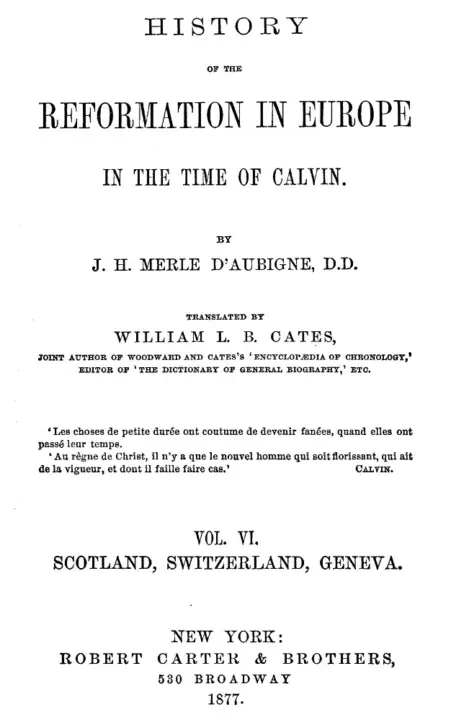
"History of the Reformation in Europe in the Time of Calvin, Vol. 6 (of 8)" by J. H. Merle D’Aubigné is a historical account written in the late 19th century. This volume focuses on the Reformation period in Scotland, Switzerland, and Geneva, emphasizing the theological and sociopolitical developments during Calvin's influence. It likely discusses the struggles for religious reformation and the impact of key figures such as John Knox and Patrick Hamilton on the Protestant movement in Scotland. The opening of the volume sets the stage for the narrative by outlining the historical background and key events leading to the Reformation in Scotland. It introduces the early influencers of the movement, touching on the historical significance of figures such as the Culdees, John Wycliffe's followers, and Patrick Hamilton. The text elegantly describes how the doctrines of the Reformation began to resonate throughout Scotland, highlighting the critical themes of faith, scripture, and the evolving relationship between the Church and Scottish society. It also begins to explore the tumultuous interplay of local nobility and religious authority, which would shape the Reformation's trajectory in the region.
Introduction adapted from the source catalogue; source summaries may be automatically generated.
Free to read · English · 180,014 words · No account needed
MAKE TIME FOR A GOOD BOOK
On by default. Untick to stop anonymous reading totals. Each page counts after 10 seconds in view. How this works.
Anonymous counting is on unless you have switched it off.
For the moment Forrest escaped death. The bishop’s saying got abroad in Scotland, and people used for a long time to say to any ignorant person, ‘Ye are like the bishop of Dunkeldene that knew neither new nor old law.’[194]
The discontent of the people with the clergy went on increasing, and at a provincial council which met at Edinburgh in March, 1536, Sir James Hamilton, in the king’s name, demanded various reforms. The men of the kirk were indignant. ‘Never had they been so ill content,’ said Angus.[195]
The monks, in alarm, began to attack the Reformation from their pulpits.
Bishop Barlow, the English envoy, thought the moment a favorable one for reform in Scotland. ‘If I may obtain the king’s license,’ he wrote to Cromwell, then first secretary of state to Henry VIII., ‘otherwise shall I not be suffered to preach, I will not spare for no bodily peril, boldly to publish the truth of God’s Word among them. Whereat though the clergy shall repine, yet many of the lay people will gladly give hearing. And until the Word of God be planted among them, I suppose their feigned promises shall be finally found frustrate without any faithful effect.’[196]
It seemed as if the hopes of the Anglican bishop were beginning to be realized. It was rumored that the King of Scotland, offended at the reception which his demands had met in the council, was going to have a conference with his uncle. The prelates thought that if that project were carried out they were undone. ‘Pray do not allow,’ they said to the king, ‘a single word to be spoken by the King of England to induce you to adopt his new constitutions of the Scripture.’[197] James was willing and unwilling: but he yielded, and the interview with the terrible Tudor was given up. But the bishops were not yet freed from their alarm; they dreaded the influence of the English ambassadors, and that of the queen-mother, and they feared that they might not be strong enough another time. In order to confirm the prince in his resolution, they conceived the plan of getting him to request a brief from the pope to forbid his holding intercourse with Henry VIII. Thompson, the apostolic prothonotary, was secretly charged with this strange mission, and the priests thought it a capital stroke to ask the King of England to grant this agent a passport, taking good care to conceal from him the object of the mission. Henry, not at all suspicious, agreed to their request, and these cunning clerks could laugh together at their paltry trick. But the queen-mother, when she became acquainted with all these intrigues, sharply rebuked her son. Sensitive and violent, as weak men frequently are, James forgot all respect, and accused his mother of accepting gifts from the king her brother to betray the king her son. Margaret indignantly declared that she would return to London,[198] and the two English envoys hastened their departure from Scotland. The Scottish clergy had been very much alarmed at the project formed by Henry VIII. of giving his daughter Mary to his nephew; but the daughter of Catherine of Aragon would not have been wanting in submissiveness to the pope. The clerical party, having succeeded in stirring up quarrels in the royal family, between the mother and the son and between the uncle and the nephew, and anxious to make the proposed union forever impossible, hinted to the young prince that the eldest daughter of the King of France, the sister-in-law of Catherine de’ Medici, would be for him a far more glorious and advantageous alliance. This scheme pleased James, and when the rumor ran that the emperor was on the point of invading France, the King of Scotland, in order to win the favor of the father of the bride whom he desired, offered to him the aid of his army.[199] Then he set sail, September 1, with six vessels, accompanied by a suite of five hundred persons, all of noble or gentle birth. In ten days he reached Dieppe,[200] and without consulting the opinion of his uncle, he asked for and obtained the hand of Madame Madeleine, who had been very tenderly brought up by her aunt, Margaret of Valois.[201] The Scottish priests were in high glee, because in their view this alliance with France tended to strengthen the papacy in Scotland; but their joy was premature. The kings of France were beginning to assume an air of superiority towards Scotland, which was offensive to a nation proud though small. It was far worse afterwards, when Henry II., king of France, marrying his son to Mary Stuart, required that princess to sign contracts which were humiliating to ancient Caledonia.
Your reading position is saved on this browser. Take it to another device with a library code. Reading pages adapt to text, rather than matching a printed edition.
BEHIND THE BOOK
This eBook is for the use of anyone anywhere in the United States and most other parts of the world at no cost and with almost no restrictions whatsoever. You may copy it, give it away or re-use it under the terms of the Project Gutenberg License included with this eBook or online at www.gutenberg.org. If you are not located in the United States, you will have to check the laws of the country where you are located before using this eBook. Read the source licence.
The original source file, including credits and licence, is retained by this library. Request an original-format copy at no charge. Please include the book title and Project Gutenberg identifier #65984.
KEEP YOUR CURIOSITY GOING
Cécile Tormay

Moritz Busch
John L. Ransom
Frances Wright
Cécile Tormay

Mabel Potter Daggett