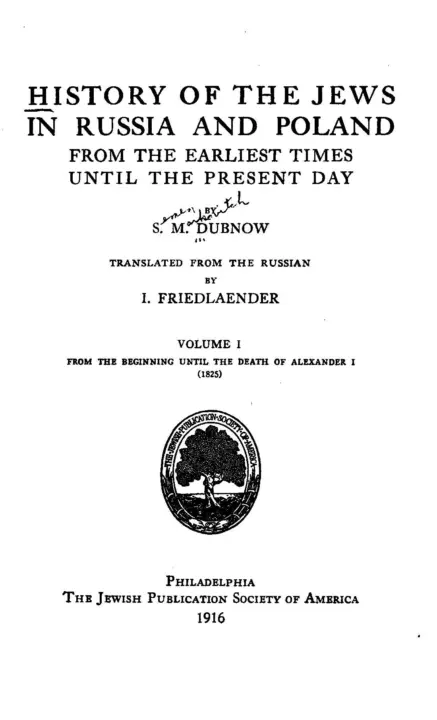
History of the Jews in Russia and Poland, Volume 1 [of 3] From the Beginning until the Death of Alexander I (1825)
Simon Dubnow
THE CLASSIC COLLECTION · 1920
"History of the Jews in Russia and Poland, Volume 3" by Simon Dubnow is a comprehensive historical account written in the early 20th century. This third volume chronicles the Jewish experience in Russia and Poland from the late 19th century to the period surrounding World War I, detailing the social, economic, and political struggles faced by the Jewish community. Dubnow's work aims to document the rich history and complex interactions between Jewish populations and the broader socio-political landscape of Eastern Europe during a time of significant upheaval and challenge. The opening of this volume sets the stage for understanding the harsh realities faced by Jewish Russians, particularly under the reign of Nicholas II, whose reactionary policies led to increased oppression and violence against the Jewish population. It discusses the fractured hopes of Jews for improved conditions following Alexander III's reign, only to be met with renewed policies of discrimination, economic hardship, and violent pogroms—events that led the Jewish community to seek both national revival through movements like Political Zionism and social reforms through Socialism. Through detailed narratives of suffering, resilience, and cultural awakening, Dubnow's work reflects a profound chapter in Jewish history marked by both despair and a burgeoning sense of national identity.
Introduction adapted from the source catalogue; source summaries may be automatically generated.
Free to read · English · 100,353 words · No account needed
MAKE TIME FOR A GOOD BOOK
On by default. Untick to stop anonymous reading totals. Each page counts after 10 seconds in view. How this works.
Anonymous counting is on unless you have switched it off.
Soon afterwards, on August 6, 1905, the so-called "Bulyghin Constitution" was made public, providing for a truncated Imperial Duma with a system of representation based on class qualifications and limited to advisory functions but without any restrictions as far as the franchise of the Jews was concerned. "Now," wrote the Voskhod, "the Jew has the right to be a popular representative, but he has no right to reside in the place in which the Imperial Duma assembles--in the capital." Russian Jewry, with the exception of its Left wing, was on the point of starting an election campaign to send its representatives to this mutilated Duma, in the hope of attaining through it to a more perfect form of representation, when the stormy course of events brought to the fore new threatening questions. This counterfeit of a national parliament failed to satisfy the Russian democracy, and the struggle with the Government broke out anew with unprecedented energy. Stormy political meetings were held at the universities and at the other institutions of higher learning, which, by an ukase of August 27, had been granted academic self-government. The autonomous professorial councils began to admit Jewish students to the schools, without any restrictive percentage, and the wave of an agitated Jewish youth was drawn into the whirling sea of the Russian student body. A new succession of strikes followed, arranged by the students, workingmen and railroad workers. A general Russian strike was being carefully prepared as a last resort in the struggle for a democratic constitution. The army of the emancipation movement was instituting a bloodless revolution, the temporary stoppage of all railroad movements and of all other activities in the country, in the hope of forcing Tzardom to an act of self-abnegation and the proclamation of civil liberties.
The month of September and the beginning of October were spent in these feverish preparations, but at the same time, the black army of absolutism was making its own arrangements for a sanguinary counter-revolution, for regular St. Bartholomew nights, directed against the participants in the emancipation movement, and particularly against the Jews. The plans of the emancipation army were universally known, but the terrible designs of the dark forces of reaction were effectively concealed. Only when the bloody undertaking was accomplished, was it possible to uncover the threads of the criminal pogrom organization, which led from the palaces of the Tzar and the highest dignitaries of state, by way of the Police Department, to the slums of murderers and hooligans. In the disclosures made by Lvov, in November, 1905, in his memorandum to Witte, the president of the Council of Ministers, the officials in the immediate environment of Nicholas II. who had organized the October pogroms were pointed out by name. They were the "patriotic" General Bogdanovich in St. Petersburg, who acted with the blessing of Archbishop[48] Vladimir and with the assistance of the Imperial camarilla and of many governors and governors-general in the provinces. During the month of September "fighting contingents" of the Black Hundred, whose number, as Bogdanovich boasted in the highest government spheres, amounted to one hundred thousand, were organized all over Russia. In every city the parts to be enacted by the administrators, the police and the pogrom hirelings from among the local riff-raff were carefully prepared and assigned. The pogrom proclamations were printed openly; the "manufacturing" center of this propaganda literature, as was afterwards disclosed in the Imperial Duma by deputy Urussov (formerly Assistant-Minister of the Interior), was located in the printing office of the Police Department. There can be no question that the Tzar was acquainted, if not with all the details of these preparations, at least with the general plan of arranging a counter-revolution by means of carefully engineered massacres of which the Jews were to become the chief victims. Millions of rubles for the organization of the pogroms were appropriated from a secret ten-million ruble fund, the disposition of which lay entirely in the hands of the Tzar.
Your reading position is saved on this browser. Take it to another device with a library code. Reading pages adapt to text, rather than matching a printed edition.
Simon Dubnow
Simon Dubnow
Simon Dubnow
BEHIND THE BOOK
This eBook is for the use of anyone anywhere in the United States and most other parts of the world at no cost and with almost no restrictions whatsoever. You may copy it, give it away or re-use it under the terms of the Project Gutenberg License included with this eBook or online at www.gutenberg.org. If you are not located in the United States, you will have to check the laws of the country where you are located before using this eBook. Read the source licence.
The original source file, including credits and licence, is retained by this library. Request an original-format copy at no charge. Please include the book title and Project Gutenberg identifier #47212.
KEEP YOUR CURIOSITY GOING
Cécile Tormay

Moritz Busch
John L. Ransom
Frances Wright
Cécile Tormay

Mabel Potter Daggett