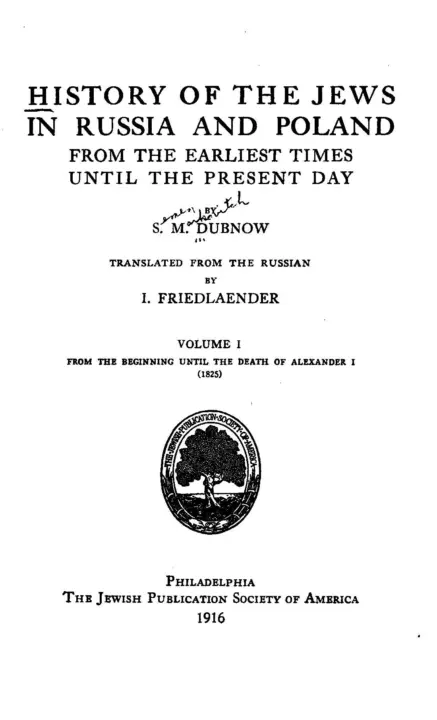
History of the Jews in Russia and Poland, Volume 1 [of 3] From the Beginning until the Death of Alexander I (1825)
Simon Dubnow
THE CLASSIC COLLECTION · 1920
"History of the Jews in Russia and Poland, Volume 3" by Simon Dubnow is a comprehensive historical account written in the early 20th century. This third volume chronicles the Jewish experience in Russia and Poland from the late 19th century to the period surrounding World War I, detailing the social, economic, and political struggles faced by the Jewish community. Dubnow's work aims to document the rich history and complex interactions between Jewish populations and the broader socio-political landscape of Eastern Europe during a time of significant upheaval and challenge. The opening of this volume sets the stage for understanding the harsh realities faced by Jewish Russians, particularly under the reign of Nicholas II, whose reactionary policies led to increased oppression and violence against the Jewish population. It discusses the fractured hopes of Jews for improved conditions following Alexander III's reign, only to be met with renewed policies of discrimination, economic hardship, and violent pogroms—events that led the Jewish community to seek both national revival through movements like Political Zionism and social reforms through Socialism. Through detailed narratives of suffering, resilience, and cultural awakening, Dubnow's work reflects a profound chapter in Jewish history marked by both despair and a burgeoning sense of national identity.
Introduction adapted from the source catalogue; source summaries may be automatically generated.
Free to read · English · 100,353 words · No account needed
MAKE TIME FOR A GOOD BOOK
On by default. Untick to stop anonymous reading totals. Each page counts after 10 seconds in view. How this works.
Anonymous counting is on unless you have switched it off.
And yet, political Zionism viewed as a theory failed to offer a satisfactory solution of the great Jewish problem in all its historic complexity. Born of the reaction against anti-Semitism, and endeavoring to soothe the pain of the wounded Jewish heart, it was marked by all the merits and demerits of a theory which was substantially Messianic in character and was entirely dependent on subjective forces, on faith and will-power. "If you only will it, then it is no fairy tale"[19]--in these words the ultimate goal of political Zionism is indicated by its founder, who firmly believed that an extraordinary exertion of the national will would transform the fairy tale of a "Jewish state" into reality. When confronted with the question as to the future of the Jewish nation in case faith and will-power should prove unable to grapple with the conditions over which it had no control, and the "fairy tale" of a united political autonomous center should not be realized, political Zionism either remained silent or indulged in a polemical retort which was in flagrant contradiction to Jewish history: "Without Zion, Judaism is bound to perish." The national conscience, however, could not be reconciled to such an answer. A more or less satisfactory solution of the problem of Judaism could not spring from the external reaction against anti-Semitism, but could only mature as the fruit of profound contemplation of the course of development pursued by the Jewish people in the Diaspora; such a solution could only be found in the endeavor to adapt the new national movement to this historic course. From this point of view political Zionism was rectified by "Spiritual Zionism," the teaching of the publicist and philosopher Ahad Ha'am (U. Ginzberg).
Even before political Zionism, or "Herzlianism," appeared on the scene, Ahad Ha'am had succeeded in substantially modifying the Palestinian idea as formulated by Lilienblum and Pinsker. In the program of the semi-Masonic order Bne Moshe ("Sons of Moses"), established by him in Odessa,[20] he laid down the fundamental principle that the preparation of the land for the people must be preceded by the transformation of the people into a firmly-knit national organization: "We must propagate the national idea, and convert it into a lofty moral ideal." Having become associated with the Palestinian colonization in a practical manner, as a leading member of the Odessa Palestine Society, founded in 1890,[21] Ahad Ha'am indefatigably preached that the significance of this microscopic colonization was not to be sought in its economic results, but in its spiritual and cultural effects, in establishing upon the historic soil of Judaism a nursing-ground for a pure national culture which should be free from foreign admixture, and from the inevitable cultural eclecticism of the Diaspora. After the spectacular appearance of political Zionism on the Jewish stage this fundamental idea of "Neo-Palestinianism" was more fully elaborated by Ahad Ha'am, assuming the shape of a comprehensive doctrine, known as the doctrine of "Spiritual Zionism." When the first Basle Congress was over, Ahad Ha'am declared that the "Jewish State," as formulated by Herzl, was beyond realization, for the reason that, under the prevailing circumstances, it was entirely impossible to transfer to Palestine the whole Diaspora, or even a substantial part of it. Consequently, the Palestinian colonization could not put an end to the material "Jewish misery," whereas a small Jewish center, gradually rising in Palestine, might, with the help of a proper organization, solve the national-spiritual problem of Judaism. The formation of a spiritual center in the historic homeland of the nation, the creation in that center of a Jewish national school, the revival of the Hebrew language as a medium of daily speech, the untrammelled development of a Jewish culture, without the pressure of a foreign environment--such in short he held to be the true goal of the Palestine idea. A "publicly and legally assured home for the Jewish spirit" of this kind would exert an uninterrupted nationalizing influence upon the Diaspora, serving as a living center of attraction for a genuine Jewish culture, and acting like a focus which scatters its rays over a large periphery.
Your reading position is saved on this browser. Take it to another device with a library code. Reading pages adapt to text, rather than matching a printed edition.
Simon Dubnow
Simon Dubnow
Simon Dubnow
BEHIND THE BOOK
This eBook is for the use of anyone anywhere in the United States and most other parts of the world at no cost and with almost no restrictions whatsoever. You may copy it, give it away or re-use it under the terms of the Project Gutenberg License included with this eBook or online at www.gutenberg.org. If you are not located in the United States, you will have to check the laws of the country where you are located before using this eBook. Read the source licence.
The original source file, including credits and licence, is retained by this library. Request an original-format copy at no charge. Please include the book title and Project Gutenberg identifier #47212.
KEEP YOUR CURIOSITY GOING
Cécile Tormay

Moritz Busch
John L. Ransom
Frances Wright
Cécile Tormay

Mabel Potter Daggett