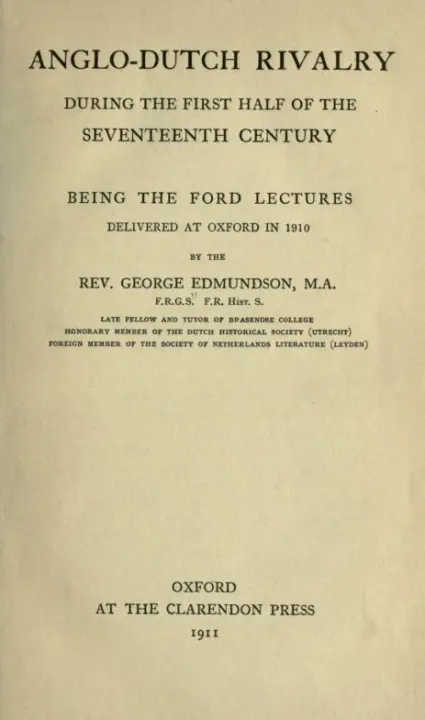
Anglo-Dutch Rivalry During the First Half of the Seventeenth Century being the Ford lectures delivered at Oxford in 1910
George Edmundson
THE CLASSIC COLLECTION · 1922
"History of Holland" by George Edmundson is a historical account likely written in the early 20th century. The book explores the significant events and transformations in the maritime province of Holland, particularly during its War of Independence and the subsequent historical developments of the Dutch state and people. It appears to provide a comprehensive overview of the socio-political landscape of Holland, reflecting on its feudal history and the enduring resilience of its people against various foreign dominations. At the start of "History of Holland," Edmundson outlines the context for the historical narrative, detailing the unique geographic characteristics of the region and their influence on the character of the Dutch people. He introduces key historical figures, including the Counts of Holland and the prominent role that the province played during the Burgundian period and beyond. The narrative establishes a foundation for understanding the complexities of Holland's governance, the emergence of factional conflicts like those between the Hooks and the Cods, and the impactful dynastic competitions that shaped its historical trajectory. The beginning not only sets the stage for a detailed exploration of Holland's history but also highlights the social and economic dynamics that contributed to its eventual independence and national identity.
Introduction adapted from the source catalogue; source summaries may be automatically generated.
Free to read · English · 179,579 words · No account needed
MAKE TIME FOR A GOOD BOOK
On by default. Untick to stop anonymous reading totals. Each page counts after 10 seconds in view. How this works.
Anonymous counting is on unless you have switched it off.
The small companies formed to carry out these ventures in the far-Eastern seas continued to grow in number, and by the very keenness of their competition threatened each other's enterprises with ruin. In these circumstances the States-General and the Estates of Holland determined, under the leadership of Oldenbarneveldt, to take a step which was to be fraught with very important consequences. The rival companies were urged to form themselves into a single corporation to which exclusive rights would be given for trading in the East-Indies. Such a proposal was in direct contradiction to that principle of free trade which had hitherto been dear to the Netherlanders, and there was much opposition, and many obstacles had to be overcome owing to the jealousies of the various provinces, towns and bodies of merchants who were interested. But at length the patience and statesmanship of Oldenbarneveldt overcame all difficulties, and on March 20,1601, a charter was issued creating the United East-India Company and giving it a monopoly of the East-India trade (for 21 years) with all lands east of the Cape of Good Hope and west of the Straits of Magellan. The executive control was vested in a College known as the Seventeen. Extensive sovereign privileges were conferred upon the company and exercised by the Seventeen in the name of the States-General. They might make treaties with native rulers and potentates, erect forts for the protection of their factories, appoint governors and officials with administrative and judicial functions, and enlist troops, but these officials and troops were required to take an oath of allegiance to the States-General. The States-General themselves became "participants" by investing the 25,000 pounds, which the company had paid them for the grant of the charter. The capital speedily reached the amount of six and a half million guilders.
The warlike operations of the year 1599 were uneventful and in the main defensive, except on the eastern frontier where the Spanish forces under the command of the Admiral of Aragon, Mendoza, captured Wesel and Rheinberg. The new rulers of the Netherlands, Albert and Isabel, did not make their entry into Brussels until the end of 1599; and almost before they had had time to organise the new government and gain firm possession of the reins of power in the Belgic provinces, they found themselves confronted with a serious danger. The seaport of Dunkirk had for many years been a nest of pirates, who preyed upon Dutch commerce in the narrow seas. The States-General, urged on by Oldenbarneveldt, resolved in the spring of 1606 to despatch an expedition to besiege and capture Dunkirk. Both Maurice and William Lewis were opposed to the project, which they regarded as rash and risky. The States-General, however, hearing reports of the archduke's soldiery being mutinous for lack of pay, persisted in their purpose, and Maurice, against his better judgment, acquiesced. A body of picked troops, 12,000 foot and 3000 horse, was assembled on the island of Walcheren. A succession of contrary winds delaying the sailing of the force, it was determined to march straight through West Flanders to Nieuport and then along the shore to Dunkirk. A deputation of the States-General, of which Oldenbarneveldt was the leading member, went to Ostend to supervise, much to Maurice's annoyance, the military operations. The stadholder, however, reached Nieuport without serious opposition and proceeded to invest it. Meanwhile the Archduke Albert had been acting with great energy. By persuasive words and large promises he succeeded in winning back the mutineers, and at the head of a veteran force of 10,000 infantry and 1500 cavalry he followed Maurice and, advancing along the dunes, came on July 1 upon a body of 2000 men under the command of Ernest Casimir of Nassau, sent by the stadholder to defend the bridge of Leffingen. At the sight of the redoubtable Spanish infantry a panic seized these troops and they were routed with heavy loss. The fight, however, gave Maurice time to unite his forces and draw them up in battle order in front of Nieuport. Battle was joined the following afternoon, and slowly, foot by foot, after a desperate conflict the archduke's Spanish and Italian veterans drove back along the dunes the troops of the States. Every hillock and sandy hollow was fiercely contested, the brunt of the conflict falling on the English and Frisians under the command of Sir Francis Vere. Vere himself was severely wounded, and the battle appeared to be lost. At this critical moment the Spaniards began to show signs of exhaustion through their tremendous exertions in two successive fights under a hot sun in the yielding sand-hills; and the prince, at the critical moment, throwing himself into the midst of his retreating troops, succeeded in rallying them. At the same time he ordered some squadrons of cavalry which he had kept in reserve to charge on the flank of the advancing foe. The effect was instantaneous. The Spaniards were thrown into confusion, broke and fled. The victory was complete. The archduke only just escaped capture, and of his army 5000 perished and a large number were taken prisoners, among these the Admiral of Aragon. Almost by a miracle was the States' army thus rescued from a desperate position. Maurice's hard-won triumph greatly enhanced his fame, for the battle of Nieuport destroyed the legend of the invincibility of the Spanish infantry in the open field. The victorious general, however, was not disposed to run any further risks. He accordingly retreated to Ostend and there embarked his troops for the ports from which they had started. The expedition had been very costly and had been practically fruitless. Oldenbarneveldt and those who had acted with him were deeply disappointed at the failure of their plans for the capture of Dunkirk and were far from satisfied with Maurice's obstinate refusal to carry out any further offensive operations. From this time there arose a feeling of soreness between the advocate and the stadholder, which further differences of opinion were to accentuate in the coming years.
Your reading position is saved on this browser. Take it to another device with a library code. Reading pages adapt to text, rather than matching a printed edition.
BEHIND THE BOOK
This eBook is for the use of anyone anywhere in the United States and most other parts of the world at no cost and with almost no restrictions whatsoever. You may copy it, give it away or re-use it under the terms of the Project Gutenberg License included with this eBook or online at www.gutenberg.org. If you are not located in the United States, you will have to check the laws of the country where you are located before using this eBook. Read the source licence.
The original source file, including credits and licence, is retained by this library. Request an original-format copy at no charge. Please include the book title and Project Gutenberg identifier #14971.
KEEP YOUR CURIOSITY GOING
Cécile Tormay

Moritz Busch
John L. Ransom
Frances Wright
Cécile Tormay

Mabel Potter Daggett