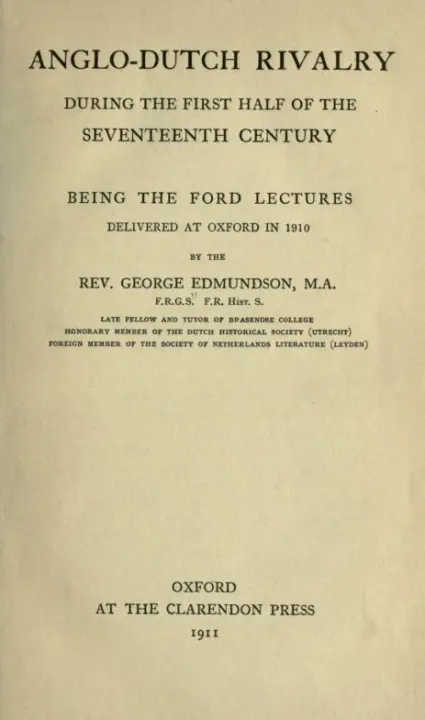
Anglo-Dutch Rivalry During the First Half of the Seventeenth Century being the Ford lectures delivered at Oxford in 1910
George Edmundson
THE CLASSIC COLLECTION · 1922
"History of Holland" by George Edmundson is a historical account likely written in the early 20th century. The book explores the significant events and transformations in the maritime province of Holland, particularly during its War of Independence and the subsequent historical developments of the Dutch state and people. It appears to provide a comprehensive overview of the socio-political landscape of Holland, reflecting on its feudal history and the enduring resilience of its people against various foreign dominations. At the start of "History of Holland," Edmundson outlines the context for the historical narrative, detailing the unique geographic characteristics of the region and their influence on the character of the Dutch people. He introduces key historical figures, including the Counts of Holland and the prominent role that the province played during the Burgundian period and beyond. The narrative establishes a foundation for understanding the complexities of Holland's governance, the emergence of factional conflicts like those between the Hooks and the Cods, and the impactful dynastic competitions that shaped its historical trajectory. The beginning not only sets the stage for a detailed exploration of Holland's history but also highlights the social and economic dynamics that contributed to its eventual independence and national identity.
Introduction adapted from the source catalogue; source summaries may be automatically generated.
Free to read · English · 179,579 words · No account needed
MAKE TIME FOR A GOOD BOOK
On by default. Untick to stop anonymous reading totals. Each page counts after 10 seconds in view. How this works.
Anonymous counting is on unless you have switched it off.
Upon the death of Frederick Henry of Orange (March, 1647), his only son succeeded to his titles and estates and also by virtue of the Act of Survivance to the offices of Stadholder in six provinces and to the Captain-Generalship and Admiral-Generalship of the Union. William was but twenty-one years of age and, having been excluded during Frederick Henry's lifetime from taking any active part in affairs of state, he had turned his energies into the pursuit of pleasure, and had been leading a gay and dissolute life. His accession to power was, however, speedily to prove that he was possessed of great abilities, a masterful will and a keen and eager ambition. He had strongly disapproved of the trend of the peace negotiations at Münster, and would have preferred with the help of the French to have attempted to drive the Spaniards out of the southern Netherlands. The preliminaries were, however, already settled in the spring of 1647; and the determination of the province of Holland and especially of the town of Amsterdam to conclude an advantageous peace with Spain and to throw over France rendered the opposition of the young Stadholder unavailing. But William, though he had perforce to acquiesce in the treaty of Münster, was nevertheless resolved at the earliest opportunity to undo it. Thus from the outset he found himself in a pronounced antagonism with the province of Holland, which could only issue in a struggle for supremacy similar to that with which his uncle Maurice was confronted in the years that followed the truce of 1609, and, to a less degree, his father after 1640.
Commerce was the predominant interest of the burgher-aristocracies who held undisputed sway in the towns of Holland; and they, under the powerful leadership of Amsterdam, were anxious that the peace they had secured should not be disturbed. They looked forward to lightening considerably the heavy load of taxation which burdened them, by reducing the number of troops and of ships of war maintained by the States. To this policy the young prince was resolutely opposed, and he had on his side the prestige of his name and a vast body of popular support even in Holland itself, among that great majority of the inhabitants, both of town and country, who were excluded from all share in government and administration and were generally Orangist in sympathy. He had also with him the officers of the army and navy and the preachers. His chief advisers were his cousin William Frederick, Stadholder of Friesland, and Cornelis van Aerssens (son of Francis) lord of Sommelsdijk. By the agency of Sommelsdijk he put himself in secret communication with Count d'Estrades, formerly French ambassador at the Hague, now Governor of Dunkirk, and through him with Mazarin, with the view of concluding an alliance with France for the conquest of the Spanish Netherlands, and for sending a joint expedition to England to overthrow the Parliamentary forces and establish the Stewarts on the throne. Mazarin was at this time, however, far too much occupied by his struggle with the Fronde to listen to the overtures of a young man who had as yet given no proof of being in a position to give effect to his ambitious proposals. Nevertheless the prince was in stern earnest. In April, 1648, his brother-in-law, James, Duke of York, had taken refuge at the Hague, and was followed in July by the Prince of Wales. William received them with open arms and, urged on by his wife, the Princess Royal, and by her aunt the exiled Queen of Bohemia, who with her family was still residing at the Hague, he became even more eager to assist in effecting a Stewart restoration than in renewing the war with Spain. The difficulties in his way were great. In 1648 public opinion in the States on the whole favoured the Parliamentary cause. But, when the Parliament sent over Dr Doreslaer and Walter Strickland as envoys to complain of royal ships being allowed to use Dutch harbours, the States-General, through the influence of the prince, refused them an audience. The Estates of Holland on this gave a signal mark of their independence and antagonism by receiving Doreslaer and forbidding the royal squadron to remain in any of the waters of the Province.
Your reading position is saved on this browser. Take it to another device with a library code. Reading pages adapt to text, rather than matching a printed edition.
BEHIND THE BOOK
This eBook is for the use of anyone anywhere in the United States and most other parts of the world at no cost and with almost no restrictions whatsoever. You may copy it, give it away or re-use it under the terms of the Project Gutenberg License included with this eBook or online at www.gutenberg.org. If you are not located in the United States, you will have to check the laws of the country where you are located before using this eBook. Read the source licence.
The original source file, including credits and licence, is retained by this library. Request an original-format copy at no charge. Please include the book title and Project Gutenberg identifier #14971.
KEEP YOUR CURIOSITY GOING
Cécile Tormay

Moritz Busch
John L. Ransom
Frances Wright
Cécile Tormay

Mabel Potter Daggett