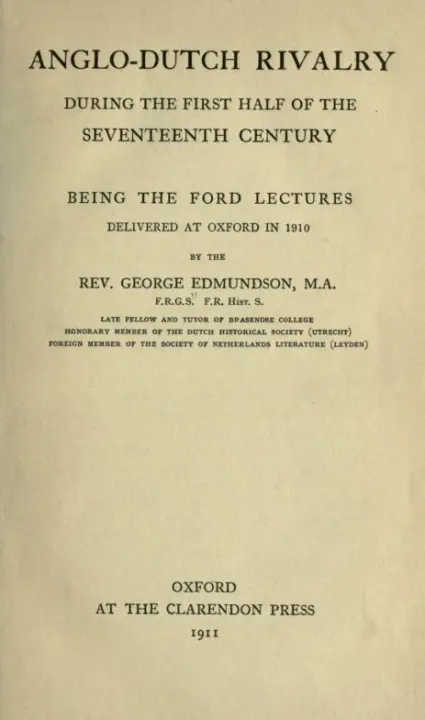
Anglo-Dutch Rivalry During the First Half of the Seventeenth Century being the Ford lectures delivered at Oxford in 1910
George Edmundson
THE CLASSIC COLLECTION · 1922
"History of Holland" by George Edmundson is a historical account likely written in the early 20th century. The book explores the significant events and transformations in the maritime province of Holland, particularly during its War of Independence and the subsequent historical developments of the Dutch state and people. It appears to provide a comprehensive overview of the socio-political landscape of Holland, reflecting on its feudal history and the enduring resilience of its people against various foreign dominations. At the start of "History of Holland," Edmundson outlines the context for the historical narrative, detailing the unique geographic characteristics of the region and their influence on the character of the Dutch people. He introduces key historical figures, including the Counts of Holland and the prominent role that the province played during the Burgundian period and beyond. The narrative establishes a foundation for understanding the complexities of Holland's governance, the emergence of factional conflicts like those between the Hooks and the Cods, and the impactful dynastic competitions that shaped its historical trajectory. The beginning not only sets the stage for a detailed exploration of Holland's history but also highlights the social and economic dynamics that contributed to its eventual independence and national identity.
Introduction adapted from the source catalogue; source summaries may be automatically generated.
Free to read · English · 179,579 words · No account needed
MAKE TIME FOR A GOOD BOOK
On by default. Untick to stop anonymous reading totals. Each page counts after 10 seconds in view. How this works.
Anonymous counting is on unless you have switched it off.
Amsterdam during this decade had been rapidly growing in importance and it was soon to be the first seaport in the world. It had become the emporium of the Baltic trade. In 1601 it is stated that between 800 and 900 ships left its quays in three days, carrying commodities to the Baltic ports. They came back laden with corn and other "east-sea" goods, which they then distributed in French, Portuguese and Spanish havens, and even as far as Italy and the Levant. Ship-building went on apace at Enkhuizen, Hoorn and other towns on the Zuyder Zee; and Zaandam was soon to become a centre of the timber trade. In Zeeland, Middelburg, through the enterprise of an Antwerp refugee of French extraction, by name Balthazar de Moucheron, was second only to Amsterdam as a sea-port, while Dordrecht and Rotterdam were also busy with shipping.
The energies of the Dutch at this springtide of their national life were far from being confined to European, waters. Dutch sailors already knew the way to the East-Indies round the Cape of Good Hope through employment on Portuguese vessels; and the trade-routes by which the Spaniards brought the treasures of the New World across the Atlantic were likewise familiar to them and for a similar reason. The East-Indies had for the merchants of Holland and Zeeland, ever keenly on the look-out for fresh markets, a peculiar attraction. At first the Cape route was thought to be too dangerous, and several attempts were made to discover a north-west passage along the coast of Siberia. Balthazar de Moucheron was the pioneer in these northern latitudes. He established a regular traffic with the Russians by way of the White Sea, and had a factory (built in 1584) at Archangel. Through his instances, aided by those of the famous geographer Petrus Plancius (likewise a refugee from Antwerp), an expedition was fitted out and despatched in 1594 to try to sail round northern Asia, but it was driven back after passing through the Waigat by ice and storms. A like fate befell a second expedition in the following year. Discouraged, but still not despairing, a third fleet set out in 1596 under the command of Jacob van Heemskerk with William Barendtsz as pilot. Forced to winter in Spitsbergen, after terrible sufferings, Heemskerk returned home in the autumn of 1597 with the remnant of his crews. Barendtsz was one of those who perished. This was the last effort in this direction, for already a body of Amsterdam merchants had formed a company for trafficking to India by the Cape; and four ships had sailed, April 2, 1596, under the command of Cornelis Houtman, a native of Gouda. A certain Jan Huyghen van Linschoten, who had been in the Portuguese service, had published in 1595 a book containing a description from personal knowledge of the route to the East and the character of the Portuguese commerce. It was the information contained in this work that led the Amsterdam merchants to venture their money upon Houtman's expedition, which Linschoten himself accompanied as guide. They reached Madagascar, Java and the Moluccas, and, after much suffering and many losses by sickness, what was left of the little fleet reached home in July, 1597. The rich cargo they brought back, though not enough to defray expenses, proved an incentive to further efforts. Three companies were formed at Amsterdam, two at Rotterdam, one at Delft and two in Zeeland, for trading in the East-Indies, all vying with one another in their eagerness to make large profits from these regions of fabled wealth, hitherto monopolised by the Portuguese. One expedition sent out by two Amsterdam companies under the command of Jacob van Neck and Wybrand van Waerwyck was very successful and came back in fifteen months richly laden with East-Indian products. The year 1598 was one of great commercial activity. Two-and-twenty large vessels voyaged to the East-Indies; others made their way to the coasts of Guinea, Guiana and Brazil; and one daring captain, Olivier van Noort, sailing through the Straits of Magellan, crossed the Pacific. It was in this year that Philip II prohibited by decree all trading in Spain with the Dutch, and all the Dutch ships in the harbours of the Peninsula were confiscated. But the Spanish trade was no longer of consequence to the Hollanders and Zeelanders. They had sought and found compensation elsewhere.
Your reading position is saved on this browser. Take it to another device with a library code. Reading pages adapt to text, rather than matching a printed edition.
BEHIND THE BOOK
This eBook is for the use of anyone anywhere in the United States and most other parts of the world at no cost and with almost no restrictions whatsoever. You may copy it, give it away or re-use it under the terms of the Project Gutenberg License included with this eBook or online at www.gutenberg.org. If you are not located in the United States, you will have to check the laws of the country where you are located before using this eBook. Read the source licence.
The original source file, including credits and licence, is retained by this library. Request an original-format copy at no charge. Please include the book title and Project Gutenberg identifier #14971.
KEEP YOUR CURIOSITY GOING
Cécile Tormay

Moritz Busch
John L. Ransom
Frances Wright
Cécile Tormay

Mabel Potter Daggett