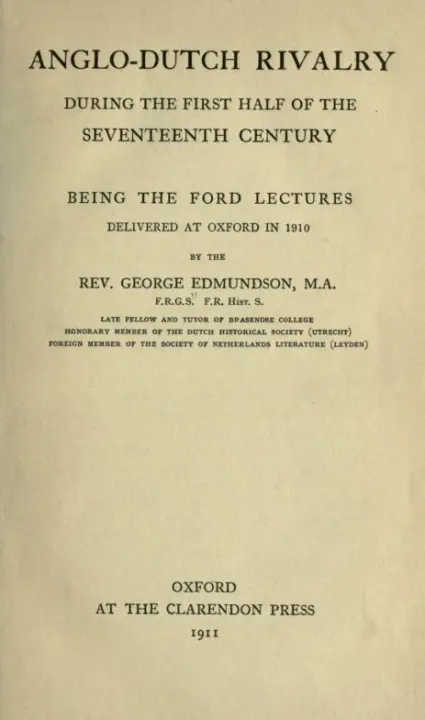
Anglo-Dutch Rivalry During the First Half of the Seventeenth Century being the Ford lectures delivered at Oxford in 1910
George Edmundson
THE CLASSIC COLLECTION · 1922
"History of Holland" by George Edmundson is a historical account likely written in the early 20th century. The book explores the significant events and transformations in the maritime province of Holland, particularly during its War of Independence and the subsequent historical developments of the Dutch state and people. It appears to provide a comprehensive overview of the socio-political landscape of Holland, reflecting on its feudal history and the enduring resilience of its people against various foreign dominations. At the start of "History of Holland," Edmundson outlines the context for the historical narrative, detailing the unique geographic characteristics of the region and their influence on the character of the Dutch people. He introduces key historical figures, including the Counts of Holland and the prominent role that the province played during the Burgundian period and beyond. The narrative establishes a foundation for understanding the complexities of Holland's governance, the emergence of factional conflicts like those between the Hooks and the Cods, and the impactful dynastic competitions that shaped its historical trajectory. The beginning not only sets the stage for a detailed exploration of Holland's history but also highlights the social and economic dynamics that contributed to its eventual independence and national identity.
Introduction adapted from the source catalogue; source summaries may be automatically generated.
Free to read · English · 179,579 words · No account needed
MAKE TIME FOR A GOOD BOOK
On by default. Untick to stop anonymous reading totals. Each page counts after 10 seconds in view. How this works.
Anonymous counting is on unless you have switched it off.
The citadel of Antwerp was, during this month of October, garrisoned by a body of mutinous Spanish troops under the command of Sancho d'Avila, the victor of Mook. Champagney, the governor, had with him a body of German mercenaries under a certain Count Oberstein; and at his request, such was the threatening attitude of the Spaniards, the States-General sent Havré with a reinforcement of Walloon troops. On Sunday, November 4, the garrison, which had been joined by other bands of mutineers, turned the guns of the citadel upon the town and sallying forth attacked the forces of Champagney. The Germans offered but a feeble resistance. Oberstein perished; Champagney and Havré took refuge on vessels in the river; and the Spaniards were masters of Antwerp. The scene of massacre, lust and wholesale pillage, which followed, left a memory behind it unique in its horror even among the excesses of this blood-stained time. The "Spanish Fury," as it was called, spelt the ruin of what, but a short time before, had been the wealthiest and most flourishing commercial city in the world.
The news of this disaster reached the States-General, as they were in the act of considering the draft proposals which had been submitted to them by the Ghent conference. At the same time tidings came that Don John, who had travelled through France in disguise, had arrived at Luxemburg. They quickly therefore came to a decision to ratify the pact, known as the Pacification of Ghent, and on November 8 it was signed. The Pacification was really a treaty between the Prince of Orange and the Estates of Holland and Zeeland on the one hand, and the States-General representing the other provinces. It was agreed that the Spanish troops should be compelled to leave the Netherlands and that the States-General of the whole seventeen provinces, as they were convened at the abdication of Charles V, should be called together to decide upon the question of religious toleration and other matters of national importance. Meanwhile the placards against heresy were suspended, and all the illegal measures and sentences of Alva declared null and void. His confiscated property was restored to Orange, and his position, as stadholder in Holland and Zeeland, acknowledged. Don John was informed that he would not be recognised as governor-general unless he would consent to dismiss the Spanish troops, accept the Pacification of Ghent, and swear to maintain the rights and privileges of the Provinces. Negotiations ensued, but for a long time to little purpose; and Don John, who was rather an impetuous knight-errant than a statesman and diplomatist, remained during the winter months at Namur, angry at his reception and chafing at the conditions imposed upon him, which he dared not accept without permission from the king. In December the States-General containing deputies from all the provinces met at Brussels, and in January the Pacification of Ghent was confirmed, and a new compact, to which the name of the Union of Brussels was given, was drawn up by a number of influential Catholics. This document, to which signatures were invited, was intended to give to the Pacification of Ghent the sanction of popular support and to be at the same time a guarantee for the maintenance of the royal authority and the Catholic religion. The Union of Brussels was generally approved throughout the southern provinces, and the signatories from every class were numbered by thousands. Don John, who was at Huy, saw that it was necessary to temporise. He was willing, he declared, to dismiss the foreign troops and send them out of the country and to maintain the ancient charters and liberties of the provinces, provided that nothing was done to subvert the king's authority or the Catholic faith. Finally, on February 12, a treaty called "The Perpetual Edict," a most inappropriate name, was signed, and the States-General acknowledged Don John as governor-general. The agreement was principally the work of Aerschot and the loyalist Catholic party, who followed his leadership, and was far from being entirely acceptable to Orange. He had no trust in the good faith of either Philip or his representative, and, though he recommended Holland and Zeeland to acquiesce in the treaty and acknowledge Don John as governor-general, it was with the secret resolve to keep a close watch upon his every action, and not to brook any attempt to interfere with religious liberty in the two provinces, in which he exercised almost sovereign power and with whose struggles for freedom he had identified himself.
Your reading position is saved on this browser. Take it to another device with a library code. Reading pages adapt to text, rather than matching a printed edition.
BEHIND THE BOOK
This eBook is for the use of anyone anywhere in the United States and most other parts of the world at no cost and with almost no restrictions whatsoever. You may copy it, give it away or re-use it under the terms of the Project Gutenberg License included with this eBook or online at www.gutenberg.org. If you are not located in the United States, you will have to check the laws of the country where you are located before using this eBook. Read the source licence.
The original source file, including credits and licence, is retained by this library. Request an original-format copy at no charge. Please include the book title and Project Gutenberg identifier #14971.
KEEP YOUR CURIOSITY GOING
Cécile Tormay

Moritz Busch
John L. Ransom
Frances Wright
Cécile Tormay

Mabel Potter Daggett