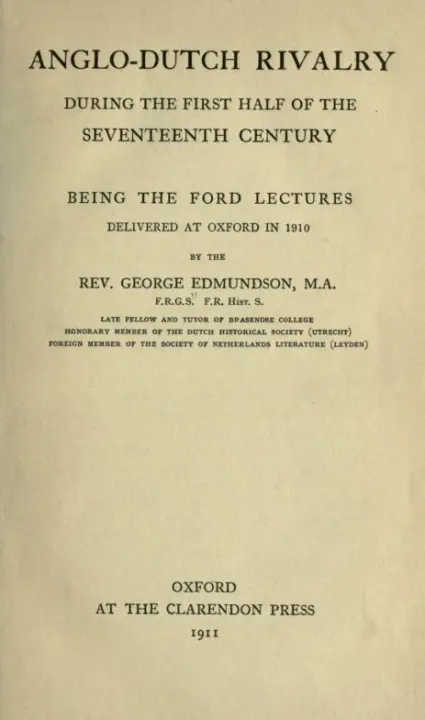
Anglo-Dutch Rivalry During the First Half of the Seventeenth Century being the Ford lectures delivered at Oxford in 1910
George Edmundson
THE CLASSIC COLLECTION · 1922
"History of Holland" by George Edmundson is a historical account likely written in the early 20th century. The book explores the significant events and transformations in the maritime province of Holland, particularly during its War of Independence and the subsequent historical developments of the Dutch state and people. It appears to provide a comprehensive overview of the socio-political landscape of Holland, reflecting on its feudal history and the enduring resilience of its people against various foreign dominations. At the start of "History of Holland," Edmundson outlines the context for the historical narrative, detailing the unique geographic characteristics of the region and their influence on the character of the Dutch people. He introduces key historical figures, including the Counts of Holland and the prominent role that the province played during the Burgundian period and beyond. The narrative establishes a foundation for understanding the complexities of Holland's governance, the emergence of factional conflicts like those between the Hooks and the Cods, and the impactful dynastic competitions that shaped its historical trajectory. The beginning not only sets the stage for a detailed exploration of Holland's history but also highlights the social and economic dynamics that contributed to its eventual independence and national identity.
Introduction adapted from the source catalogue; source summaries may be automatically generated.
Free to read · English · 179,579 words · No account needed
MAKE TIME FOR A GOOD BOOK
On by default. Untick to stop anonymous reading totals. Each page counts after 10 seconds in view. How this works.
Anonymous counting is on unless you have switched it off.
On the death of Requesens the Council of State had assumed temporary charge of the administration. There had for some time been growing dissatisfaction even amongst the loyalist Catholics of the southern provinces at the presence and over-bearing attitude of so many Spanish officials and Spanish troops in the land and at the severity of the religious persecution. Representations were made to the king by the Council of State of the general discontent throughout the country, of the deplorable results of the policy of force and repression, and urging the withdrawal of the troops, the mitigation of the edicts, and the appointment of a member of the royal house to the governorship. To these representations and requests no answer was sent for months in accordance with Philip's habitual dilatoriness in dealing with difficult affairs of State. He did, however, actually nominate in April his bastard brother, Don John of Austria, the famous victor of Lepanto, as Requesens' successor. But Don John, who was then in Italy, had other ambitions, and looked with suspicion upon Philip's motives in assigning him the thankless task of dealing with the troubles in the Low Countries. Instead of hurrying northwards, he first betook himself to Madrid where he met with a cold reception. Delay, however, so far from troubling Philip, was thoroughly in accordance with the whole bent of his character and policy. For six months Don John remained in Spain, and it was a half-year during which the situation in the Netherlands had been to a very large extent transformed.
The position of Orange and his followers in Holland and Zeeland in the spring of 1576 had again darkened. In June the surrender of Zierikzee to Mondragon was a heavy blow to the patriot cause, for it gave the Spaniards a firm footing in the very heart of the Zeeland archipelago and drove a wedge between South Holland and the island of Walcheren. This conquest was, however, destined to have important results of a very different character from what might have been expected. The town had surrendered on favourable terms and pillage was forbidden. Baulked of their expected booty, the Spanish troops, to whom large arrears of pay were due, mutinied. Under their own "eletto" they marched to Aalst, where they were joined by other mutineers, and soon a large force was collected together, who lived by plunder and were a terror to the country. The Council declared them to be outlaws, but the revolted soldiery defied its authority and scoffed at its threats. This was a moment which, as Orange was quick to perceive, was extremely favourable for a vigorous renewal of his efforts to draw together all the provinces to take common action in their resistance to Spanish tyranny. His agents and envoys in all parts of the Netherlands, but especially in Flanders and Brabant, urged his views upon the more influential members of the provincial estates and upon leading noblemen, like the Duke of Aerschot and other hitherto loyal supporters of the government, who were now suspected of wavering. His efforts met with a success which a few months earlier would have been deemed impossible. The conduct of the Spanish troops, and the lack of any central authority to protect the inhabitants against their insolence and depredations, had effected a great change in public opinion. In Brussels Baron de Héze (a god-child of the prince) had been appointed to the command of the troops in the pay of the Estates of Brabant. De Héze exerted himself to arouse popular opinion in the capital in favour of Orange and against the Spaniards. To such an extent was he successful that he ventured, Sept. 21, to arrest the whole of the Council of State with the exception of the Spanish member Roda, who fled to Antwerp. William now entered into direct negotiations with Aerschot and other prominent nobles of Flanders and Brabant. He took a further step by sending, at the request of the citizens of Ghent, a strong armed force to protect the town against the Spanish garrison in the citadel. In the absence of any lawful government, the States-General were summoned to meet at Brussels on September 22. Deputies from Brabant, Flanders and Hainault alone attended, but in the name of the States-General they nominated Aerschot, Viglius and Sasbout as Councillors of State, and appointed Aerschot to the command of the forces, with the Count of Lalaing as his lieutenant. They then, Sept. 27, approached the prince with proposals for forming a union of all the provinces. As a preliminary it was agreed that the conditions, which had been put forward by William as indispensable--namely, exclusion of all foreigners from administrative posts, dismissal of foreign troops, and religious toleration--should be accepted. The proposals were gladly received by William, and Ghent was chosen as the place where nine delegates from Holland and Zeeland should confer with nine delegates nominated by the States-General as representing the other provinces. They met on October 19. Difficulties arose on two points--the recognition to be accorded to Don John of Austria, and the principle of non-interference with religious beliefs. Orange himself had always been an advocate of toleration, but the representatives of Holland and Zeeland showed an obstinate disinclination to allow liberty of Catholic worship within their borders; and this attitude of theirs might, in spite of the prince's efforts, have led to a breaking-off of the negotiations, had not an event occurred which speedily led to a sinking of differences on the only possible basis, that of mutual concession and compromise.
Your reading position is saved on this browser. Take it to another device with a library code. Reading pages adapt to text, rather than matching a printed edition.
BEHIND THE BOOK
This eBook is for the use of anyone anywhere in the United States and most other parts of the world at no cost and with almost no restrictions whatsoever. You may copy it, give it away or re-use it under the terms of the Project Gutenberg License included with this eBook or online at www.gutenberg.org. If you are not located in the United States, you will have to check the laws of the country where you are located before using this eBook. Read the source licence.
The original source file, including credits and licence, is retained by this library. Request an original-format copy at no charge. Please include the book title and Project Gutenberg identifier #14971.
KEEP YOUR CURIOSITY GOING
Cécile Tormay

Moritz Busch
John L. Ransom
Frances Wright
Cécile Tormay

Mabel Potter Daggett