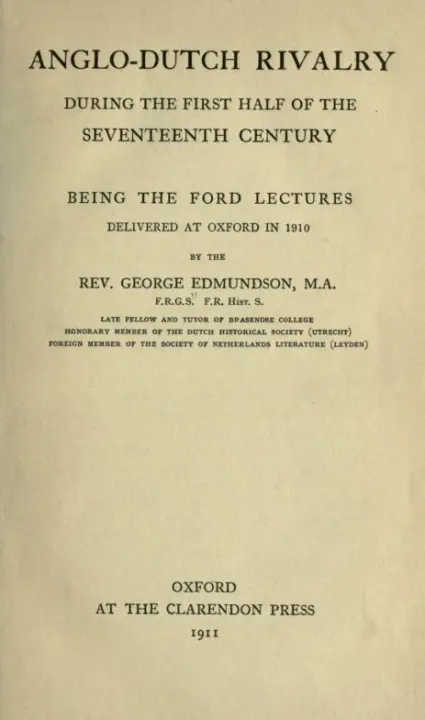
Anglo-Dutch Rivalry During the First Half of the Seventeenth Century being the Ford lectures delivered at Oxford in 1910
George Edmundson
THE CLASSIC COLLECTION · 1922
"History of Holland" by George Edmundson is a historical account likely written in the early 20th century. The book explores the significant events and transformations in the maritime province of Holland, particularly during its War of Independence and the subsequent historical developments of the Dutch state and people. It appears to provide a comprehensive overview of the socio-political landscape of Holland, reflecting on its feudal history and the enduring resilience of its people against various foreign dominations. At the start of "History of Holland," Edmundson outlines the context for the historical narrative, detailing the unique geographic characteristics of the region and their influence on the character of the Dutch people. He introduces key historical figures, including the Counts of Holland and the prominent role that the province played during the Burgundian period and beyond. The narrative establishes a foundation for understanding the complexities of Holland's governance, the emergence of factional conflicts like those between the Hooks and the Cods, and the impactful dynastic competitions that shaped its historical trajectory. The beginning not only sets the stage for a detailed exploration of Holland's history but also highlights the social and economic dynamics that contributed to its eventual independence and national identity.
Introduction adapted from the source catalogue; source summaries may be automatically generated.
Free to read · English · 179,579 words · No account needed
MAKE TIME FOR A GOOD BOOK
On by default. Untick to stop anonymous reading totals. Each page counts after 10 seconds in view. How this works.
Anonymous counting is on unless you have switched it off.
For a brief time Louis was doubtful as to what course of action would be most advantageous to French interests, but not for long. On November 11 he publicly announced to his court at Versailles that his grandson had accepted the Spanish crown. This step was followed by the placing of French garrisons in some of the frontier fortresses of the Belgic Netherlands by consent of the governor, the Elector of Bavaria. The following months were spent in the vain efforts of diplomacy to obtain such guarantees from the French king as would give security to the States and satisfaction to England and the emperor, and so avoid the outbreak of war. In the States Heinsius, who was working heart and soul with the stadholder in this crisis, had no difficulty in obtaining the full support of all parties, even in Holland, to the necessity of making every effort to be ready for hostilities. William had a more difficult task in England, but he had the support of the Whig majority in Parliament and of the commercial classes; and he laboured hard, despite constant and increasing ill-health, to bring once more into existence the Grand Alliance of 1689. In July negotiations were opened between the maritime powers and the emperor at the Hague, which after lengthy discussions were brought to a conclusion in September, in no small degree through the tact and persuasiveness of Lord Marlborough, the English envoy, who had now begun that career which was shortly to make his name so famous. The chief provisions of the treaty of alliance, signed on September 7, 1701, were that Austria was to have the Italian possessions of Spain; the Belgic provinces were to remain as a barrier and protection for Holland against French aggression; and England and the States were to retain any conquests they might make in the Spanish West Indies. Nothing was said about the crown of Spain, a silence which implied a kind of recognition of Philip V. To this league were joined Prussia, Hanover, Lüneburg, Hesse-Cassel, while France, to whom Spain was now allied, could count upon the help of Bavaria. War was not yet declared, but at this very moment Louis XIV took a step which was wantonly provocative. James II died at St Germain on September 6; and his son was at once acknowledged by Louis as King of England, by the title of James III. This action aroused a storm of indignation among the English people, and William found himself supported by public opinion in raising troops and obtaining supplies for war. The preparations were on a vast scale. The emperor undertook to place 90,000 men in the field; England, 40,000; the German states, 54,000; and the Republic no less than 100,000. William had succeeded at last in the object of his life; a mighty confederation had been called into being to maintain the balance of power in Europe, and overthrow the threatened French domination. This confederation in arms, of which he was the soul and the acknowledged head, was destined to accomplish the object for which it was formed, but not under his leadership. The king had spent the autumn in Holland in close consultation with Heinsius, visiting the camps, the arsenals and the dockyards, and giving instructions to the admirals and generals to have everything in readiness for the campaign of the following spring. Then in November he went to England to hurry on the preparations, which were in a more backward condition than in the States. But he had overtaxed his strength. Always frail and ailing, William had for years by sheer force of will-power conquered his bodily weakness and endured the fatigue of campaigns in which he was content to share all hardships with his soldiers. In his double capacity, too, of king and stadholder, the cares of government and the conduct of foreign affairs had left him no rest. Especially had this been the case in England during the years which had followed Queen Mary's death, when he found himself opposed and thwarted and humiliated by party intrigues and cabals, to such an extent that he more than once thought of abdicating. He was feeling very ill and tired when he returned, and he grew weaker, for the winter in England always tried him. His medical advisers warned him that his case was one for which medicine was of no avail, and that he was not fit to bear the strain of the work he was doing. But the indomitable spirit of the man would not give way, and he still hoped with the spring to be able to put himself at the head of his army. It was not to be; an accident was the immediate cause by which the end came quickly. He was riding in Bushey Park when his horse stumbled over a mole-hill and the king was thrown, breaking his collar-bone (March 14,1702). The shock proved fatal in his enfeebled state; and, after lingering for four days, during which, in full possession of his mental faculties, he continued to discuss affairs of state, he calmly took leave of his special friends, Bentinck, Earl of Portland and Keppel, Earl of Albemarle, and of the English statesmen who stood round his death-bed, and, after thanking them for their services, passed away. For four generations the House of Orange had produced great leaders of men, but it may be said without disparagement to his famous predecessors that the last heir-male of that House was the greatest of them all. He saved the Dutch Republic from destruction; and during the thirty years of what has well been called his reign he gave to it a weighty place in the Councils of Europe and raised it to a height of great material prosperity. But even such services as these were dwarfed by the part that he played in laying the foundation of constitutional monarchy in England, and of the balance of power in Europe. It is difficult to say whether Holland, England or Europe owed the deepest debt to the life-work of William III.
Your reading position is saved on this browser. Take it to another device with a library code. Reading pages adapt to text, rather than matching a printed edition.
BEHIND THE BOOK
This eBook is for the use of anyone anywhere in the United States and most other parts of the world at no cost and with almost no restrictions whatsoever. You may copy it, give it away or re-use it under the terms of the Project Gutenberg License included with this eBook or online at www.gutenberg.org. If you are not located in the United States, you will have to check the laws of the country where you are located before using this eBook. Read the source licence.
The original source file, including credits and licence, is retained by this library. Request an original-format copy at no charge. Please include the book title and Project Gutenberg identifier #14971.
KEEP YOUR CURIOSITY GOING
Cécile Tormay

Moritz Busch
John L. Ransom
Frances Wright
Cécile Tormay

Mabel Potter Daggett