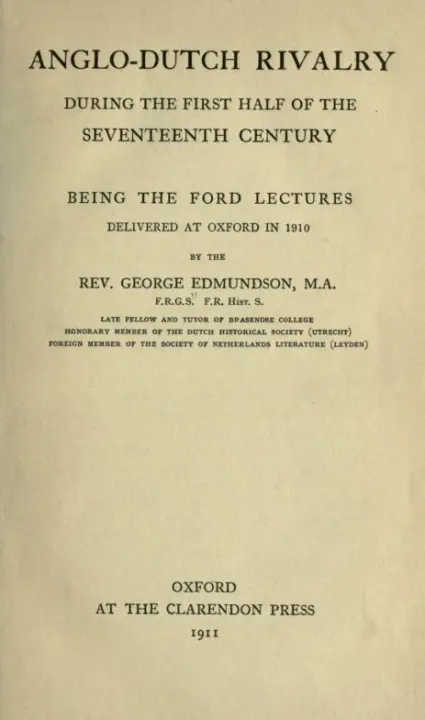
Anglo-Dutch Rivalry During the First Half of the Seventeenth Century being the Ford lectures delivered at Oxford in 1910
George Edmundson
THE CLASSIC COLLECTION · 1922
"History of Holland" by George Edmundson is a historical account likely written in the early 20th century. The book explores the significant events and transformations in the maritime province of Holland, particularly during its War of Independence and the subsequent historical developments of the Dutch state and people. It appears to provide a comprehensive overview of the socio-political landscape of Holland, reflecting on its feudal history and the enduring resilience of its people against various foreign dominations. At the start of "History of Holland," Edmundson outlines the context for the historical narrative, detailing the unique geographic characteristics of the region and their influence on the character of the Dutch people. He introduces key historical figures, including the Counts of Holland and the prominent role that the province played during the Burgundian period and beyond. The narrative establishes a foundation for understanding the complexities of Holland's governance, the emergence of factional conflicts like those between the Hooks and the Cods, and the impactful dynastic competitions that shaped its historical trajectory. The beginning not only sets the stage for a detailed exploration of Holland's history but also highlights the social and economic dynamics that contributed to its eventual independence and national identity.
Introduction adapted from the source catalogue; source summaries may be automatically generated.
Free to read · English · 179,579 words · No account needed
MAKE TIME FOR A GOOD BOOK
On by default. Untick to stop anonymous reading totals. Each page counts after 10 seconds in view. How this works.
Anonymous counting is on unless you have switched it off.
It was well understood, however, by all the parties that the peace of Ryswyck was a truce during which the struggle concerning the Spanish Succession would be transferred from the field of battle to the field of diplomacy, in the hope that some solution might be found. The question was clearly of supreme importance to the States, for it involved the destiny of the Spanish Netherlands. England, too, had great interests at stake, and was determined to prevent the annexation of the Belgic provinces by France. With Charles II the male line of the Spanish Habsburgs became extinct; and there were three principal claimants in the female line of succession. The claim of the Dauphin was much the strongest, for he was the grandson of Anne of Austria, Philip III's eldest daughter, and the son of Maria Theresa of Austria, Charles II's eldest sister. But both these queens of France had on their marriage solemnly renounced their rights of succession. Louis XIV, however, asserted that his wife's renunciation was invalid, since the dowry, the payment of which was guaranteed by the marriage contract, had never been received. The younger sister of Maria Theresa had been married to the emperor; and two sons and a daughter had been the fruit of the union. This daughter in her turn had wedded the Elector of Bavaria, and had issue one boy of ten years. The Elector himself, Maximilian Emmanuel, had been for five years Governor of the Spanish Netherlands, where his rule had been exceedingly popular. William knew that one of the chief objects of the French king in concluding peace was to break up the Grand Alliance and so prepare the way for a masterful assertion of his rights as soon as the Spanish throne was vacant; and with patient diplomatic skill he set to work at once to arrange for such a partition of the Spanish monarchy among the claimants as should prevent the Belgic provinces from falling into the hands of a first-class power and preserve Spain itself with its overseas possessions from the rule of a Bourbon prince. He had no difficulty in persuading the States to increase their fleet and army in case diplomacy should fail, for the Dutch were only too well aware of the seriousness of the French menace to their independence. In England, where jealousy of a standing army had always been strong, he was less successful, and Parliament insisted on the disbanding of many thousands of seasoned troops. The object at which William aimed was a partition treaty; and a partition was actually arranged (October 11, 1698). This arrangement, according to the ideas of the time, paid no respect whatever to the wishes of the peoples, who were treated as mere pawns by these unscrupulous diplomatists. The Spanish people, as might be expected, were vehemently opposed to any partition of the empire of Charles V and Philip II; and, in consequence of the influences that were brought to bear upon him, Charles II left by will the young electoral prince, Joseph Ferdinand, heir to his whole inheritance. By the secret terms of the partition treaty the crown of Spain together with the Netherlands and the American colonies had been assigned to the Bavarian claimant, but the Spanish dominions in Italy were divided between the two other claimants, the second son of the Dauphin, Philip, Duke of Anjou, receiving Naples and Sicily; the second son of the emperor, the Archduke Charles, the Milanese. Unfortunately, Joseph Ferdinand fell sick of the small-pox and died (March, 1699). With William and Heinsius the main point now was to prevent the French prince from occupying the Spanish throne; and in all secrecy negotiations were again opened at the Hague for a second partition treaty. They found Louis XIV still willing to conclude a bargain. To the Duke of Anjou was now assigned, in addition to Naples and Sicily, the duchy of Lorraine (whose duke was to receive the Milanese in exchange); the rest of the Spanish possessions were to fall to the Archduke Charles (March, 1700). The terms of this arrangement between the French king and the maritime powers did not long remain a secret; and when they were known they displeased the emperor, who did not wish to see French influence predominant in Italy and his own excluded, and still more the Spanish people, who objected to any partition and to the Austrian ruler. The palace of Charles II became a very hot-bed of intrigues, and finally the dying king was persuaded to make a fresh will and nominate Anjou as his universal heir. Accordingly on Charles' death (November 1, 1700) Philip V was proclaimed king.
Your reading position is saved on this browser. Take it to another device with a library code. Reading pages adapt to text, rather than matching a printed edition.
BEHIND THE BOOK
This eBook is for the use of anyone anywhere in the United States and most other parts of the world at no cost and with almost no restrictions whatsoever. You may copy it, give it away or re-use it under the terms of the Project Gutenberg License included with this eBook or online at www.gutenberg.org. If you are not located in the United States, you will have to check the laws of the country where you are located before using this eBook. Read the source licence.
The original source file, including credits and licence, is retained by this library. Request an original-format copy at no charge. Please include the book title and Project Gutenberg identifier #14971.
KEEP YOUR CURIOSITY GOING
Cécile Tormay

Moritz Busch
John L. Ransom
Frances Wright
Cécile Tormay

Mabel Potter Daggett