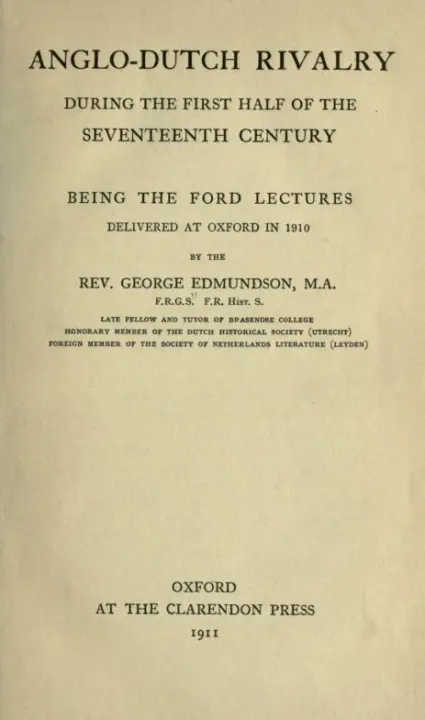
Anglo-Dutch Rivalry During the First Half of the Seventeenth Century being the Ford lectures delivered at Oxford in 1910
George Edmundson
THE CLASSIC COLLECTION · 1922
"History of Holland" by George Edmundson is a historical account likely written in the early 20th century. The book explores the significant events and transformations in the maritime province of Holland, particularly during its War of Independence and the subsequent historical developments of the Dutch state and people. It appears to provide a comprehensive overview of the socio-political landscape of Holland, reflecting on its feudal history and the enduring resilience of its people against various foreign dominations. At the start of "History of Holland," Edmundson outlines the context for the historical narrative, detailing the unique geographic characteristics of the region and their influence on the character of the Dutch people. He introduces key historical figures, including the Counts of Holland and the prominent role that the province played during the Burgundian period and beyond. The narrative establishes a foundation for understanding the complexities of Holland's governance, the emergence of factional conflicts like those between the Hooks and the Cods, and the impactful dynastic competitions that shaped its historical trajectory. The beginning not only sets the stage for a detailed exploration of Holland's history but also highlights the social and economic dynamics that contributed to its eventual independence and national identity.
Introduction adapted from the source catalogue; source summaries may be automatically generated.
Free to read · English · 179,579 words · No account needed
MAKE TIME FOR A GOOD BOOK
On by default. Untick to stop anonymous reading totals. Each page counts after 10 seconds in view. How this works.
Anonymous counting is on unless you have switched it off.
In England the attempt of James II to bring about a Catholic reaction by the arbitrary use of the royal prerogative was rapidly alienating the loyalty of all classes, including many men of high position, and even some of his own ministers. William watched keenly all that was going on and kept himself in close correspondence with several of the principal malcontents. He was well aware that all eyes were turning to him (and he accepted the position) as the natural defender, should the need arise, of England's civil and religious liberties. The need arose and the call came in the summer of 1688, and it found William prepared. The climax of the conflict between King James and his people was reached with the acquittal of the Seven Bishops in May, 1688, amidst public rejoicings, speedily followed on June 10 by the birth of a Prince of Wales. The report was spread that the child was supposititious and it was accepted as true by large numbers of persons, including the Princess Anne, and also, on the strength of her testimony, by the Prince and Princess of Orange.
The secret relations of William with the leaders of opposition had for some time been carried on through his trusted confidants, Dijkveld, the State's envoy at the English Court, and William of Nassau, lord of Zuilestein. A bold step was now taken. Several Englishmen of note signed an invitation to the prince to land in England with an armed force in defence of the religion and liberties of the country; and it was brought to him by Admiral Russell, one of the signatories. After some hesitation William, with the consent and approval of the princess, decided to accept it. No man ever had a more loyal and devoted wife than William III of Orange, and he did not deserve it. For some years after his marriage he treated Mary with coldness and neglect. He confessed on one occasion to Bishop Burnet that his churlishness was partly due to jealousy; he could not bear the thought that Mary might succeed to the English throne and he would in that country be inferior in rank to his wife. The bishop informed the princess, who at once warmly declared that she would never accept the crown unless her husband received not merely the title of king, but the prerogatives of a reigning sovereign. From that time forward a complete reconciliation took place between them, and the affection and respect of William for this loyal, warm-hearted and self-sacrificing woman deepened as the years went on. Mary's character, as it is revealed in her private diaries, which have been preserved, deserves those epithets. Profoundly religious and a convinced Protestant, Mary with prayers for guidance and not without many tears felt that the resolve of her husband to hazard all on armed intervention in England was fully justified; and at this critical juncture she had no hesitation in allowing her sense of duty to her husband and her country to override that of a daughter to her father. Already in July vigorous preparations in all secrecy began to be made for the expedition. The naval yards were working at full pressure with the ostensible object of sending out a fleet to suppress piracy in the Mediterranean. The stadholder felt that he was able to rely upon the willing co-operation of the States in his project. His difficulty now, as always, was to secure the assent of Amsterdam. But the opposition of that city proved less formidable than was anticipated. The peril to Protestantism should England under James II be leagued with France, was evident, and scarcely less the security of the commerce on which Amsterdam depended for its prosperity. The support of Amsterdam secured that of the Estates of Holland; and finally, after thus surmounting successfully the elements of opposition in the town and the province, where the anti-Orange party was most strongly represented, the prince had little difficulty in obtaining, on October 8, the unanimous approval of the States-General, assembled in secret session, to the proposed expedition. By that time an army of 14,000 men had been gathered together and was encamped at Mook. Of these the six English and Scottish regiments, who now, as throughout the War of Independence, were maintained in the Dutch service, formed the nucleus. The force also comprised the prince's Dutch guards and other picked Dutch troops, and also some German levies. Marshal Schomberg was in command. The pretext assigned was the necessity of protecting the eastern frontier of the Republic against an attack from Cologne, where Cardinal Fürstenberg, the nominee and ally of Louis XIV, had been elected to the archiepiscopal throne.
Your reading position is saved on this browser. Take it to another device with a library code. Reading pages adapt to text, rather than matching a printed edition.
BEHIND THE BOOK
This eBook is for the use of anyone anywhere in the United States and most other parts of the world at no cost and with almost no restrictions whatsoever. You may copy it, give it away or re-use it under the terms of the Project Gutenberg License included with this eBook or online at www.gutenberg.org. If you are not located in the United States, you will have to check the laws of the country where you are located before using this eBook. Read the source licence.
The original source file, including credits and licence, is retained by this library. Request an original-format copy at no charge. Please include the book title and Project Gutenberg identifier #14971.
KEEP YOUR CURIOSITY GOING
Cécile Tormay

Moritz Busch
John L. Ransom
Frances Wright
Cécile Tormay

Mabel Potter Daggett