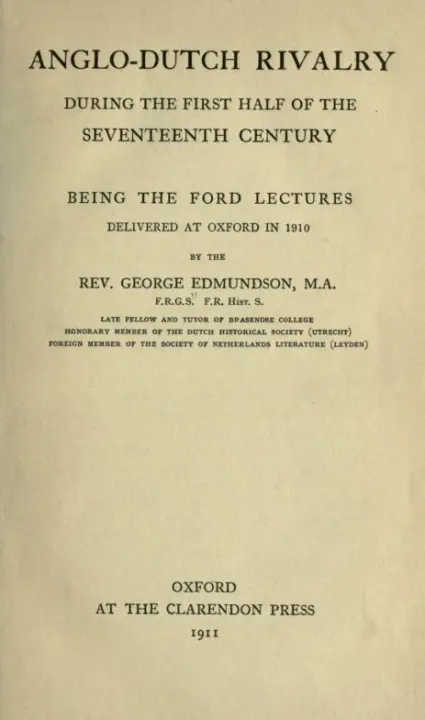
Anglo-Dutch Rivalry During the First Half of the Seventeenth Century being the Ford lectures delivered at Oxford in 1910
George Edmundson
THE CLASSIC COLLECTION · 1922
"History of Holland" by George Edmundson is a historical account likely written in the early 20th century. The book explores the significant events and transformations in the maritime province of Holland, particularly during its War of Independence and the subsequent historical developments of the Dutch state and people. It appears to provide a comprehensive overview of the socio-political landscape of Holland, reflecting on its feudal history and the enduring resilience of its people against various foreign dominations. At the start of "History of Holland," Edmundson outlines the context for the historical narrative, detailing the unique geographic characteristics of the region and their influence on the character of the Dutch people. He introduces key historical figures, including the Counts of Holland and the prominent role that the province played during the Burgundian period and beyond. The narrative establishes a foundation for understanding the complexities of Holland's governance, the emergence of factional conflicts like those between the Hooks and the Cods, and the impactful dynastic competitions that shaped its historical trajectory. The beginning not only sets the stage for a detailed exploration of Holland's history but also highlights the social and economic dynamics that contributed to its eventual independence and national identity.
Introduction adapted from the source catalogue; source summaries may be automatically generated.
Free to read · English · 179,579 words · No account needed
MAKE TIME FOR A GOOD BOOK
On by default. Untick to stop anonymous reading totals. Each page counts after 10 seconds in view. How this works.
Anonymous counting is on unless you have switched it off.
No more conclusive proof of the inflexible resolve of William III can be found than the patience he now exhibited. His faith in himself was never shaken, and his patience in awaiting the favourable moment was inexhaustible. To him far more appropriately than to his great-grandfather might the name of William the Silent have been given. He had no confidants, except Waldeck and William Bentinck; and few could even guess at the hidden workings of that scheming mind or at the burning fires of energy and will-power beneath the proud and frigid reserve of a man so frail in body and always ailing. Very rarely could a born leader of men have been more unamiable or less anxious to win popular applause, but his whole demeanour inspired confidence and, ignoring the many difficulties and oppositions which thwarted him, he steadfastly bided his time and opportunity. It now came quickly, for the year 1685 was marked by two events--the accession of James II to the throne of England, and the Revocation of the Edict of Nantes--which were to have far-reaching consequences.
The new King of England was not merely a strong but a bigoted Roman Catholic. Had he been a wise and patriotic prince, he would have tried by a studiously moderate policy to win the loyal allegiance of his subjects, but he was stubborn, wrong-headed and fanatical, and from the first he aimed at the impossible. His attempts to establish absolute rule, to bring back the English nation to the fold of the Catholic Church and, as a means to that end, to make himself independent of Parliament by accepting subsidies from the French king, were bound to end in catastrophe. This was more especially the case as Louis XIV had, at the very time of King James' accession, after having for a number of years persecuted the Huguenots in defiance of the Edict of Nantes, taken the step of revoking that great instrument of religious toleration on November 17, 1685. The exile of numerous families, who had already been driven out by the dragonnades, was now followed by the expulsion of the entire Huguenot body, of all at least who refused to conform to the Catholic faith. How many hundreds of thousands left their homes to find refuge in foreign lands it is impossible to say, but amongst them were great numbers of industrious and skilled artisans and handicraftsmen, who sought asylum in the Dutch Republic and there found a ready and sympathetic welcome. The arrival of these unhappy immigrants had the effect of arousing a strong feeling of indignation in Holland, and indeed throughout the provinces, against the government of Louis XIV. They began to see that the policy of the French king was not merely one of territorial aggression, but was a crusade against Protestantism. The governing classes in Holland, Zeeland, Friesland and Groningen were stirred up by the preachers to enforce more strictly the laws against the Catholics in those provinces, for genuine alarm was felt at the French menace to the religion for which their fathers had fought and suffered. The cause of Protestantism was one with which the Princes of Orange had identified themselves; but none of his ancestors was so keen an upholder of that cause as was William III. The presence in their midst of the Huguenot refugees had the effect of influencing public opinion powerfully in the States in favour of their stadholder's warlike policy. Nor was the Dutch Republic the only State which was deeply moved by the ruthless treatment of his Protestant subjects by the French king. The Elector of Brandenburg, as head of the principal Protestant State in Germany, had also offered an asylum to the French exiles and now reverted once more to his natural alliance with the United Provinces. He sent his trusted councillor, Paul Fuchs, in May, 1685, to offer to his nephew, the Prince of Orange, his friendly co-operation in the formation of a powerful coalition against France. Fuchs was a skilled diplomatist, and by his mediation an understanding was arrived at between the stadholder and his opponents in Amsterdam. At the same time strong family influence was brought to bear upon Henry Casimir of Friesland, and a reconciliation between the two stadholders was effected. William thus found himself, before the year 1685 came to an end, able to pursue his policy without serious let or hindrance. He was quite ready to seize his opportunity, and by tactful diplomacy he succeeded by August, 1686, in forming an alliance between the United Provinces, Brandenburg, Sweden, Austria, Spain and a number of the smaller Rhenish states, to uphold the treaties of Westphalia and Nijmwegen against the encroachments of French military aggression. But the design of William was still incomplete. The naval power and financial resources of England were needed to enable the coalition to grapple successfully with the mighty centralised power of Louis XIV.
Your reading position is saved on this browser. Take it to another device with a library code. Reading pages adapt to text, rather than matching a printed edition.
BEHIND THE BOOK
This eBook is for the use of anyone anywhere in the United States and most other parts of the world at no cost and with almost no restrictions whatsoever. You may copy it, give it away or re-use it under the terms of the Project Gutenberg License included with this eBook or online at www.gutenberg.org. If you are not located in the United States, you will have to check the laws of the country where you are located before using this eBook. Read the source licence.
The original source file, including credits and licence, is retained by this library. Request an original-format copy at no charge. Please include the book title and Project Gutenberg identifier #14971.
KEEP YOUR CURIOSITY GOING
Cécile Tormay

Moritz Busch
John L. Ransom
Frances Wright
Cécile Tormay

Mabel Potter Daggett