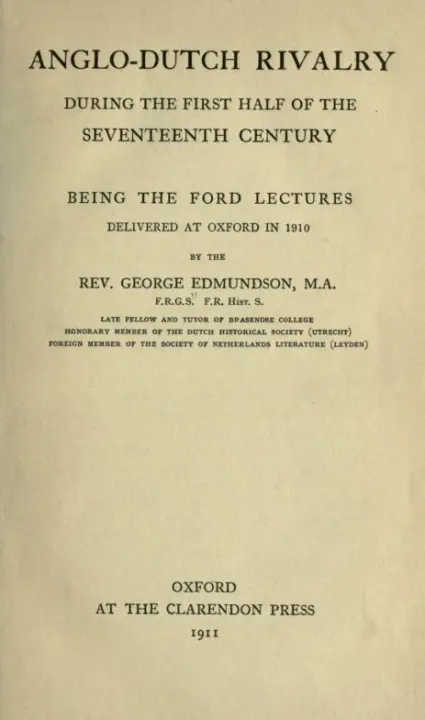
Anglo-Dutch Rivalry During the First Half of the Seventeenth Century being the Ford lectures delivered at Oxford in 1910
George Edmundson
THE CLASSIC COLLECTION · 1922
"History of Holland" by George Edmundson is a historical account likely written in the early 20th century. The book explores the significant events and transformations in the maritime province of Holland, particularly during its War of Independence and the subsequent historical developments of the Dutch state and people. It appears to provide a comprehensive overview of the socio-political landscape of Holland, reflecting on its feudal history and the enduring resilience of its people against various foreign dominations. At the start of "History of Holland," Edmundson outlines the context for the historical narrative, detailing the unique geographic characteristics of the region and their influence on the character of the Dutch people. He introduces key historical figures, including the Counts of Holland and the prominent role that the province played during the Burgundian period and beyond. The narrative establishes a foundation for understanding the complexities of Holland's governance, the emergence of factional conflicts like those between the Hooks and the Cods, and the impactful dynastic competitions that shaped its historical trajectory. The beginning not only sets the stage for a detailed exploration of Holland's history but also highlights the social and economic dynamics that contributed to its eventual independence and national identity.
Introduction adapted from the source catalogue; source summaries may be automatically generated.
Free to read · English · 179,579 words · No account needed
MAKE TIME FOR A GOOD BOOK
On by default. Untick to stop anonymous reading totals. Each page counts after 10 seconds in view. How this works.
Anonymous counting is on unless you have switched it off.
Charles, who had a few months previously reached the zenith of his power by being crowned with the iron crown of Lombardy and with the imperial crown at the hands of Pope Clement VII at Bologna (February 22 and 24, 1530), appointed as governess in Margaret's place his sister Mary, the widowed queen of Louis, King of Hungary, who had been slain by the Turks at the battle of Mohacs, August 29, 1526.
Mary, who had passed her early life in the Netherlands under the care of her aunt Margaret, proved herself in every way her worthy successor. She possessed, like Margaret, a strong character, statesmanlike qualities and singular capacity in the administration of affairs. She filled the difficult post of regent for the whole period of twenty-four years between the death of Margaret and the abdication of Charles V in 1555. It was fortunate indeed for that great sovereign that these two eminent women of his house should, each in turn for one half of his long reign, have so admirably conducted the government of this important portion of his dominions, as to leave him free for the carrying out of his far-reaching political projects and constant military campaigns in other lands. Two years after Mary entered upon her regency Charles appointed three advisory and administrative bodies--the Council of State, the Council of Finance and the Privy Council--to assist her in the government. The Council of State dealt with questions of external and internal policy and with the appointment of officials; the Council of Finance with the care of the revenue and private domains of the sovereign; to the Privy Council were entrusted the publication of edicts and "placards," and the care of justice and police.
When Charles succeeded Philip the Fair only a portion of the Netherlands was subject to his sway. With steady persistence he set himself to the task of bringing all the seventeen provinces under one sovereign. In 1515 George of Saxe-Meissen sold to him his rights over Friesland. Henry of Bavaria, who in opposition to his wishes had been elected Bishop of Utrecht, was compelled (1528) to cede to him the temporalities of the see, retaining the spiritual office only. Charles thus added the Upper and Lower Sticht--Utrecht and Overyssel--to his dominions. He made himself (1536) master of Groningen and Drente after a long and obstinate struggle with Charles of Gelderland, and seven years later he forced Charles' successor, William of Jülich and Cleves, to renounce in his favour his claims to Gelderland and Zutphen. During the reign of Charles V the States-General were summoned many times, chiefly for the purpose of voting subsidies, but it was only on special and solemn occasions, that the representatives of all the seventeen provinces were present, as for instance when Philip received their homage in 1549 and when Charles V announced his abdication in 1555. The names of the seventeen provinces summoned on these occasions were Brabant, Limburg, Luxemburg, Gelderland, Flanders, Holland, Zeeland, Artois, Hainault, Namur, Lille with Douay and Orchies, Tournay and district, Mechlin, Friesland, Utrecht, Overyssel with Drente and Groningen. The bishopric of Liège, though nominally independent, was under the strict control of the government at Brussels. The relations of Charles' Burgundian domains to the empire were a matter of no small moment, and he was able to regulate them in a manner satisfactory to himself. Several times during his reign tentative attempts were made to define those relations, which were of a very loose kind. The fact that the head of the house of Habsburg was himself emperor had not made him any less determined than the Burgundian sovereigns, his ancestors, to assert for his Netherland territories a virtual independence of imperial control or obligation. The various states of which the Netherlands were composed were as much opposed as the central government at Brussels to any recognition of the claims of the empire; and both Margaret of Austria and Mary of Hungary ventured to refuse to send representatives to the imperial diets, even when requested to do so by the emperor. At last in 1548, when all the Netherland provinces had been brought under the direct dominion or control of one sovereign prince, a convention was drawn up at the diet of Augsburg, chiefly by the exertions of the Regent Mary and her tried councillors Viglius and Granvelle, by which the unity of the Netherland territories was recognised and they were freed from imperial jurisdiction. Nominally, they formed a circle of the empire,--the Burgundian circle--and representatives of the circle were supposed to appear at the diets and to bear a certain share of imperial taxation in return for the right to the protection of the empire against attacks by France. As a matter of fact, no representatives were ever sent and no subsidy was paid, nor was the protection of the empire ever sought or given.
Your reading position is saved on this browser. Take it to another device with a library code. Reading pages adapt to text, rather than matching a printed edition.
BEHIND THE BOOK
This eBook is for the use of anyone anywhere in the United States and most other parts of the world at no cost and with almost no restrictions whatsoever. You may copy it, give it away or re-use it under the terms of the Project Gutenberg License included with this eBook or online at www.gutenberg.org. If you are not located in the United States, you will have to check the laws of the country where you are located before using this eBook. Read the source licence.
The original source file, including credits and licence, is retained by this library. Request an original-format copy at no charge. Please include the book title and Project Gutenberg identifier #14971.
KEEP YOUR CURIOSITY GOING
Cécile Tormay

Moritz Busch
John L. Ransom
Frances Wright
Cécile Tormay

Mabel Potter Daggett