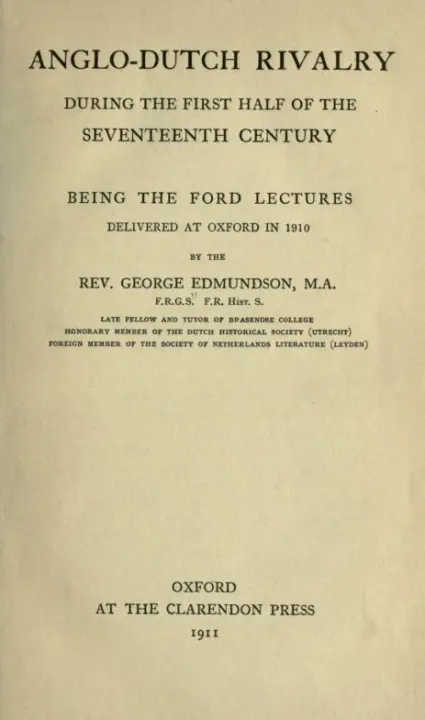
Anglo-Dutch Rivalry During the First Half of the Seventeenth Century being the Ford lectures delivered at Oxford in 1910
George Edmundson
THE CLASSIC COLLECTION · 1922
"History of Holland" by George Edmundson is a historical account likely written in the early 20th century. The book explores the significant events and transformations in the maritime province of Holland, particularly during its War of Independence and the subsequent historical developments of the Dutch state and people. It appears to provide a comprehensive overview of the socio-political landscape of Holland, reflecting on its feudal history and the enduring resilience of its people against various foreign dominations. At the start of "History of Holland," Edmundson outlines the context for the historical narrative, detailing the unique geographic characteristics of the region and their influence on the character of the Dutch people. He introduces key historical figures, including the Counts of Holland and the prominent role that the province played during the Burgundian period and beyond. The narrative establishes a foundation for understanding the complexities of Holland's governance, the emergence of factional conflicts like those between the Hooks and the Cods, and the impactful dynastic competitions that shaped its historical trajectory. The beginning not only sets the stage for a detailed exploration of Holland's history but also highlights the social and economic dynamics that contributed to its eventual independence and national identity.
Introduction adapted from the source catalogue; source summaries may be automatically generated.
Free to read · English · 179,579 words · No account needed
MAKE TIME FOR A GOOD BOOK
On by default. Untick to stop anonymous reading totals. Each page counts after 10 seconds in view. How this works.
Anonymous counting is on unless you have switched it off.
The extant correspondence between Maximilian and Margaret, which is of the most confidential character, on matters of high policy, is a proof of the high opinion the emperor entertained of his daughter's intelligence and capacity. In nothing was his confidence more justified than in the assiduous care and interest that the regent took in the education of the Archduke Charles and his three sisters, who had been placed in her charge. In 1515 Charles, on entering his sixteenth year, was declared by Maximilian to be of age; Margaret accordingly handed over to him the reins of government and withdrew for the time into private life. Her retirement was not, however, to be of long continuance. On January 23, 1516, King Ferdinand of Aragon died, and Charles, who now became King of Castile and of Aragon, was obliged to leave the Netherlands to take possession of his Spanish dominions. Before sailing he reinstated his aunt as governess, and appointed a council to assist her. This post she continued to hold till the day of her death, for Charles was never again able to take up his permanent residence in the Netherlands. During the first years after his accession to the thrones of Ferdinand and Isabel he was much occupied with Spanish affairs; and the death of Maximilian, January 12, 1519, opened out to him a still wider field of ambition and activity. On June 28 Charles was elected emperor, a result which he owed in no small degree to the diplomatic skill and activity of Margaret. Just a year later the emperor visited the Netherlands, where Charles of Gelderland was again giving trouble, and his presence was required both for the purpose of dealing with the affairs of the provinces and also for securing a grant of supply, for he was sorely in need of funds. Margaret had at his request summoned the States-General to meet at Brussels, where Charles personally addressed them, and explained at some length the reasons which led him to ask his loyal and devoted Netherland subjects for their aid on his election to the imperial dignity. The States-General on this, as on other occasions, showed no niggardliness in responding to the request of a sovereign who, though almost always absent, appealed to their patriotism as a born Netherlander, who had been brought up in their midst and spoke their tongue. Charles was crowned at Aachen, October 23, 1520, and some three months later presided at the famous diet of Worms, where he met Martin Luther face to face. Before starting on his momentous journey he again appointed Margaret regent, and gave to her Council, which he nominated, large powers; the Council of Mechlin, the Court of Holland and other provincial tribunals being subjected to its superior authority and jurisdiction. By this action the privileges of the provinces were infringed, but Charles was resolute in carrying out the centralising policy of his ancestors, the Dukes of Burgundy, and he had the power to enforce his will in spite of the protests that were raised. And so under the wise and conciliatory but firm administration of Margaret during a decade of almost continuous religious and international strife--a decade marked by such great events as the rapid growth of the Reformation in Germany, the defeat and capture of Francis I at Pavia, the sack of Rome by the troops of Bourbon and the victorious advance of the Turks in Hungary and along the eastern frontier of the empire--the Netherland provinces remained at peace, save for the restless intrigues of Charles of Egmont in Gelderland, and prospered. Their wealth furnished indeed no small portion of the funds which enabled Charles to face successfully so many adversaries and to humble the power of France. The last important act of Margaret, like her first, was connected with the town of Cambray. In this town, as the representative and plenipotentiary of her nephew the emperor, she met, July, 1529, Louise of Savoy, who had been granted similar powers by her son Francis I, to negotiate a treaty of peace. The two princesses proved worthy of the trust that had been placed in them, and a general treaty of peace, often spoken of as "the Ladies' Peace," was speedily drawn up and ratified. The conditions were highly advantageous to the interests of Spain and the Netherlands. On November 30 of the following year Margaret died, as the result of a slight accident to her foot which the medical science of the day did not know how to treat properly, in the 50th year of her age and the 24th of her regency.
Your reading position is saved on this browser. Take it to another device with a library code. Reading pages adapt to text, rather than matching a printed edition.
BEHIND THE BOOK
This eBook is for the use of anyone anywhere in the United States and most other parts of the world at no cost and with almost no restrictions whatsoever. You may copy it, give it away or re-use it under the terms of the Project Gutenberg License included with this eBook or online at www.gutenberg.org. If you are not located in the United States, you will have to check the laws of the country where you are located before using this eBook. Read the source licence.
The original source file, including credits and licence, is retained by this library. Request an original-format copy at no charge. Please include the book title and Project Gutenberg identifier #14971.
KEEP YOUR CURIOSITY GOING
Cécile Tormay

Moritz Busch
John L. Ransom
Frances Wright
Cécile Tormay

Mabel Potter Daggett