THE CLASSIC COLLECTION✦An outlaw’s diary: the CommuneCLASSIC FREE BOOKS
An outlaw’s diary: the Commune
Cécile Tormay
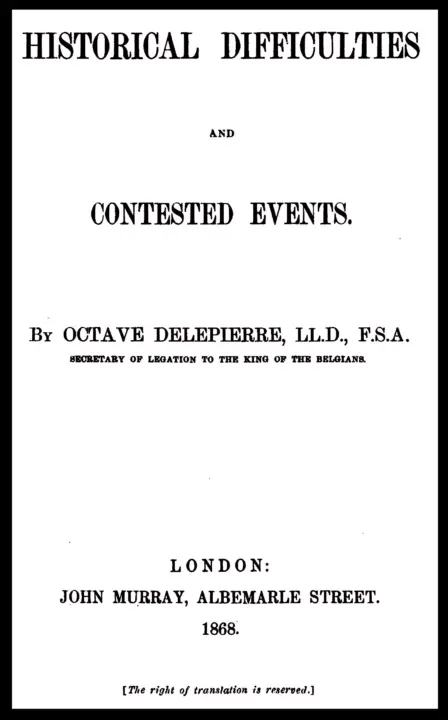
THE CLASSIC COLLECTION · 1868
"Historical Difficulties and Contested Events" by Octave Delepierre is a historical account written in the late 19th century. The book explores well-known historical events and figures through a critical lens, aiming to uncover the truths behind popular beliefs that may be based on fiction or exaggeration. By examining key historical phenomena, Delepierre seeks to differentiate between fact and fabricated narratives that have persisted through time. The opening of the book sets the stage for its analytical approach to history, emphasizing the importance of critical inquiry into accepted beliefs. Delepierre quotes various historical and philosophical figures to highlight the risks of accepting hearsay without scrutiny. He proceeds to outline subjects that will be discussed in detail throughout the essays, such as the Colossus of Rhodes, the story of Belisarius, and the legendary figure of William Tell, casting doubt on their widely accepted narratives while inviting readers to consider the integrity of historical accounts.
Introduction adapted from the source catalogue; source summaries may be automatically generated.
Free to read · English · 35,088 words · No account needed
MAKE TIME FOR A GOOD BOOK
On by default. Untick to stop anonymous reading totals. Each page counts after 10 seconds in view. How this works.
Anonymous counting is on unless you have switched it off.
9. HISTOIRE DE LA VILLE DE BRUGES, DEPUIS LES TEMPS LES PLUS RECULÉS.
8ᵛᵒ. Bruges.
10. REVUE ANALYTIQUE DES OUVRAGES ÉCRITS EN CENTONS, DEPUIS LES TEMPS ANCIENS, JUSQU’AU XIXᵐᵉ SIÈCLE. 8ᵛᵒ. London, Trübner & Co.
[1] See a curious work by M. Boissonnade, Notice des Manuscrits, Vol.
X, p. 157.
[2] See Magasin Pittoresque, June 1844, p. 190.
[3] Mémoires de la Société des Antiquaires, Vol. XII. p. 104-152.
[4] Revue des Deux Mondes, 1. November 1843. p. 480. Journal des
Débats. 1. December 1815.
[5] Navarette, Les quatres Voyages de Colomb, in 8ᵛᵒ. t. I. p. 116; and Berger de Xivrey, Revue de Paris, Nov. 25 1838, p. 269.
[6] Gentleman’s Magazine, May 1825, p. 350. Henry Halford, Essays and
Orations.
[7] Mémoires de l’Académie des Inscriptions, Vol. XXIV.
[8] Histoire du Monde, Vol. IV. p. 319.
[9] Religion des Anciens, p. 211.
[10] Researches in Asia Minor. 8ᵛᵒ. London. 1842.
[11] It was reprinted with a Latin translation by J. C. Orelli, at Leipzig in 1816. Strabo also mentions the Colossus as one of the seven wonders of the world.
[12] This Greek word signifies, according to Cicero, a secret book, set apart to contain the doings and tricks of contemporaries which it is not desirable to reveal to the public.
[13] Lucan’s Pharsalia, Book X. p. 230, 231, translated by N. Rowe.
[14] Dissertation historique sur la Bibliothèque d’Alexandrie, by Bonamy, in the Histoire de l’Académie des Inscriptions et Belles Lettres, Vol. IX. year 1736.
[15] In a report of the meeting of the Academy of Sciences in Paris, May 1857, M. le Baron Dupin, the spokesman of the Academy, informed the public “that Omar, Mahomet’s general, having conquered the valley of the Nile, his lieutenant Amrou suggested to him the formation of a canal direct from Suez to Pelusium; but,” continues Monsieur Dupin, “was it likely that the man (Amrou) who was guilty of burning the Alexandrian library, should possess sufficient capacity to carry out so grand an idea.”
Now there are here almost as many errors as words. First, the Emir Omar never did conquer the valley of the Nile. Secondly, he could not have rejected the idea of the construction of a canal from Suez to Pelusium, for the very good reason that the canal already existed; and lastly, he did not burn the Ptolomean library of Alexandria, as it had been destroyed two centuries and a half previously.
[16] This literal translation from the passage in Arabic is due to Silvestre de Sacy. G. Heyne, in his Opuscula Academica, explains concisely all the vicissitudes the Alexandrian Library underwent.
[17] Mémoire de C. Langlès, Magasin Encyclopédique, 1799, Vol. III.
[18] Martinus Polonus died about the year 1270, that is to say 184
years after Marianus. His remarks on Pope Joan are not fit for
transcription.
Your reading position is saved on this browser. Take it to another device with a library code. Reading pages adapt to text, rather than matching a printed edition.
BEHIND THE BOOK
This eBook is for the use of anyone anywhere in the United States and most other parts of the world at no cost and with almost no restrictions whatsoever. You may copy it, give it away or re-use it under the terms of the Project Gutenberg License included with this eBook or online at www.gutenberg.org. If you are not located in the United States, you will have to check the laws of the country where you are located before using this eBook. Read the source licence.
The original source file, including credits and licence, is retained by this library. Request an original-format copy at no charge. Please include the book title and Project Gutenberg identifier #71537.
KEEP YOUR CURIOSITY GOING
Cécile Tormay

Moritz Busch
John L. Ransom
Frances Wright
Cécile Tormay

Mabel Potter Daggett