THE CLASSIC COLLECTION✦An outlaw’s diary: the CommuneCLASSIC FREE BOOKS
An outlaw’s diary: the Commune
Cécile Tormay
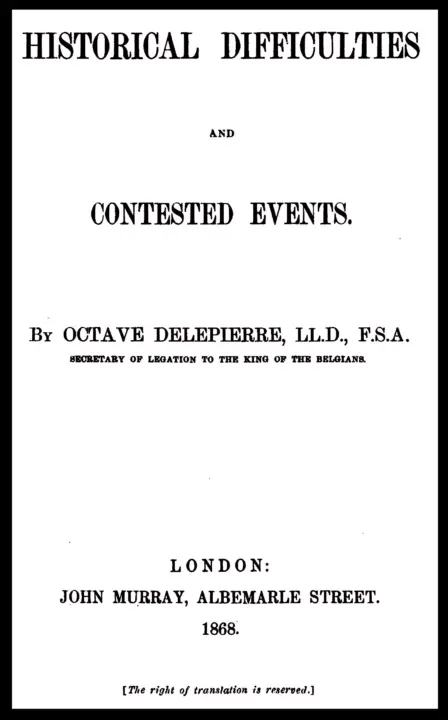
THE CLASSIC COLLECTION · 1868
"Historical Difficulties and Contested Events" by Octave Delepierre is a historical account written in the late 19th century. The book explores well-known historical events and figures through a critical lens, aiming to uncover the truths behind popular beliefs that may be based on fiction or exaggeration. By examining key historical phenomena, Delepierre seeks to differentiate between fact and fabricated narratives that have persisted through time. The opening of the book sets the stage for its analytical approach to history, emphasizing the importance of critical inquiry into accepted beliefs. Delepierre quotes various historical and philosophical figures to highlight the risks of accepting hearsay without scrutiny. He proceeds to outline subjects that will be discussed in detail throughout the essays, such as the Colossus of Rhodes, the story of Belisarius, and the legendary figure of William Tell, casting doubt on their widely accepted narratives while inviting readers to consider the integrity of historical accounts.
Introduction adapted from the source catalogue; source summaries may be automatically generated.
Free to read · English · 35,088 words · No account needed
MAKE TIME FOR A GOOD BOOK
On by default. Untick to stop anonymous reading totals. Each page counts after 10 seconds in view. How this works.
Anonymous counting is on unless you have switched it off.
[19] Familier éclaircissement de la question si une femme a été assise au siège Papal de Rome: Amsterdam 1747, in 8ᵛᵒ.
[20] In his dissertation De nummo argenteo, Benedicti III.: Rome
1749, in 4ᵗᵒ.
[21] Inserted in vol. II. part 1. of the Rerum Italicarum Scriptores.
[22] Annales de Philosophie Chrétienne: Février 1863.
[23] This decree of the council is delivered in terms sufficiently damaging to the reputation of the convent of which Eloisa was prioress: “In communi audientiâ conclamatum est super enormitate et infamiâ cujusdam monasterii sanctimonialium quod dicitur Argentolium in quo paucæ moniales multiplici infamiâ ad ignominiam sui ordinis degentes, multo tempore spurcâ et infami conversatione omnem ejusdem loci affinitatem fœdaverant.” (Gallia Christiana, Vol. VII. p. 52.)
[24] Dulcius mihi semper exstitit amicæ vocabulum aut si non indigneris, concubinæ vel scorti. Charius mihi et dignius videretur tua dici meretrix quam Augusti imperatrix.
[25] The rest is better left in Latin: “Concupiscentia te mihi potius quam amicitia sociavit, libidinis ardor potius quam amor. Ubi igitur quod desiderabas cessavit, quicquid propter hoc exhibebas pariter evanuit.”
[26] Frustra utrumque geritur quod amore Dei non agitur. In omni autem Deus scit, vitæ meæ statu, te magis adhuc offendere quam Deum vereor. Tibi placere amplius quam ipsi appeto. Tua me ad religionis habitum jussio, non divina traxit dilectio. Vide quam infelicem et omnibus miserabiliorem ducam vitam, si tanta hic frustra substineo: nihil habitura remunerations in futuro!!
[27] M. Lenoir, at the time of the publication of his work, was the keeper of the Musée des petits Augustins, in Paris.
[28] Annales archéologiques de Didron, 1846. p. 12.
[29] Lettres d’Abailard et d’Héloïse traduite sur les manuscrits de la Bibliothèque Royale par E. Oddoul, avec une préface par Monsieur Guizot Paris 1839, gr. in 8ᵒ, gravures.
[30] It was taken down 1861 and a plaister statue of Tell erected in
its place.
[31] L’illustre Châtelaine des environs de Vaucluse; dissertation et examen critique de la Laure de Pétrarque. Paris 1842, in 8ᵛᵒ.
[32] As already stated, a large tablet was carried before her on which her alleged crimes were inscribed.
[33] Namely: Mémoire tiré des archives de Chateaubriand par feu le
Président Ferrand.
[34] Mignet, Amédée Pichot, and W. Stirling.
M. Gachard has rather given the rein, we believe, to his imagination, and adopts the legend of the funeral obsequies. We shall see how triumphantly M. Mignet rebuts it.
[35] It was the Venetian, Frederic Badouaro, who conceived the comical idea of representing Giovanni Torriano as a simple clockmaker. Cardanus, in book XVII. of his work De Artibus, mentions a wonderful piece of mechanism constructed by Torriano.
[36] Henry Coiffier de Ruzé d’Effiat, Marquis de Cinq-Mars, beheaded at Lyons in 1642 by order of Richelieu. He was secretly married to Marion Delorme.
Your reading position is saved on this browser. Take it to another device with a library code. Reading pages adapt to text, rather than matching a printed edition.
BEHIND THE BOOK
This eBook is for the use of anyone anywhere in the United States and most other parts of the world at no cost and with almost no restrictions whatsoever. You may copy it, give it away or re-use it under the terms of the Project Gutenberg License included with this eBook or online at www.gutenberg.org. If you are not located in the United States, you will have to check the laws of the country where you are located before using this eBook. Read the source licence.
The original source file, including credits and licence, is retained by this library. Request an original-format copy at no charge. Please include the book title and Project Gutenberg identifier #71537.
KEEP YOUR CURIOSITY GOING
Cécile Tormay

Moritz Busch
John L. Ransom
Frances Wright
Cécile Tormay

Mabel Potter Daggett