THE CLASSIC COLLECTION✦The gray wolf’s daughterCLASSIC FREE BOOKS
The gray wolf’s daughter
Gertrude Warden
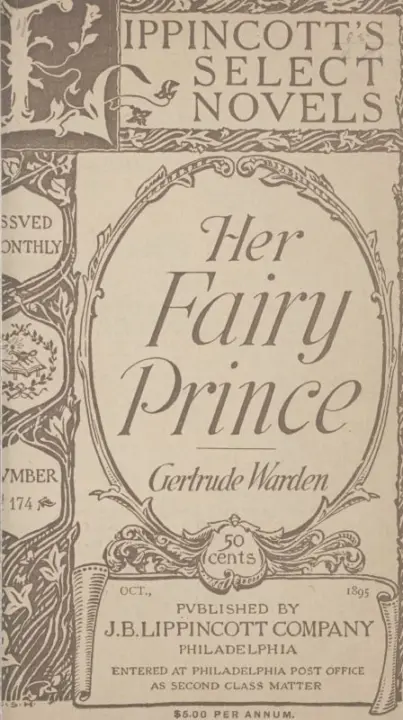
THE CLASSIC COLLECTION · 1895
"Her Fairy Prince" by Gertrude Warden is a novel written in the late 19th century. The story opens with two Englishmen, Captain Garth and Wallace Armstrong, reuniting in Boulogne after several years apart. As they converse, it becomes clear that Armstrong is in dire straits financially and is disillusioned with life. He presents himself as a man marked by past indiscretions but is still hopeful for redemption, primarily through a marriage that could restore his fortune and regain the favor of his wealthy uncle. The opening of the novel introduces readers to the complex relationship between Garth, a gambler and opportunist, and Armstrong, a young man who feels lost and embittered. Through their dialogue, we learn of Armstrong's struggles and a desperate drive to secure a better future, including a potential marriage to Garth's daughter, Laline. Laline is portrayed as innocent and unaware of the sordid realities surrounding her impending marriage, which is implied to be a calculated move to escape her father's gambling lifestyle and a means for Armstrong to secure his uncle's wealth. As the plot unfolds, the dynamics of deception, economic desperation, and emotional manipulation set the scene for Laline's journey, which promises to explore themes of innocence, sacrifice, and the pursuit of a better life.
Introduction adapted from the source catalogue; source summaries may be automatically generated.
Free to read · English · 92,870 words · No account needed
MAKE TIME FOR A GOOD BOOK
On by default. Untick to stop anonymous reading totals. Each page counts after 10 seconds in view. How this works.
Anonymous counting is on unless you have switched it off.
The wind was keen, and every now and then drifting snowflakes told of the coming storm. The Round Pond was covered with a thin sheet of ice, and upon the green roof of Kensington Palace the snow was lightly strewn.
Laline walked fast, with eyes fixed steadfastly in front of her, absorbed in her own thoughts, holding her cloak together round her, and bending her supple frame to the wind.
It was her first walk unattended in the Gardens, and her errant footsteps led her to a long leafless avenue, through which she walked rapidly, listening to the wind in the branches above her head.
Suddenly mingling with the sound came a voice close behind her, upon hearing which she stopped with a smothered cry and turned a startled face towards the speaker.
Some instinct had told her that she would meet him, and it was to her own astonishment that she realised how glad she was to see him.
"Good-afternoon, Miss Grahame! Isn't it odd? Bad as the day is, I felt certain I should meet you here!"
"And I knew that I should meet you," she returned, quickly, before
taking thought; then, seeing the gladness in his eyes, she added,
hastily,--
"That is nothing! I have had those presentiments about people ever since I was a child. And they are not necessarily about people I know and like well, but also----"
"About people you dislike--such as I?"
"I was not going to say that, Mr. Armstrong," she said, rather coldly. "'About strangers,' I should have said, although I really think," she added, thoughtfully, "that there is a sympathy of dislike, if one can call it so."
"And so by your sympathy of dislike you knew I should be here, and by my sympathy of like I knew you would be here--and we have met."
This was flirting, of course. Even inexperienced Laline knew that quite well. There was, of course, no harm in flirting with one's own husband; but then he did not know he was that, and must be put in his place.
"I am not good at discussing abstract subjects with strangers," she said; "and, also, I must be getting back home now."
"Just a moment," he pleaded. "I know Mrs. Vandeleur will be at Lady Northlake's conversazione--so that she can spare you; and this keen wind is wonderfully invigorating. Don't you feel the benefit of it after the exotic atmosphere of Mrs. Vandeleur's study? Too much of that can't be good for any one, either physically or mentally; and especially," he added, glancing at her thin face and lustrous eyes--"especially bad for you."
"Why especially bad for me?"
Your reading position is saved on this browser. Take it to another device with a library code. Reading pages adapt to text, rather than matching a printed edition.
BEHIND THE BOOK
This eBook is for the use of anyone anywhere in the United States and most other parts of the world at no cost and with almost no restrictions whatsoever. You may copy it, give it away or re-use it under the terms of the Project Gutenberg License included with this eBook or online at www.gutenberg.org. If you are not located in the United States, you will have to check the laws of the country where you are located before using this eBook. Read the source licence.
The original source file, including credits and licence, is retained by this library. Request an original-format copy at no charge. Please include the book title and Project Gutenberg identifier #70582.
KEEP YOUR CURIOSITY GOING
Coulson Kernahan

Maurice Baring
Frances Wright
Cécile Tormay

Frederic Jesup Stimson

W. H. P. (William Henry Pope) Jarvis