THE CLASSIC COLLECTION✦The gray wolf’s daughterCLASSIC FREE BOOKS
The gray wolf’s daughter
Gertrude Warden
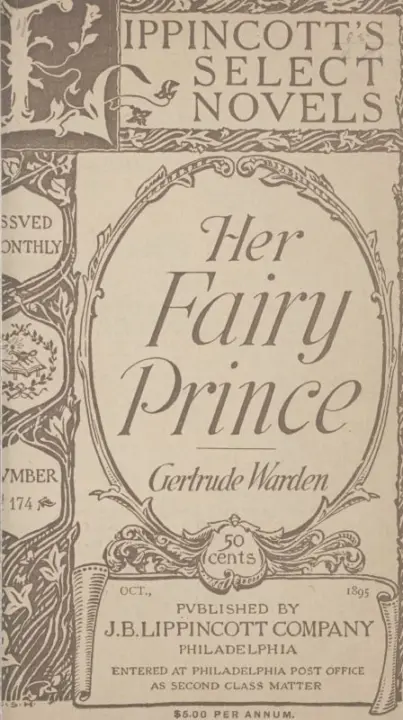
THE CLASSIC COLLECTION · 1895
"Her Fairy Prince" by Gertrude Warden is a novel written in the late 19th century. The story opens with two Englishmen, Captain Garth and Wallace Armstrong, reuniting in Boulogne after several years apart. As they converse, it becomes clear that Armstrong is in dire straits financially and is disillusioned with life. He presents himself as a man marked by past indiscretions but is still hopeful for redemption, primarily through a marriage that could restore his fortune and regain the favor of his wealthy uncle. The opening of the novel introduces readers to the complex relationship between Garth, a gambler and opportunist, and Armstrong, a young man who feels lost and embittered. Through their dialogue, we learn of Armstrong's struggles and a desperate drive to secure a better future, including a potential marriage to Garth's daughter, Laline. Laline is portrayed as innocent and unaware of the sordid realities surrounding her impending marriage, which is implied to be a calculated move to escape her father's gambling lifestyle and a means for Armstrong to secure his uncle's wealth. As the plot unfolds, the dynamics of deception, economic desperation, and emotional manipulation set the scene for Laline's journey, which promises to explore themes of innocence, sacrifice, and the pursuit of a better life.
Introduction adapted from the source catalogue; source summaries may be automatically generated.
Free to read · English · 92,870 words · No account needed
MAKE TIME FOR A GOOD BOOK
On by default. Untick to stop anonymous reading totals. Each page counts after 10 seconds in view. How this works.
Anonymous counting is on unless you have switched it off.
"Because I should think you are exceptionally sensitive, Miss Grahame. What you said just now proved that--I mean about those presentiments."
"Are you exceptionally sensitive, then?" she asked, forcing a little laugh. "For, as I understand, you have presentiments, too."
"Perhaps I am," he answered, slowly, "where some people are concerned. I have an impression about you, Miss Grahame, which is very strong indeed, and about which I want to speak to you."
For a moment Laline's heart seemed to stand still. Was he going to tell her that he had recognised her, and to show himself at last in his true colours?
"Please don't tell me!" she cried, sharply, with an unmistakable tremor in her voice. "It is late, and I am going home. Good-afternoon, Mr. Armstrong!"
"Don't go yet! Just walk once more up the avenue."
"I have not been very much about the world," Laline said, icily, "but I do not think it is customary for young ladies to walk about with strangers."
"I am not a stranger!" he said, emphatically. "Why do you look so startled, Miss Grahame? I can't believe that you and I met for the first time a week ago. If we did, why did you drop that crystal ball in consternation as soon as I entered the room, and why did I feel, as soon as I saw the lamplight on your face, that I had beheld it before? Only my recollection of you is as a child, with long bright hair waving about your shoulders, and----"
"Fancies--mere fancies!" she interrupted. "Mine is not an unusual type
of face in England."
"A most unusual type, I call it," he rejoined, earnestly, "and one that I am longing to commit to paper. My body, you must know, Miss Grahame, sits before a desk in a bank all day, but in my mind I am forever drawing and painting, committing lovely scenes and lovely faces very inadequately to canvas."
"I remember," she said, in constrained tones, "that you first met Miss Cavan in a picture-gallery."
"And I remember," he returned, composedly, "how like I thought her to a Paris Bordone. Miss Cavan's colouring is very fine, and there is altogether a Venetian opulence about her appearance. If you are at all interested in pictures, you will see some very good ones when you come, as I hope you will, with Mrs. Vandeleur to my uncle's house next week to tea."
"Thank you," she said, trying vainly to adopt an indifferent 'society' tone. "I am unfortunately engaged that day."
Your reading position is saved on this browser. Take it to another device with a library code. Reading pages adapt to text, rather than matching a printed edition.
BEHIND THE BOOK
This eBook is for the use of anyone anywhere in the United States and most other parts of the world at no cost and with almost no restrictions whatsoever. You may copy it, give it away or re-use it under the terms of the Project Gutenberg License included with this eBook or online at www.gutenberg.org. If you are not located in the United States, you will have to check the laws of the country where you are located before using this eBook. Read the source licence.
The original source file, including credits and licence, is retained by this library. Request an original-format copy at no charge. Please include the book title and Project Gutenberg identifier #70582.
KEEP YOUR CURIOSITY GOING
Coulson Kernahan

Maurice Baring
Frances Wright
Cécile Tormay

Frederic Jesup Stimson

W. H. P. (William Henry Pope) Jarvis