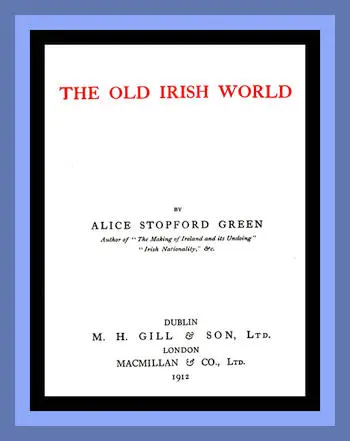
The Old Irish World
Alice Stopford Green
THE CLASSIC COLLECTION · 1888
"Henry the Second" by Alice Stopford Green is a historical account written during the late 19th century. The book delves into the life and reign of Henry II of England, exploring his impact on the development of English law, governance, and the broader implications of his rule across Britain and France. It highlights how his reforms laid the groundwork for modern governance and unified diverse regions under his rule. The opening of the book sets the stage for a detailed examination of Henry II's influence, character, and the political landscape of 12th-century England. It introduces Henry Plantagenet as a formidable foreign king who spoke little English, yet shaped a unified identity among the conquered and conqueror races over his 35-year reign. The narrative describes the legacy of Henry's reforms, including the establishment of common law and the relationship between the Church and the State. As the chapter progresses, it outlines the political turmoil surrounding Henry's rise, including his early life, struggles for power, and the historical context of England at the time, ultimately establishing the foundation for understanding his role as a transformative figure in history.
Introduction adapted from the source catalogue; source summaries may be automatically generated.
Free to read · English · 64,228 words · No account needed
MAKE TIME FOR A GOOD BOOK
On by default. Untick to stop anonymous reading totals. Each page counts after 10 seconds in view. How this works.
Anonymous counting is on unless you have switched it off.
As Henry hesitated for a moment at these crushing demands, a sudden terrible thunder broke from the still air. Both kings fell back with superstitious awe, for there had been no warning cloud or darkness. After a little space they again went forward, and again out of the serene sky came a yet louder and more awful peal. Henry, half fainting with suffering, was only prevented from falling to the ground by the friends who held him up on horseback while he made his submission to his rival and accepted the terms of peace. Then for the last time he spoke with his faithless son Richard. As the formal kiss of peace was given, the count caught his father's fierce whisper, "May God not let me die until I have worthily avenged myself on thee!" The terrible words were to Richard only a merry tale, with which on his return he stirred the French court to great laughter.
Henry was carried back the same day in a litter to Chinon. So sudden and amazing a downfall was to the superstitious terror of the time, evident token that the curse of Thomas had come to rest on him. The vengeance of the implacable martyr seemed to follow him through every act of the great drama. In Philip's scornful refusal to allow Henry to swear obedience, "saving his honour and the dignity of his kingdom," the zealots of the day saw a just retribution. At Chinon a deputation of monks from Canterbury met him. "Trusting that in his affliction he might pity the affliction of the Church," and grant demands long urged by the convent, they had sought him out, "going through swords." "The convent of Canterbury salutes you as their lord," they began, as they forced their way into the sick king's presence. Henry broke in with bitter indignation, "Then lord I have been, and am still, and will be yet--small thanks to you, ye evil traitors!" he added in a lower voice, which just caught the ears of the furious monks. But he listened patiently to their complaint. "Now go out," he said, "I will speak with my faithful servants." As the monks passed out one of them stopped and laid his curse on the king, who trembled and grew pale at the terrible words. "The omnipotent God of His ineffable mercy, and for the merits of the blessed martyr Thomas, if his life and passion has been well pleasing to Him, will shortly do us justice on thy body." Tortured with suffering, Henry still summoned strength for his last public act. He called his clerk and dictated a letter to Canterbury, to urge patience till his return, when he would consider their complaint and find a way out of the difficulty. The same evening his chancellor, whom he had sent to Philip at Tours, returned with the list of those who had conspired against him Henry bade him read the names. "Sire," he said, "may Jesus Christ help me! the first name which is written here is the name of Count John your son." The king started up from his pillow. "Is it true," he cried, "that John, my very heart, whom I have loved beyond all my sons, and for whose gain I have brought upon me all this misery, has forsaken me?" Then he laid himself down again and turned his face to the wall. "Now you have said enough," he said. "Let all the rest go as it will, I care no more for myself nor for the world." From this time he grew delirious. But still in the intervals of his ravings the great passionate nature, the defiance, the unconquered will broke out with inextinguishable force. He cursed the day on which he was born, and called down Heaven's vengeance on his sons. The great king's pride was bowed in the extremity of his ruin and defeat. "Shame," he muttered constantly, "shame on a conquered king." Geoffrey watched by him faithfully, and the dying king's last thoughts turned to him with grateful love. On the 6th of July, the seventh day of his illness, he was seized with violent hemorrhage, and the end came almost instantaneously. The next day his body was borne to Fontevraud, where his sculptured tomb still stands. To the astonished onlookers at the great tragedy, the grave in a convent church, separated from the tombs of his Angevin forefathers and of his Norman ancestors, far from his English kingdom, seemed part of the strange disasters foretold by Merlin and inspired messengers. But no ruler of his age had raised for himself so great a monument as Henry. Amid the ruin that overwhelmed his imperial schemes, his realm of England stood as the true and lasting memorial of his genius. Englishmen then, as Englishmen now, taught by the "remembrance of his good times," recognized him as one of the foremost on the roll of those who have been the makers of England's greatness.
Your reading position is saved on this browser. Take it to another device with a library code. Reading pages adapt to text, rather than matching a printed edition.
Alice Stopford Green
Alice Stopford Green
BEHIND THE BOOK
This eBook is for the use of anyone anywhere in the United States and most other parts of the world at no cost and with almost no restrictions whatsoever. You may copy it, give it away or re-use it under the terms of the Project Gutenberg License included with this eBook or online at www.gutenberg.org. If you are not located in the United States, you will have to check the laws of the country where you are located before using this eBook. Read the source licence.
The original source file, including credits and licence, is retained by this library. Request an original-format copy at no charge. Please include the book title and Project Gutenberg identifier #10494.
KEEP YOUR CURIOSITY GOING
Cécile Tormay

Moritz Busch
John L. Ransom
Frances Wright
Cécile Tormay

Mabel Potter Daggett