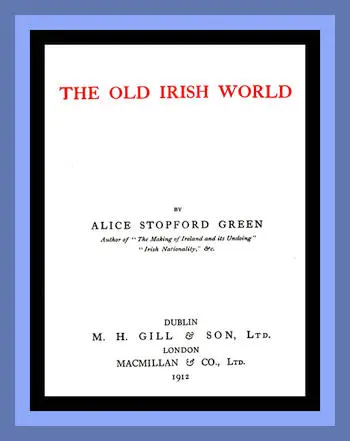
The Old Irish World
Alice Stopford Green
THE CLASSIC COLLECTION · 1888
"Henry the Second" by Alice Stopford Green is a historical account written during the late 19th century. The book delves into the life and reign of Henry II of England, exploring his impact on the development of English law, governance, and the broader implications of his rule across Britain and France. It highlights how his reforms laid the groundwork for modern governance and unified diverse regions under his rule. The opening of the book sets the stage for a detailed examination of Henry II's influence, character, and the political landscape of 12th-century England. It introduces Henry Plantagenet as a formidable foreign king who spoke little English, yet shaped a unified identity among the conquered and conqueror races over his 35-year reign. The narrative describes the legacy of Henry's reforms, including the establishment of common law and the relationship between the Church and the State. As the chapter progresses, it outlines the political turmoil surrounding Henry's rise, including his early life, struggles for power, and the historical context of England at the time, ultimately establishing the foundation for understanding his role as a transformative figure in history.
Introduction adapted from the source catalogue; source summaries may be automatically generated.
Free to read · English · 64,228 words · No account needed
MAKE TIME FOR A GOOD BOOK
On by default. Untick to stop anonymous reading totals. Each page counts after 10 seconds in view. How this works.
Anonymous counting is on unless you have switched it off.
The new kingdom which Henry had added to his dominions in France might well seem to a man of less inexhaustible energy to make the task of government impossible. The imperial system of his dreams was as recklessly defiant of physical difficulties as it was heedless of all the sentiments of national tradition. In the two halves of his empire no common political interest and no common peril could arise; the histories of north and south were carried on apart, as completely as the histories of America and England when they were apparently united under one king, and were in fact utterly severed by the ocean which defined the limits of two worlds. England had little part or lot in the history of Europe. Foreign policy it had none; when its kings passed to Normandy, English chroniclers knew nothing of their doings or their wars. Some little trade was carried on with the nearest lands across the sea,--with Normandy, with Flanders, or with Scandinavia,--but the country was almost wholly agricultural. Feudal in its social structure, governed by tradition, with little movement of inner life or contact with the world about it, its people had remained jealous of strangers, and as yet distinguished from the nations of Europe by a strange immobility and want of sympathy with the intellectual and moral movements around them. Sometimes strangers visited its kings; sometimes English pilgrims made their way to Rome by a dangerous and troublesome journey. But even the connection with the Papacy was slight. A foreign legate had scarcely ever landed on its shores; hardly any appeals were carried to the Roman Curia; the Church managed its own business after a customary fashion which was in harmony with English traditions, which had grown up during centuries of undisturbed and separate life.
On the other side of the Channel Henry ruled over a straggling line of loosely compacted states equal in extent to almost half of the present France. His long line of ill-defended frontier brought him in contact with the lands of the Count of Flanders, one of the chief military powers of the day; with the kingdom of France, which, after two hundred years of insignificance, was beginning to assert its sway over the great feudal vassals, and preparing to build up a powerful monarchy; and with the Spanish kingdoms which were emerging from the first successful effort of the Christian states to throw back the power of the Moors. Normandy and Auvergne were separated only by a narrow belt of country from the Empire, which, under the greatest ruler and warrior of the age, Frederick Barbarossa, was extending its power over Burgundy, Provence, and Italy. His claims to the over-lordship of Toulouse gave Henry an interest in the affairs of the great Mediterranean power--the kingdom of Sicily; and his later attempts on the territories of the Count of Maurienne brought him into close connection with Italian politics. No ruler of his time was forced more directly than Henry into the range of such international politics as were possible in the then dim and inchoate state of European affairs. England, which in the mind of the Norman kings had taken the first place, fell into the second rank of interests with her Angevin rulers. Henry's thoughts and hopes and ambitions centred in his continental domains. Lord of Rouen, of Angers, of Bordeaux, master of the sea-coast from Flanders to the Pyrenees, he seemed to hold in his hand the feeble King of Paris and of Orleans, who was still without a son to inherit his dignities and lands. The balance of power, as of ability and military skill, lay on his side; and, long as the House of Anjou had been the bulwark of the French throne, it even seemed as if the time might come peaceably to mount it themselves. Looking from our own island at the work which Henry did, and seeing more clearly by the light of later events, we may almost forget the European ruler in the English king. But this was far from being the view of his own day. In the thirty-five years of his reign little more than thirteen years were spent in England and over twenty-one in France. Thrice only did he remain in the kingdom as much as two years at a time; for the most part his visits were but for a few months torn from the incessant tumult and toil of government abroad; and it was only after long years of battling against invincible forces that he at last recognized England as the main factor of his policy, and in great crises chose rather to act as an English king than as the creator of an empire.
Your reading position is saved on this browser. Take it to another device with a library code. Reading pages adapt to text, rather than matching a printed edition.
Alice Stopford Green
Alice Stopford Green
BEHIND THE BOOK
This eBook is for the use of anyone anywhere in the United States and most other parts of the world at no cost and with almost no restrictions whatsoever. You may copy it, give it away or re-use it under the terms of the Project Gutenberg License included with this eBook or online at www.gutenberg.org. If you are not located in the United States, you will have to check the laws of the country where you are located before using this eBook. Read the source licence.
The original source file, including credits and licence, is retained by this library. Request an original-format copy at no charge. Please include the book title and Project Gutenberg identifier #10494.
KEEP YOUR CURIOSITY GOING
Cécile Tormay

Moritz Busch
John L. Ransom
Frances Wright
Cécile Tormay

Mabel Potter Daggett