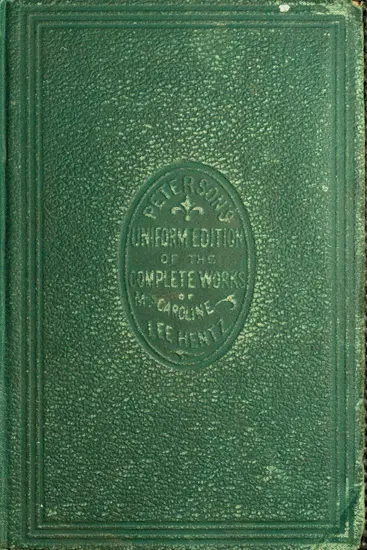
Love After Marriage; and Other Stories of the Heart
Caroline Lee Hentz
THE CLASSIC COLLECTION · 1853
"Helen and Arthur; or, Miss Thusa's Spinning Wheel" by Caroline Lee Hentz is a novel written in the mid-19th century. The story centers on young Helen, a child characterized by her vivid imagination and deep emotions, who finds herself in the care of Miss Thusa, an eccentric spinner and storyteller. As Helen navigates her fears and curious fantasies, the narrative explores themes of childhood innocence, the supernatural, and the contrast between life and death, particularly in the backdrop of Southern domestic life. The opening of the novel introduces Helen and Miss Thusa on a blustery night, where Miss Thusa, spinning by the fire, captivates Helen with her tales, blending elements of horror with comfort. Helen's fascination with these stories, particularly those that send shivers down her spine, fosters a rich inner world filled with contrasting joys and terrors. Soon, the narrative hints at deeper emotional challenges, particularly as Helen's mother struggles with illness, framing a poignant exploration of grief and childhood vulnerability. This initial setup promises a blend of whimsical yet dark storytelling, inviting readers into a soulful reflection on the complexities of growing up.
Introduction adapted from the source catalogue; source summaries may be automatically generated.
Free to read · English · 98,161 words · No account needed
MAKE TIME FOR A GOOD BOOK
On by default. Untick to stop anonymous reading totals. Each page counts after 10 seconds in view. How this works.
Anonymous counting is on unless you have switched it off.
"Which Helen values not," said the young doctor, half in assertion and
half in interrogation.
"No, no," she replied, "a counter influence has saved her from the
misery and shame."
Mittie paused, clasped her hands together, and pressed them tightly on
her bosom.
"Oh!" she exclaimed, "it is no metaphor, when they talk of arrows piercing the breast. I feel them here."
Her countenance expressed physical suffering as well as mental agony. She shivered with cold one moment, the next glowed with feverish heat.
Arthur took off his cloak, and folded it round her, and she offered no resistance. She was sinking into that passive state, which often succeeds too high-wrought emotion.
"You are very kind," said she, "but you will suffer."
"No--I am accustomed to brave the elements. But if you think I suffer, let us hasten to a warmer region. Give me your hand."
Firmly grasping it, he extinguished the lamp, and in total darkness they left the cell, groped through the long, narrow passage, down the winding stairs, at the foot of which was the jailer's room. Arthur was familiar with this gloomy dwelling, so often had he visited it on errands of mercy and compassion. It was not the first time he had been entrusted with the key of the cells, though he suspected that it would be the last. The keeper, only half awakened, received the key, locked his own door, and went back to his bed, muttering that "there were not many men to be trusted, but the young doctor was one."
When Arthur and Mittie emerged from the dark prison-house into the clear, still moonlight, (for the moon had risen, and over the night had thrown a veil of silvery gauze,) Arthur's excited spirit subsided into peace, beneath its pale, celestial glory. Mittie thought of the fugitive, and shrunk from the beams that might betray his flight. The sudden barking of the watch-dog made her tremble. Even their own shadows on the white, frozen ground, she mistook for the avengers of crime, in the act of pursuit.
"What shall we do?" said Arthur, when, having arrived at Mr. Gleason's door, they found it fastened. "I wish you could enter unobserved."
Mittie's solitary habits made her departure easy, and her absence unsuspected, but she could not steal in through the bolts and locks that impeded her admission.
"No matter," she cried, "leave me here--I will lie down by the threshold, and wait the morning. All places are alike to me."
Your reading position is saved on this browser. Take it to another device with a library code. Reading pages adapt to text, rather than matching a printed edition.
BEHIND THE BOOK
This eBook is for the use of anyone anywhere in the United States and most other parts of the world at no cost and with almost no restrictions whatsoever. You may copy it, give it away or re-use it under the terms of the Project Gutenberg License included with this eBook or online at www.gutenberg.org. If you are not located in the United States, you will have to check the laws of the country where you are located before using this eBook. Read the source licence.
The original source file, including credits and licence, is retained by this library. Request an original-format copy at no charge. Please include the book title and Project Gutenberg identifier #23106.
KEEP YOUR CURIOSITY GOING
Coulson Kernahan

Maurice Baring
Frances Wright
Cécile Tormay

Frederic Jesup Stimson

W. H. P. (William Henry Pope) Jarvis