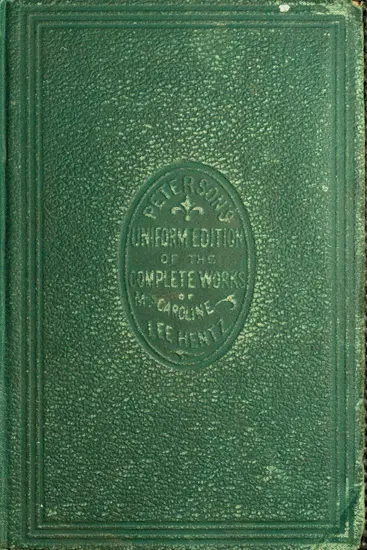
Love After Marriage; and Other Stories of the Heart
Caroline Lee Hentz
THE CLASSIC COLLECTION · 1853
"Helen and Arthur; or, Miss Thusa's Spinning Wheel" by Caroline Lee Hentz is a novel written in the mid-19th century. The story centers on young Helen, a child characterized by her vivid imagination and deep emotions, who finds herself in the care of Miss Thusa, an eccentric spinner and storyteller. As Helen navigates her fears and curious fantasies, the narrative explores themes of childhood innocence, the supernatural, and the contrast between life and death, particularly in the backdrop of Southern domestic life. The opening of the novel introduces Helen and Miss Thusa on a blustery night, where Miss Thusa, spinning by the fire, captivates Helen with her tales, blending elements of horror with comfort. Helen's fascination with these stories, particularly those that send shivers down her spine, fosters a rich inner world filled with contrasting joys and terrors. Soon, the narrative hints at deeper emotional challenges, particularly as Helen's mother struggles with illness, framing a poignant exploration of grief and childhood vulnerability. This initial setup promises a blend of whimsical yet dark storytelling, inviting readers into a soulful reflection on the complexities of growing up.
Introduction adapted from the source catalogue; source summaries may be automatically generated.
Free to read · English · 98,161 words · No account needed
MAKE TIME FOR A GOOD BOOK
On by default. Untick to stop anonymous reading totals. Each page counts after 10 seconds in view. How this works.
Anonymous counting is on unless you have switched it off.
Louis, the impulsive, warm-hearted, and confiding Louis Gleason, was drawn as if by fascination towards this young man. There was a luminous atmosphere around him, that dazzled the judgment, and rendered it blind to his moral defects. Dissipation appeared covered with a golden tissue, that concealed all its deformity; and reckless prodigality received the honors due to princely generosity.
When Clinton accompanied Louis to his father's house, and beheld the beautiful Mittie, gilt, as he first saw her by the rays of the setting sun, he gave her the spontaneous homage which beauty ever received from him. He admired and for a little time imagined he loved her. But she was too easy a conquest to elate his vanity, and he soon wearied of her too exacting love. Helen, the shy, child-like, simple hearted Helen, baffled and interested him. She shunned and feared him, and therefore he pursued her with increasing fervor of feeling and earnestness of purpose. Finding himself terribly annoyed by Mittie's frantic jealousy, he resolved to absent himself awhile till the tempest he had raised was lulled, and urging Louis to be his companion, that he might have a plea for returning, departed, as has been described, not to his pretended home, but to haunts of guilty pleasure, where the deluded Louis followed, believing in his infatuation that he was only walking side by side with one sorely tempted, reluctantly transgressing, and as oft repenting as himself.
With the native chivalry of his character, he refused to criminate his friend, and justify his father's anger. It was to Clinton his debts of honor were chiefly due, and it was for this reason he shrunk from revealing them to his father.
When Clinton found himself excluded from the presence of Helen, whose love he was resolved to win, his indignation and mortification were indescribable; but acknowledging no obstacles to his designs, he watched his opportunity and entered Miss Thusa's cabin, as we have related in the last chapter. He was no actor in that interview, for he really felt for Helen, emotions purer, deeper and stronger than he had ever before cherished for woman. He had likewise all the stimulus of rivalry, for he believed that Arthur Hazleton loved her, that calm, self-possessed and inscrutable being, whose dark, spirit-reaching eye his own had ever shunned. Helen's unaffected terror, her repulsion and flight were wormwood and gall to his pampered vanity and starving love. Her undisguised emotion at the mention of Arthur, convinced him of his ascendency over her heart, and the hopelessness of his present pursuit. Still he lingered near the spot, unwilling to relinquish an object that seemed more and more precious as the difficulty of obtaining it increased. He stood by the window, watching, at times, glimpses of Helen's sweet, yet troubled countenance, as the curtain flapped in the wintry wind. It was then he heard Miss Thusa relate the secret of her hidden wealth, and the demon of temptation whispered in his ear that the hidden gold might be his. Helen cared not for it--she knew not its value, she needed it not. Very likely when the wheel should come into her possession, and she examined its mystery, if the legacy were missing, she would believe its history the dream of an excited imagination, and think of it no more. He had never stolen, and it did seem low and ungentlemanlike to steal, but this was more like finding some buried treasure, something cast up from the ocean's bed. It was not so criminal after all as cheating at the gaming-table, which he was in the constant habit of doing. Then why should he hesitate if opportunity favored his design? Mr. Gleason had insulted him in the grossest manner, Helen had rejected him, Louis had released himself from his thraldom. There was no motive for him to remain longer where he was, and he was assured suspicion would never rest on him, though he took his immediate departure. The next night he attempted to execute his shameful purpose by forging the note, sending it by an unsuspecting messenger, thus despatching the young doctor, on a professional errand. Every thing seemed to favor him. The woman whom Arthur had commanded to keep watch during his absence had sunk back into a heavy sleep as soon as his voice died on her ear--so there was nothing to impede the robber's entrance. Clinton waited till he thought Arthur had had time to reach the place of his destination, and then stole into the sick chamber with noiseless steps. Miss Thusa was awakened by a metallic, grating sound, and beheld, with unspeakable horror, her beloved wheel lying in fragments at the feet of the spoiler. The detection, the arrest, the imprisonment are already known.
Your reading position is saved on this browser. Take it to another device with a library code. Reading pages adapt to text, rather than matching a printed edition.
BEHIND THE BOOK
This eBook is for the use of anyone anywhere in the United States and most other parts of the world at no cost and with almost no restrictions whatsoever. You may copy it, give it away or re-use it under the terms of the Project Gutenberg License included with this eBook or online at www.gutenberg.org. If you are not located in the United States, you will have to check the laws of the country where you are located before using this eBook. Read the source licence.
The original source file, including credits and licence, is retained by this library. Request an original-format copy at no charge. Please include the book title and Project Gutenberg identifier #23106.
KEEP YOUR CURIOSITY GOING
Coulson Kernahan

Maurice Baring
Frances Wright
Cécile Tormay

Frederic Jesup Stimson

W. H. P. (William Henry Pope) Jarvis