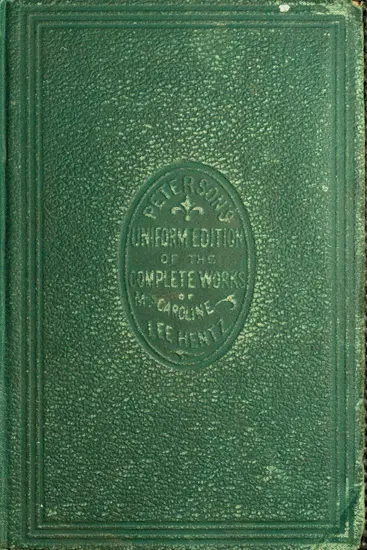
Love After Marriage; and Other Stories of the Heart
Caroline Lee Hentz
THE CLASSIC COLLECTION · 1853
"Helen and Arthur; or, Miss Thusa's Spinning Wheel" by Caroline Lee Hentz is a novel written in the mid-19th century. The story centers on young Helen, a child characterized by her vivid imagination and deep emotions, who finds herself in the care of Miss Thusa, an eccentric spinner and storyteller. As Helen navigates her fears and curious fantasies, the narrative explores themes of childhood innocence, the supernatural, and the contrast between life and death, particularly in the backdrop of Southern domestic life. The opening of the novel introduces Helen and Miss Thusa on a blustery night, where Miss Thusa, spinning by the fire, captivates Helen with her tales, blending elements of horror with comfort. Helen's fascination with these stories, particularly those that send shivers down her spine, fosters a rich inner world filled with contrasting joys and terrors. Soon, the narrative hints at deeper emotional challenges, particularly as Helen's mother struggles with illness, framing a poignant exploration of grief and childhood vulnerability. This initial setup promises a blend of whimsical yet dark storytelling, inviting readers into a soulful reflection on the complexities of growing up.
Introduction adapted from the source catalogue; source summaries may be automatically generated.
Free to read · English · 98,161 words · No account needed
MAKE TIME FOR A GOOD BOOK
On by default. Untick to stop anonymous reading totals. Each page counts after 10 seconds in view. How this works.
Anonymous counting is on unless you have switched it off.
"Pick them up, and put them back," said Miss Thusa, "and screw it up again--all the joints will open in that way. The wood is hollowed out and filled with gold, which I bequeath to you. My will is in there, too, made by the lawyers where I found the money. You remember when that advertisement was put in the papers, and I went on that journey, part of the way with you. Well, I must tell you the shortest way, though it's a long story. It was written by a lady, on her death-bed, a widow lady, who had no children, and a large property of her own. You don't remember my brother, but your father does. He was a hater of the world, and almost made me one. Well, it seemed he had a cause for his misanthropy which I never knew of, for when he was a young man he went away from home, and we didn't hear from him for years. When he came back, he was sad and sickly, and wanted to get into some little quiet place, where nobody would molest him. Then it was we came to this little cabin, where he died, in this very room, and this very bed, too."
Miss Thusa paused, and the room and the bed seemed all at once clothed with supernatural solemnity, by the sad consecration of death. Death had been there--death was waiting there.
"Oh! Miss Thusa, you are faint and weary. Do stop and rest, I pray you," cried Helen, bathing her forehead with camphor, and holding a glass of water to her lips.
But the unnatural strength which opium gives, sustained her, and she
continued her narrative.
"This lady, when young, had loved and been betrothed to my brother, and then forsook him for a wealthier man. It was that which ruined him, and I never knew it. He had one of those still natures, where the waters of sorrow lie deep as a well. They never overflow. She told me that she never had had one happy moment from the time she married, and that her conscience gnawed her for her broken faith. Her husband died, and left her a rich widow, without a child to leave her property to. After a while she fell sick of a long and lingering disease, for which there is no cure. Then she thought if she could leave her money to my brother, or he being dead, to some of his kin, she could die with more comfort. So, she put the advertisement in the paper, which you all saw. I didn't want the money, and wanted to come away without it, but she sent for a lawyer, and had it all fastened upon me by deeds and writings, whether I was willing or not. She didn't live but a few days after I got there. The lawyer was very kind, and assisted me in my plans, though he thought them very odd. There is no need of wasting my breath in telling how I had the money changed into gold, and the wheel fixed in the way you see it, after a fashion of my own. I would not have touched one cent of it, had it not been for you, and next to you, that poor boy, Louis. I didn't want any one to know it, and be dinning in my ears about money from morning to night. I had no use for it myself, for habits don't change when the winter of life is begun. There is no use for it in the dark grave to which I am hastening. There is no use for it near the great white throne of God, where I shall shortly stand. When I am dead and gone, Helen, take that wheel home, and give it a place wherever you are, for old Miss Thusa's sake. I really think--I'm a strange, foolish old woman--but I really think I should like to have its likeness painted on my coffin lid. A kind of coat-of-arms, you know, child."
Your reading position is saved on this browser. Take it to another device with a library code. Reading pages adapt to text, rather than matching a printed edition.
BEHIND THE BOOK
This eBook is for the use of anyone anywhere in the United States and most other parts of the world at no cost and with almost no restrictions whatsoever. You may copy it, give it away or re-use it under the terms of the Project Gutenberg License included with this eBook or online at www.gutenberg.org. If you are not located in the United States, you will have to check the laws of the country where you are located before using this eBook. Read the source licence.
The original source file, including credits and licence, is retained by this library. Request an original-format copy at no charge. Please include the book title and Project Gutenberg identifier #23106.
KEEP YOUR CURIOSITY GOING
Coulson Kernahan

Maurice Baring
Frances Wright
Cécile Tormay

Frederic Jesup Stimson

W. H. P. (William Henry Pope) Jarvis