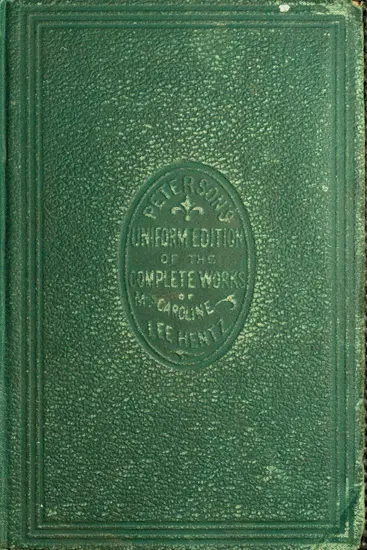
Love After Marriage; and Other Stories of the Heart
Caroline Lee Hentz
THE CLASSIC COLLECTION · 1853
"Helen and Arthur; or, Miss Thusa's Spinning Wheel" by Caroline Lee Hentz is a novel written in the mid-19th century. The story centers on young Helen, a child characterized by her vivid imagination and deep emotions, who finds herself in the care of Miss Thusa, an eccentric spinner and storyteller. As Helen navigates her fears and curious fantasies, the narrative explores themes of childhood innocence, the supernatural, and the contrast between life and death, particularly in the backdrop of Southern domestic life. The opening of the novel introduces Helen and Miss Thusa on a blustery night, where Miss Thusa, spinning by the fire, captivates Helen with her tales, blending elements of horror with comfort. Helen's fascination with these stories, particularly those that send shivers down her spine, fosters a rich inner world filled with contrasting joys and terrors. Soon, the narrative hints at deeper emotional challenges, particularly as Helen's mother struggles with illness, framing a poignant exploration of grief and childhood vulnerability. This initial setup promises a blend of whimsical yet dark storytelling, inviting readers into a soulful reflection on the complexities of growing up.
Introduction adapted from the source catalogue; source summaries may be automatically generated.
Free to read · English · 98,161 words · No account needed
MAKE TIME FOR A GOOD BOOK
On by default. Untick to stop anonymous reading totals. Each page counts after 10 seconds in view. How this works.
Anonymous counting is on unless you have switched it off.
"You will stay with me to-night, my child," said she, in a voice
strangely altered. "I've got something to tell you--and the time is
come."
"Yes. I will stay with you as long as you wish, Miss Thusa," replied Helen, passing her hand softly over the hoary looks that shaded the brow of the sufferer. "I will nurse you so tenderly, that you will soon be well again."
"Good child--blessed child!" murmured she, closing her eyes beneath the slumberous weight of the anodyne, and sinking into a deep sleep.
And now Helen sat alone, watching the aged friend, whose strongly-marked and peculiar character had had so great an influence on her own. For awhile the echo of Arthur's parting words made so much music in her ear, it drowned the harsh, solemn ticking of the old clock, and stole like a sweet lullaby over her spirit. But gradually the ticking sounded louder and louder, and her loneliness pressed heavily upon her. There was a little, dark, walnut table, standing on three curiously wrought legs, in a corner of the room. On this a large Bible, covered with dark, linen cloth, was laid, and on the top of this Miss Thusa's spectacles, with the bows crossing each other, like the stiffened arms of a corpse. Helen could not bear to look upon those spectacles, which had always seemed to her an inseparable part of Miss Thusa, lying so still and melancholy there. She took them up reverently, and laid them on a shelf, then drawing the table near the fire, or rather carrying it, so as not to awaken the sleeper, she opened the sacred book. The first words which happened to meet her eye, were--
"Where is God, my Maker, who giveth me songs in the night?"
The pious heart of the young girl thrilled as she read this beautiful
and appropriate text.
"Surely, oh God, Thou art here," was the unspoken language of that young, believing heart, "here in this lonely cottage, here by this bed of sickness, and here also in this trembling, fearing, yet trusting spirit. In every life-beat throbbing in my veins, Thy awful steps I hear. Yet Thou canst not come, Thou canst not go, for Thou art ever near, unseen, yet felt, an all pervading, glorious presence."
Had any one seen Helen, seated by that solitary hearth, with her hands clasped over those holy pages, her mild, devotional eyes raised to Heaven, the light quivering in a halo round her brow, they might have imagined her a young Saint, or a young Sister of Charity, ministering to the sufferings of that world whose pleasures she had abjured.
Your reading position is saved on this browser. Take it to another device with a library code. Reading pages adapt to text, rather than matching a printed edition.
BEHIND THE BOOK
This eBook is for the use of anyone anywhere in the United States and most other parts of the world at no cost and with almost no restrictions whatsoever. You may copy it, give it away or re-use it under the terms of the Project Gutenberg License included with this eBook or online at www.gutenberg.org. If you are not located in the United States, you will have to check the laws of the country where you are located before using this eBook. Read the source licence.
The original source file, including credits and licence, is retained by this library. Request an original-format copy at no charge. Please include the book title and Project Gutenberg identifier #23106.
KEEP YOUR CURIOSITY GOING
Coulson Kernahan

Maurice Baring
Frances Wright
Cécile Tormay

Frederic Jesup Stimson

W. H. P. (William Henry Pope) Jarvis