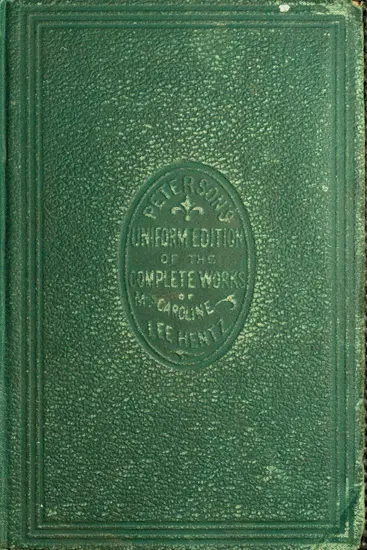
Love After Marriage; and Other Stories of the Heart
Caroline Lee Hentz
THE CLASSIC COLLECTION · 1853
"Helen and Arthur; or, Miss Thusa's Spinning Wheel" by Caroline Lee Hentz is a novel written in the mid-19th century. The story centers on young Helen, a child characterized by her vivid imagination and deep emotions, who finds herself in the care of Miss Thusa, an eccentric spinner and storyteller. As Helen navigates her fears and curious fantasies, the narrative explores themes of childhood innocence, the supernatural, and the contrast between life and death, particularly in the backdrop of Southern domestic life. The opening of the novel introduces Helen and Miss Thusa on a blustery night, where Miss Thusa, spinning by the fire, captivates Helen with her tales, blending elements of horror with comfort. Helen's fascination with these stories, particularly those that send shivers down her spine, fosters a rich inner world filled with contrasting joys and terrors. Soon, the narrative hints at deeper emotional challenges, particularly as Helen's mother struggles with illness, framing a poignant exploration of grief and childhood vulnerability. This initial setup promises a blend of whimsical yet dark storytelling, inviting readers into a soulful reflection on the complexities of growing up.
Introduction adapted from the source catalogue; source summaries may be automatically generated.
Free to read · English · 98,161 words · No account needed
MAKE TIME FOR A GOOD BOOK
On by default. Untick to stop anonymous reading totals. Each page counts after 10 seconds in view. How this works.
Anonymous counting is on unless you have switched it off.
It was about a week after the arrival of Louis and the coming of Alice, that, as the family were assembled round the evening fireside, a note was brought to Louis.
"Clinton is come," cried he, in an agitated voice, "he waits me at the
hotel."
"What shall I say to him, father?" asked he, turning to Mr. Gleason, whose folded arms gave an air of determination to his person, which Louis did not like.
"Come with me into the next room, Louis," said Mr. Gleason, and Louis followed with a firm step but a sinking heart.
"I have reflected deeply, deliberately, prayerfully on this subject, my son, since we last discussed it, and the result is this: I cannot, while such dark doubts disturb my mind, I cannot, consistent with my duty as a father and a Christian, allow this young man to be domesticated in my family again. If I wrong him, may God forgive me--but if I wrong my own household, I fear He never will."
"I cannot go--I will not go!" exclaimed Louis, dashing the note on the floor. "This is the last brimming drop in the cup of humiliation, bitterer than all the rest."
"Louis, Louis, have you not merited humiliation? Have you a right to murmur at the decree? Have I upbraided you for the anxious days and sleepless nights you have occasioned me? For my blasted hopes and embittered joys? No, Louis. I saw that your own heart condemned you, and I left you to your God, who is greater than your own heart and mine!"
"Oh, father!" cried Louis, melted at once by this pathetic and solemn appeal, "I know I have no right to claim any thing at your hands, but I beg, I supplicate--not for myself--but another!"
"'Tis in vain, Louis. Urge me no more. On this point I am inflexible. But, since it is so painful to you, I will go myself and openly avow the reasons of my conduct."
"No, sir," exclaimed Louis, "not for the world. I will go at once."
He turned suddenly and quitted the apartment, and then the house, with a half-formed resolution of fleeing to the wild woods, and never more returning.
Mittie, who was fortunately in her room above, (fortunately, we say, for her presence would have been as fuel to flame,) heard the quick opening and shutting of doors, and the sound of rapid steps on the flag-stones of the yard.
"Louis, Louis," she cried, opening the window and recognizing his figure in the star-lit night, "whither are you going?"
"To perdition!" was the passionate reply.
"Oh, Louis, speak and tell me truly, is Clinton come?"
"He is."
Your reading position is saved on this browser. Take it to another device with a library code. Reading pages adapt to text, rather than matching a printed edition.
BEHIND THE BOOK
This eBook is for the use of anyone anywhere in the United States and most other parts of the world at no cost and with almost no restrictions whatsoever. You may copy it, give it away or re-use it under the terms of the Project Gutenberg License included with this eBook or online at www.gutenberg.org. If you are not located in the United States, you will have to check the laws of the country where you are located before using this eBook. Read the source licence.
The original source file, including credits and licence, is retained by this library. Request an original-format copy at no charge. Please include the book title and Project Gutenberg identifier #23106.
KEEP YOUR CURIOSITY GOING
Coulson Kernahan

Maurice Baring
Frances Wright
Cécile Tormay

Frederic Jesup Stimson

W. H. P. (William Henry Pope) Jarvis