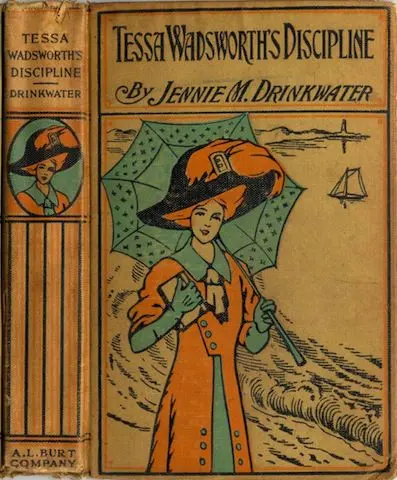
Tessa Wadsworth’s Discipline: A Story of the Development of a Young Girl’s Life
Nathaniel, Mrs. Conklin

THE CLASSIC COLLECTION · 1894
"Growing Up: A Story of the Girlhood of Judith Mackenzie" by Jennie M. Drinkwater is a fictional novel written in the late 19th century. The story revolves around the life of young Judith Mackenzie, exploring her experiences and thoughts as she navigates the complexities of girlhood while caring for her bedridden mother. The narrative is steeped in themes of love, family, and personal growth, as Judith's character develops and matures through her interactions with her mother and other relatives. The opening of the story presents a tender scene between Judith and her mother, where Judith takes joy in sharing her imaginative "pictures" with her mother while she is confined to a wheelchair. The dialogue reveals their strong bond and Judith's ambitions, dreams, and curiosity about the world. Through Judith's storytelling, we see her growing independence and aspirations for the future, including the desire to help her mother gain strength. This introduction sets the tone for a narrative rich in emotional depth and life lessons as Judith learns about love, responsibility, and growing up in a world filled with expectations and challenges.
Introduction adapted from the source catalogue; source summaries may be automatically generated.
Free to read · English · 81,489 words · No account needed
MAKE TIME FOR A GOOD BOOK
On by default. Untick to stop anonymous reading totals. Each page counts after 10 seconds in view. How this works.
Anonymous counting is on unless you have switched it off.
“Something you said Sunday evening.”
“Tell me.”
“I will read it to you in your earliest leisure.”
“Do you intend to keep this thing up and be a dreadful literary
creature?”
“Only as long as the burning lasts.”
“But while you muse the fire burns; you must give up musing.”
“Are you serious?” she asked, troubled.
“No, dear. Give everything that is in you. That is what it is in
you for.”
“I know that,” she answered, confidently. “In almost all your sermons I find a thought to make a story of.”
“You illustrate me. I am the author; you are the artist.”
“Then how can I go away and keep house for Don?”
“You mercenary creature, you want to make money out of me.”
“When I was a little girl and thought of writing stories I wanted to earn money; now I only think of the joy of writing things down.”
“That is creating—like the joy of the Lord. May it last forever—like
his joy.”
Judith was silent from sheer happiness. Her work was so little, but so dear: Roger and Marion always understood; she was no more shy with them about her stories than about her thoughts; she gave herself to them utterly, as she had given herself to her mother.
The parsonage at Meadow Centre was in Meadow Centre; it was not in a village, or a ville; it was not in any place, but its own place, where it stood; the church was the nearest building, the post-office was two miles distant; there were farm-houses scattered about for miles; the most distant parishioner lived three miles from the church.
The parsonage, built of wood and stone, a story and a half, with the trumpet vine climbing luxuriously to its low roof, had passed its birthday of three-score years and ten. It was old, and it looked as if it felt old.
The gate was swung wide open, the path leading to the closed front door was weed-grown, the flower beds on each side of the path were a mass of wild, bright bloom.
“How pretty! How like a picture!” exclaimed Judith, in admiration; “there’s a grape-vine running up an apple tree, and there’s the old oaken bucket. What a pity for no one to live here.”
“Somebody stays here,” said Roger.
“Is it the parsonage? How can they neglect it so?”
“Whoa, Daisy. The farmers are all busy. King should learn to use a scythe, and a lawn-mower; he’s a born hermit. If he wanted to he could find a housekeeper; he forgets he hasn’t any.”
“But there’s no one at home.”
Your reading position is saved on this browser. Take it to another device with a library code. Reading pages adapt to text, rather than matching a printed edition.
Nathaniel, Mrs. Conklin
BEHIND THE BOOK
This eBook is for the use of anyone anywhere in the United States and most other parts of the world at no cost and with almost no restrictions whatsoever. You may copy it, give it away or re-use it under the terms of the Project Gutenberg License included with this eBook or online at www.gutenberg.org. If you are not located in the United States, you will have to check the laws of the country where you are located before using this eBook. Read the source licence.
The original source file, including credits and licence, is retained by this library. Request an original-format copy at no charge. Please include the book title and Project Gutenberg identifier #42408.
KEEP YOUR CURIOSITY GOING
Coulson Kernahan

Maurice Baring
Frances Wright
Cécile Tormay

Frederic Jesup Stimson

W. H. P. (William Henry Pope) Jarvis