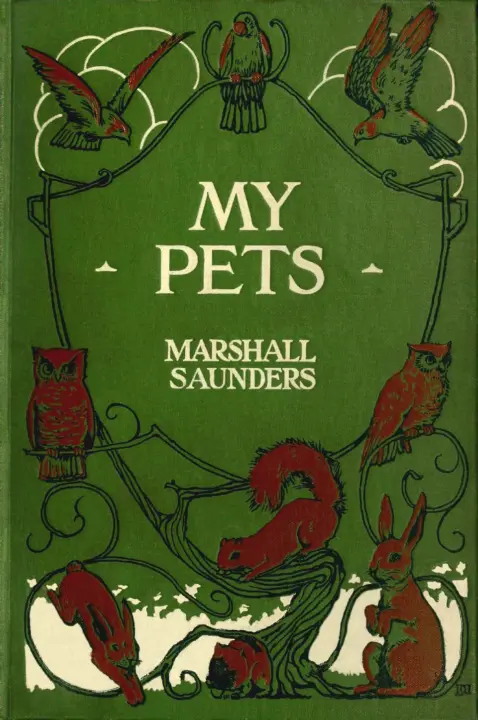
My pets
Marshall Saunders
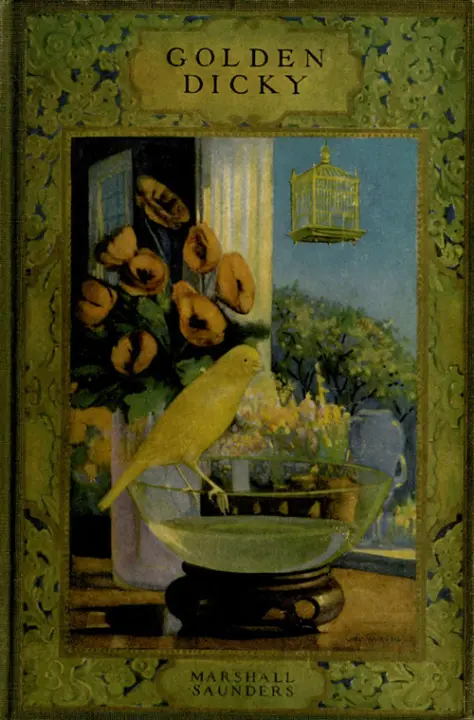
THE CLASSIC COLLECTION · 1919
"Golden Dicky, The Story of a Canary and His Friends" by Marshall Saunders is a children's novel written in the early 20th century. It presents an endearing tale revolving around a canary named Dicky-Dick and his family and friends in a bird room, intertwined with moral lessons about compassion for animals and the importance of kindness. The book likely appeals to young readers with its charming cast of animal characters and lighthearted adventures. The opening of the story introduces Dicky-Dick as he reflects on his early life as a baby bird in a comfortable bird-room, lovingly cared for by his mother, Dixie, and father, Norfolk. The narrative showcases the canary's initial experiences, including the excitement of opening his eyes for the first time and meeting his siblings. Dicky-Dick's complicated relationship with his brother, Green-Top, begins to unfold as the canary learns valuable lessons about family, rivalry, and self-worth while also offering glimpses into the vibrant lives of the other birds around him. The chapters set the stage for an exploration of his friendships and the adventures that await as he navigates his world beyond the nest.
Introduction adapted from the source catalogue; source summaries may be automatically generated.
Free to read · English · 53,204 words · No account needed
MAKE TIME FOR A GOOD BOOK
On by default. Untick to stop anonymous reading totals. Each page counts after 10 seconds in view. How this works.
Anonymous counting is on unless you have switched it off.
Perching on the roof of the barn, I called softly, “Squirrie,
Squirrie, where are you?”
For a long time he would not speak, then I heard him mocking me, “Here I am, baby, baby,” and he unexpectedly put his head out of a hole right behind me.
I turned round, and he made one of his dreadful faces at me.
“Squirrie,” I said gently, for I was determined not to lose patience with him, “come out, I want to talk to you.”
“And what have you to say that is worth listening to?” he asked teasingly, and sticking his head a little further out of the hole.
“I want to tell you how sorry I am for you,” I went on, “and to ask you if I can help you to try to be a better squirrel. The birds are getting pretty angry with you, and I fear they may run you out of the neighborhood if you don’t improve.”
At this bit of news he came right out, his eyes twinkling dangerously.
“What are they planning to do?” he asked.
“Oh, nothing definite. They’re just talking of what they’ll do if you tease their young ones this year, as you did last year. You remember they got very angry with you before the nesting season was over.”
He began to hum his favorite song—“I care for nobody; no, not I—”
“Squirrie,” I said pleadingly, “if you only knew how much pleasanter it is to be good and have everybody love you.”
“Just like you—little sneaking soft-face!” he said.
I was quite shocked. “I am not a sneak,” I said, “and why do you call me soft-face—I, a hard-billed bird?”
“You’re such a little drooling darling,” he said disdainfully, “making up to all the birds in the neighborhood, and pretending to be such an angel. You’re a little weasel, that’s what you are.”
“A weasel,” I exclaimed in horror, “a bad animal that sucks birds’ blood. Squirrie, you’re crazy!”
“I’m not crazy,” he said, coming quite out of the hole and sitting up on his hind legs and shaking his forepaws threateningly at me. “I see through you, Mr. Snake-in-the-grass.”
I was silent for a minute under this torrent of abuse and overwhelmed at his audacity in calling me, a tiny bird, by the names of bad animals—not that snakes are all bad, nor are weasels, but he used the bad part of them to describe me.
“Well,” I said at last, “you are taking my call in a wrong spirit.”
Your reading position is saved on this browser. Take it to another device with a library code. Reading pages adapt to text, rather than matching a printed edition.
Marshall Saunders
Marshall Saunders
Marshall Saunders
Marshall Saunders
BEHIND THE BOOK
This eBook is for the use of anyone anywhere in the United States and most other parts of the world at no cost and with almost no restrictions whatsoever. You may copy it, give it away or re-use it under the terms of the Project Gutenberg License included with this eBook or online at www.gutenberg.org. If you are not located in the United States, you will have to check the laws of the country where you are located before using this eBook. Read the source licence.
The original source file, including credits and licence, is retained by this library. Request an original-format copy at no charge. Please include the book title and Project Gutenberg identifier #55173.
KEEP YOUR CURIOSITY GOING
Coulson Kernahan

Maurice Baring
Frances Wright
Cécile Tormay

Frederic Jesup Stimson

W. H. P. (William Henry Pope) Jarvis