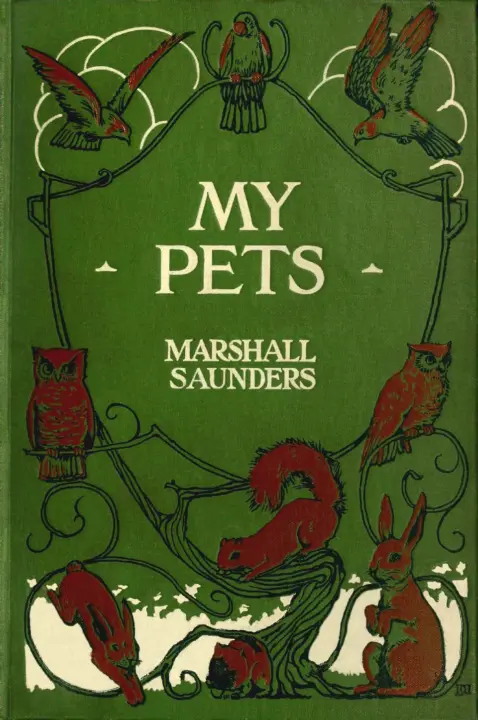
My pets
Marshall Saunders
THE CLASSIC COLLECTION · 1919
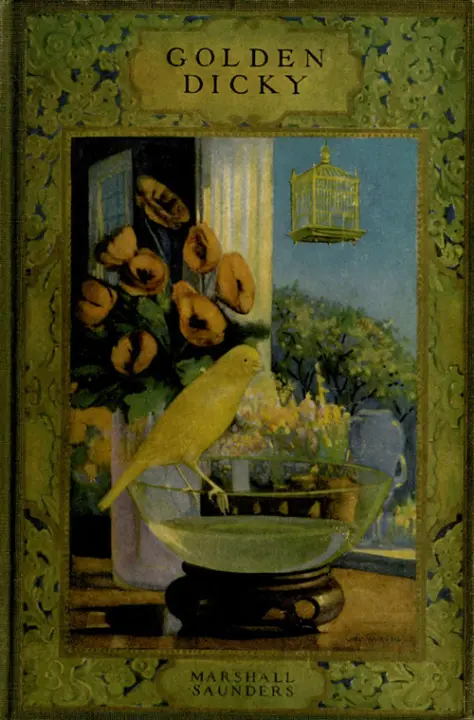
"Golden Dicky, The Story of a Canary and His Friends" by Marshall Saunders is a children's novel written in the early 20th century. It presents an endearing tale revolving around a canary named Dicky-Dick and his family and friends in a bird room, intertwined with moral lessons about compassion for animals and the importance of kindness. The book likely appeals to young readers with its charming cast of animal characters and lighthearted adventures. The opening of the story introduces Dicky-Dick as he reflects on his early life as a baby bird in a comfortable bird-room, lovingly cared for by his mother, Dixie, and father, Norfolk. The narrative showcases the canary's initial experiences, including the excitement of opening his eyes for the first time and meeting his siblings. Dicky-Dick's complicated relationship with his brother, Green-Top, begins to unfold as the canary learns valuable lessons about family, rivalry, and self-worth while also offering glimpses into the vibrant lives of the other birds around him. The chapters set the stage for an exploration of his friendships and the adventures that await as he navigates his world beyond the nest.
Introduction adapted from the source catalogue; source summaries may be automatically generated.
Free to read · English · 53,204 words · No account needed
MAKE TIME FOR A GOOD BOOK
On by default. Untick to stop anonymous reading totals. Each page counts after 10 seconds in view. How this works.
Anonymous counting is on unless you have switched it off.
“How are you getting on, dearie, dearie?” I sang, as I found her working away at a heap of nest lining that Mrs. Martin had given us.
“Nicely, nicely,” she said, in her funny, husky little voice. She has been allowed to hang near a cold window in winter, and it has hurt her throat. In summer, she was nearly baked by being kept all the time in the sun, and I tell her she must be a very tough little canary, or she would have been dead before this.
“If you would just whistle a pretty little tune to me, Dicky-Dick,” she said, “while I work, and not interfere; I know just how these tiny, soft bits of cotton go. I must throw out that red stuff; I don’t like bright colors for any nest of mine.”
“Mrs. Martin never put that in,” I said. “It must have been the children. You might put it in the middle of the nest where no strange bird would see it.”
“And suppose it is hot, and I sweat,” she said, “and get the young
ones all damp?”
“I don’t think you will perspire, Daisy,” I said. “You are such a cool little bird. I will sing you ‘By a Nice Stream of Water a Canary Bird Sat.’”
“Thank you,” she said, and I, perching on the top of the cage, was beginning one of my best strains, with fine long notes in it, when I heard a well-known footstep in the hall.
It was Mr. Martin coming home in the middle of the morning. What could
be the matter with him?
His wife came hurrying out of the bedroom. “Henry, are you ill?”
“No,” he said wearily, passing his hand over his forehead, “but I saw this in the street, and bought it for you,” and he handed her a cardboard box.
Missie opened it, and in the box sat a dear little ring-dove, of a pale, dull, creamy color, and with a black half ring round the nape of the neck.
“Oh, Henry,” she said, “where did you get it?”
“From a man in the street. He had two to sell and one was dying. I took it into a drug store and had it put out of its misery and brought this one home to you.”
“You gentle thing!” said Missie, and, lifting the little creature out of the box, she set hemp seed and water before it.
The dove ate and drank greedily, then finding a place in the sun on the table, flew to it and began cleaning her feathers.
“She is used to strangers,” said Mr. Martin. “She has no fear of us.”
Your reading position is saved on this browser. Take it to another device with a library code. Reading pages adapt to text, rather than matching a printed edition.
Marshall Saunders
Marshall Saunders
Marshall Saunders
Marshall Saunders
BEHIND THE BOOK
This eBook is for the use of anyone anywhere in the United States and most other parts of the world at no cost and with almost no restrictions whatsoever. You may copy it, give it away or re-use it under the terms of the Project Gutenberg License included with this eBook or online at www.gutenberg.org. If you are not located in the United States, you will have to check the laws of the country where you are located before using this eBook. Read the source licence.
The original source file, including credits and licence, is retained by this library. Request an original-format copy at no charge. Please include the book title and Project Gutenberg identifier #55173.
KEEP YOUR CURIOSITY GOING
Coulson Kernahan

Maurice Baring
Frances Wright
Cécile Tormay

Frederic Jesup Stimson

W. H. P. (William Henry Pope) Jarvis