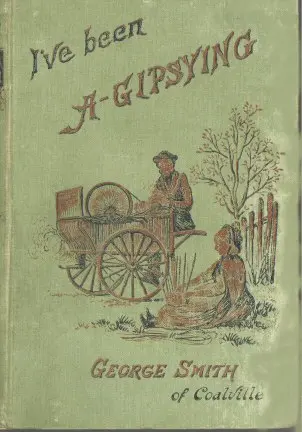
I’ve been a Gipsying or, Rambles among our Gipsies and their children in their tents and vans
George Smith
THE CLASSIC COLLECTION · 1880
"Gipsy Life" by George Smith is an account written in the late 19th century that examines the lives, origins, and social conditions of the Gipsy population in England. The book delves into the challenges faced by Gipsies, particularly women and children, highlighting themes of neglect and societal misunderstanding. The opening reveals the author's dedication to raising awareness about the plight of Gipsies and the need for educational intervention in their lives. Smith outlines the historical treatment of Gipsies across Europe, touching on their origins and the stigma associated with their lifestyle. He paints a vivid picture of the struggles they have endured, from persecution in various countries to their current state in England, emphasizing the importance of understanding their story to foster compassion and potential improvement in their circumstances.
Introduction adapted from the source catalogue; source summaries may be automatically generated.
Free to read · English · 108,927 words · No account needed
MAKE TIME FOR A GOOD BOOK
On by default. Untick to stop anonymous reading totals. Each page counts after 10 seconds in view. How this works.
Anonymous counting is on unless you have switched it off.
"We entered, Mr. George Smith and I, and were received as friends. Had I gone by myself, I question whether my reception would have been a pleasant one. As Gipsies pay no taxes, they can keep any number of dogs, and these dogs have a way of sniffing and snarling, anything but agreeable to an unbidden guest. The poor people complained to me no one ever came to see them. I should be surprised if any one did; but Mr. George Smith, of Coalville, is no common man, and having secured fair play for the poor children of the brick-fields--he himself was brought up in a brick-yard--and for the poor, and sadly-neglected, inmates of the canal-boats, he has now turned his attention to the Gipsies. His idea is--and it is a good one--that an Act of Parliament should be passed for their benefit--something similar to that he has been the means of carrying for the canal and brick-field children. In a paper read before the Social Science Congress at Manchester, Mr. Smith argued that all tents, shows, caravans, auctioneer vans, and like places used as dwellings should be registered and numbered, and under proper sanitary arrangements, with sanitary inspectors and School Board officers, in every town and village. Thus in every district the children would have their names and attendance registered in a book, which they could take with them from place to place, and when endorsed by the schoolmaster, it would show that the children were attending school. In carrying out this idea, it is a pity that Mr. Smith should have to bear all the burden. As it is, he has suffered greatly in his pocket by his philanthropic effort. . . .
"It is no joke going into a Gipsy yard, and it is still less so when you go down on your hands and knees, and crawl into the Gipsy's wigwam; but the worst of it is, when you have done so, there is little to see after all. In the middle, on a few bricks, is a stove or fireplace of some kind. On the ground is a floor of wood-chips, or straw, or shavings, and on this squat some two or three big, burly men, who make linen-pegs and skewers, and mend chairs and various articles, the tribe, as they wander along, seek to sell. The women are away, for it is they who bring the grist to the mill, as they tell fortunes, or sell their wares, or follow their doubtful trade; but the place swarms with children; and it was wonderful to see with what avidity they stretched out the dirtiest little hand imaginable as Mr. Smith prepared to distribute some sweets he had brought with him for that purpose. As we entered, all the vans were shut up, and the tents only were occupied, the vans being apparently deserted but presently a door was opened half-way, and out popped a little Gipsy head, with sparkling eyes and curly hair; and then another door opened, and a similar spectacle was to be seen. Let us look into the van, about the size of a tiny cabin, and chock full, in the first place, with a cooking-stove; and then with shelves, with curtains and some kind of bedding, apparently not very clean, on which the family repose. It is a piteous life, even at the best, in that van; even when the cooking pot is filled with something more savoury than cabbages or potatoes; the usual fare; but the children seem happy, nevertheless, in their dirty rags, and with their luxurious heads of curly hair. All of them are as ignorant as Hottentots, and lead a life horrible to think of. I only saw one woman in the camp, and I only saw her by uncovering the top and looking into the tent in which she resides. She is terribly poor, she says, and pleads earnestly for a few coppers; and I can well believe she wants them, for in this England of ours, and especially in the outskirts of London, the Gipsy is not a little out of place. Around us are some strapping girls, one with a wonderfully sweet smile on her face, who, if they could be trained to domestic service, would have a far happier life than they can ever hope to lead. The cold and wet seem to affect them not, nor the poor diet, nor the smoke and bad air of their cabins, in which they crowd, while the men lazily work, and the mothers are far away. The leading lady in this camp is absent on business; but she is a firm adherent of Mr. George Smith, and wishes to see the children educated; and as she is a Lee, and as a Lee in Gipsy annals take the same rank as a Norfolk Howard in aristocratic circles, that says a good deal; but, then, if you educate a Gipsy girl, she will want to have her hands and face, at any rate, clean; and a Gipsy boy, when he learns to read, will feel that he is born for a nobler end than to dwell in a stinking wigwam, to lead a lawless life, to herd with questionable characters, and to pick up a precarious existence at fairs and races; and our poets and novelists and artists will not like that. However, just now, by means of letters in the newspapers, and engravings in the illustrated journals, a good deal of attention is paid to the Gipsies, and if they can be reclaimed and turned into decent men and women a good many farmers' wives will sleep comfortably at night, especially when geese and turkeys are being fattened for Christmas fare; and a desirable impulse will be given to the trade in soap."
Your reading position is saved on this browser. Take it to another device with a library code. Reading pages adapt to text, rather than matching a printed edition.
George Smith
George Smith
BEHIND THE BOOK
This eBook is for the use of anyone anywhere in the United States and most other parts of the world at no cost and with almost no restrictions whatsoever. You may copy it, give it away or re-use it under the terms of the Project Gutenberg License included with this eBook or online at www.gutenberg.org. If you are not located in the United States, you will have to check the laws of the country where you are located before using this eBook. Read the source licence.
The original source file, including credits and licence, is retained by this library. Request an original-format copy at no charge. Please include the book title and Project Gutenberg identifier #28548.
KEEP YOUR CURIOSITY GOING
Cécile Tormay

Moritz Busch
John L. Ransom
Frances Wright
Cécile Tormay

Mabel Potter Daggett