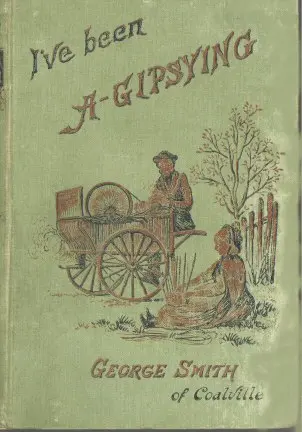
I’ve been a Gipsying or, Rambles among our Gipsies and their children in their tents and vans
George Smith
THE CLASSIC COLLECTION · 1880
"Gipsy Life" by George Smith is an account written in the late 19th century that examines the lives, origins, and social conditions of the Gipsy population in England. The book delves into the challenges faced by Gipsies, particularly women and children, highlighting themes of neglect and societal misunderstanding. The opening reveals the author's dedication to raising awareness about the plight of Gipsies and the need for educational intervention in their lives. Smith outlines the historical treatment of Gipsies across Europe, touching on their origins and the stigma associated with their lifestyle. He paints a vivid picture of the struggles they have endured, from persecution in various countries to their current state in England, emphasizing the importance of understanding their story to foster compassion and potential improvement in their circumstances.
Introduction adapted from the source catalogue; source summaries may be automatically generated.
Free to read · English · 108,927 words · No account needed
MAKE TIME FOR A GOOD BOOK
On by default. Untick to stop anonymous reading totals. Each page counts after 10 seconds in view. How this works.
Anonymous counting is on unless you have switched it off.
On January 3rd, 1880, additional illustrations were given in the Illustrated London News. 1. Tent at Hackney; 2. Tent at Hackney; 3. Sketch near Latimer Road, Notting Hill; 4. A Bachelor's Bedroom, Mitcham Common; 5. Encampment at Mitcham Common; 6. A Knife-grinder at Hackney Wick; 7. A Tent at Hackney Marshes. "A few additional sketches, continuing those of this subject which have appeared in our journal, are engraved for the present number. It is estimated by Mr. George Smith, of Coalville, Leicester, who has recently been exploring the queer outcast world of Gipsydom in different parts of England, that some 2,000 people called by that name, but of very mixed race, living in the manner of Zulu Kaffirs rather than of European citizens, frequent the neighbourhood of London. They are not all thieves, not even all beggars and impostors, and they escape the law of vagrancy by paying a few shillings of weekly rent for pitching their tents or booths, and standing their waggons or wheeled cabins, on pieces of waste ground. The western side of Notting Hill, where the railway passenger going to Shepherd's Bush or Hammersmith sees a vast quantity of family linen hung out to dry in the gardens and courtyards of small dwelling-houses, bordered towards Wormwood Scrubs by a dismal expanse of brick-fields, might tempt the Gipsies so inclined to take a clean shirt or petticoat--certainly not for their own wearing. But we are not aware that the police inspectors and magistrates of that district have found such charges more numerous in their official record than has been experienced in other quarters of London; and it is possible that honest men and women, though of irregular and slovenly habits, may exist among this odd fragment of our motley population. It is for the sake of their children, who ought to be, at least equally with those of the English labouring classes, since they cannot get it from their parents, provided with means of decent Christian education, that Mr. George Smith has brought this subject under public notice. The Gipsies, so long as they refrain from picking and stealing, and do not obstruct the highways, should not be persecuted; for they are a less active nuisance than the Italian organ-grinders in our city streets, whose tormenting presence we are content to suffer, to the sore interruption both of our daily work and our repose. But it is expedient that there should be an Act of Parliament, if the Home Secretary has not already sufficient legal powers, to establish compulsory registration of the travelling Gipsy families, and a strict licensing system, with constant police supervision, for their temporary encampments, while their children should be looked after by the local School Board. These measures, combined with judicious offers of industrial help for the adults and industrial training for the juniors, with the special exercise of Poor-Law Guardian administration, and some parochial or missionary religious efforts, might put an end to vagabond Gipsy life in England before the commencement of the twentieth century, or within one generation. We hope to see the matter discussed in the House of Lords or the House of Commons during the ensuing session; for it actually concerns the moral and social welfare of more than thirty thousand people in our own country, which is an interest quite as considerable as that we have in Natal or the Transvaal, among Zulus and Basutos, and the rest of Kaffirdom. The sketches we now present in illustration of this subject are designed to show the squalid and savage aspect of Gipsy habitations in the suburban districts, at Hackney and Hackney Wick, north-east of London; where the marsh-meadows of the river Lea, unsuitable for building-land, seem to forbid the extension of town streets and blocks of brick or stuccoed terraces; where the pleasant wooded hills of Epping and Hainault Forest appear in the distance, inviting the jaded townsman, on summer holidays, to saunter in the Royal Chace of the old English kings and queens; where genuine ruralities still lie within an hour's walk, of which the fashionable West-ender knoweth nought. There lurks the free and fearless Gipsy scamp, if scamp he truly be, with his squaw and his piccaninnies, in a wigwam hastily constructed of hoops and poles and blankets, or perhaps, if he be the wealthy sheikh of his wild Bedouin tribe, in a caravan drawn from place to place by some lost and strayed plough-horse, the lawful owner of which is a farmer in Northamptonshire. Far be it from us to say or suspect that the Gipsy stole the horse; 'convey, the wise it call;' and if horse or donkey, dog, or pig, or cow, if cock and hen, duck or turkey, be permitted to escape from field or farmyard, these fascinated creatures will sometimes follow the merry troop of 'Romany Rye' quite of their own accord, such is the magic of Egyptian craft and the innate superiority of an Oriental race. These Gipsies, Zingari, Bohemians, whatever they be called in the kingdoms of Europe, are masters of a secret science of mysterious acquisition, as remote from proved crime of theft or fraud as from the ways of earning or winning by ordinary industry and trade. There is many a rich and splendid establishment at the West-end supported by a different application of the same mysterious craft. Solicitors and stockbrokers may have seen it in action. It is that of silently appropriating what no other person may be quite prepared to claim."
Your reading position is saved on this browser. Take it to another device with a library code. Reading pages adapt to text, rather than matching a printed edition.
George Smith
George Smith
BEHIND THE BOOK
This eBook is for the use of anyone anywhere in the United States and most other parts of the world at no cost and with almost no restrictions whatsoever. You may copy it, give it away or re-use it under the terms of the Project Gutenberg License included with this eBook or online at www.gutenberg.org. If you are not located in the United States, you will have to check the laws of the country where you are located before using this eBook. Read the source licence.
The original source file, including credits and licence, is retained by this library. Request an original-format copy at no charge. Please include the book title and Project Gutenberg identifier #28548.
KEEP YOUR CURIOSITY GOING
Cécile Tormay

Moritz Busch
John L. Ransom
Frances Wright
Cécile Tormay

Mabel Potter Daggett