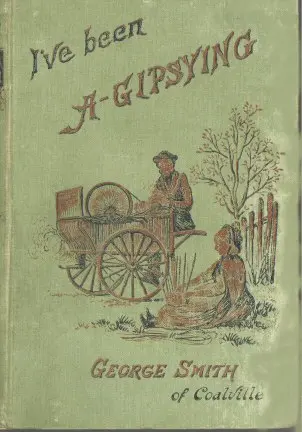
I’ve been a Gipsying or, Rambles among our Gipsies and their children in their tents and vans
George Smith
THE CLASSIC COLLECTION · 1880
"Gipsy Life" by George Smith is an account written in the late 19th century that examines the lives, origins, and social conditions of the Gipsy population in England. The book delves into the challenges faced by Gipsies, particularly women and children, highlighting themes of neglect and societal misunderstanding. The opening reveals the author's dedication to raising awareness about the plight of Gipsies and the need for educational intervention in their lives. Smith outlines the historical treatment of Gipsies across Europe, touching on their origins and the stigma associated with their lifestyle. He paints a vivid picture of the struggles they have endured, from persecution in various countries to their current state in England, emphasizing the importance of understanding their story to foster compassion and potential improvement in their circumstances.
Introduction adapted from the source catalogue; source summaries may be automatically generated.
Free to read · English · 108,927 words · No account needed
MAKE TIME FOR A GOOD BOOK
On by default. Untick to stop anonymous reading totals. Each page counts after 10 seconds in view. How this works.
Anonymous counting is on unless you have switched it off.
I next turned my steps towards London, having heard that Gipsies were to be found in the outskirts of this Babylon. I set off early one morning in quest of them from my lodgings, not knowing whither; but my earliest association came to my relief. Knowing that Gipsies are generally to be found in the neighbourhood of brick-yards, I took the 'bus to Notting Hill, and after asking the policeman, for neither clergyman or other ministers could tell me where they were to be found, I wended my way to Wormwood Scrubs, and the following letter, which appeared in the Daily News, September 6th of last year, is the outcome of that "run out," and is as follows:--"It has been the custom for years--I might almost say centuries--when speaking of the Gipsies, to introduce in one form or other during the conversation either 'the King of the Gipsies,' 'the Queen,' or some other member of 'the Royal Family.' It may surprise many of your readers who cling to the romantic side of a Gipsy's life, and shut their eyes to the fearful amount of ignorance, wretchedness, and misery there is amongst them, to say that this extraordinary being is nothing but a mythological jack-o'-th'-lantern, phantom of the brain, illusion, the creation of lying tongues practising the art of deception among some of the 'green horns' in the country lanes, or on the village greens. It is true there are some 'horse-leeches' among the Gipsies who have got fat out of their less fortunate hedge-bottom brethren and the British public, who delight in calling them either 'the King,' 'Queen,' 'Prince,' or 'Princess.' It is true also that there are vast numbers of the Gipsies who, with a chuckle, tongue in cheek, wink of the eye, side grin and a sneer, say they have these important personages amongst them; and if any little extra stir is being made at a fair-time in the country lanes, in the neighbourhood of straw-yards, they will be sure to tell them that either the 'king,' 'queen,' or some member of the 'royal family' is being married or visiting them; and nothing pleases the poor, ignorant Gipsies better than to get the bystanders, with mouths open, to believe their tales and lies. I should think that there is scarcely a county in England but what a Gipsy king's or queen's wedding has not taken place there within the last twenty years. There was one in Bedfordshire not long since; another at Epping Forest; and the last I heard of this wonderful airy being was that he had taken up his head-quarters at the Royal Hotel, Liverpool, and a carriage with eight wheels and six piebald horses had been presented to him as a wedding present from the Gipsies. Gipsy 'kings,' 'queens,' and 'princes,' their marriages and deaths, are innumerable among the 'royal family.' It is equally believing in moonshine and air-bubbles to believe that the Gipsies never speak of their dead. There is a beautiful headstone put in a little churchyard about two and a half miles from Barnet in memory of the Brinkly family, and it is carefully looked after by members of the family; one of the Lees has a tombstone erected to his memory in Hanwell Cemetery; and such silly nonsense is put out by the cunning, crafty Gipsies as 'dazzlers,' to enable them more readily to practise the art of lying and deception upon their gullible listeners. Then again, with reference to the Gipsies having a religion of their own. There is not a word of truth in this imaginative notion prevalent in the minds or some who have been trying to study their habits. Excepting the language of some of the old-fashioned real Gipsies, and a few other little peculiarities, any one studying the real hard facts of a Gipsy's life with reference to the amount of ignorance, and everything that is bad among them, will come to the conclusion that there is much among them to compare very unfavourably with the most neglected in our back streets and slums. Of course, there are some good among them, as with other 'ragamuffin' ramblers. The following particulars, related to me by a well-known Gipsy woman in the neighbourhood of 'Wormwood Scrubs' and the 'North Pole,' remarkable for her truthfulness, honesty, and uprightness, will tend to show that my previous statement as regards the amount of ignorance prevalent among the poor Gipsy children has not been over-stated. She has had six brothers and one sister, all born in a tent, and only one of the eight could read a little. She has had nine children born in a tent, four of whom are alive, and only one could read and write a little. She has seventeen grandchildren, and only two of them can read and write a little, and thinks this a fair average of other Gipsy children. She tells me that she got a most fat living for more than twenty years by telling lies and fortunes to servant-girls, old maids, and young men, mostly out of a book of which she could not read a sentence, or tell a letter. She said she had heard that I had taken up the cause of the poor Gipsy children to get them educated, and, with hands uplifted and tears in her eyes, which left no doubt of her meaning, said, 'I do hope from the bottom of my heart that God will bless and prosper you in the work till a law is passed, and the poor Gipsy children are brought under the School Board, and their parents compelled to send them to school as other people are. The poor Gipsy children are poor, ignorant things, I can assure you.' She also said 'Does the Queen wish all our poor Gipsy children to be educated?' I told her that the Queen took special interest in the children of the working-classes, and was always pleased to hear of their welfare. Again, with tears trickling down her face, she said, 'I do thank the Lord for such a good Queen, and for such a noble-hearted woman. I do bless her. Do Thou, 'Lord, bless her!' After some further conversation, and taking dinner with her in her humble way in the van, she said she hoped I would not be insulted if she offered me, as from a poor Gipsy woman, a shilling to help me in the work of getting a law passed to compel the Gipsies to send their children to school. I took the shilling, and, after making her a present of a copy of the new edition of my 'Cry of the Children from the Brick-yards of England,' which she wrapped in a beautiful white cloth, and after a shake of the hand, we parted, hoping to meet again on some future day."
Your reading position is saved on this browser. Take it to another device with a library code. Reading pages adapt to text, rather than matching a printed edition.
George Smith
George Smith
BEHIND THE BOOK
This eBook is for the use of anyone anywhere in the United States and most other parts of the world at no cost and with almost no restrictions whatsoever. You may copy it, give it away or re-use it under the terms of the Project Gutenberg License included with this eBook or online at www.gutenberg.org. If you are not located in the United States, you will have to check the laws of the country where you are located before using this eBook. Read the source licence.
The original source file, including credits and licence, is retained by this library. Request an original-format copy at no charge. Please include the book title and Project Gutenberg identifier #28548.
KEEP YOUR CURIOSITY GOING
Cécile Tormay

Moritz Busch
John L. Ransom
Frances Wright
Cécile Tormay

Mabel Potter Daggett