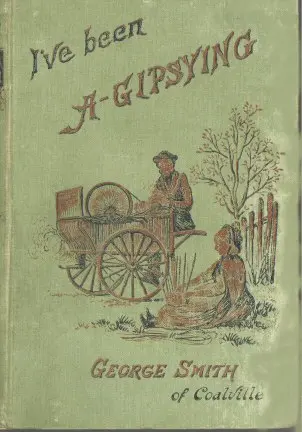
I’ve been a Gipsying or, Rambles among our Gipsies and their children in their tents and vans
George Smith
THE CLASSIC COLLECTION · 1880
"Gipsy Life" by George Smith is an account written in the late 19th century that examines the lives, origins, and social conditions of the Gipsy population in England. The book delves into the challenges faced by Gipsies, particularly women and children, highlighting themes of neglect and societal misunderstanding. The opening reveals the author's dedication to raising awareness about the plight of Gipsies and the need for educational intervention in their lives. Smith outlines the historical treatment of Gipsies across Europe, touching on their origins and the stigma associated with their lifestyle. He paints a vivid picture of the struggles they have endured, from persecution in various countries to their current state in England, emphasizing the importance of understanding their story to foster compassion and potential improvement in their circumstances.
Introduction adapted from the source catalogue; source summaries may be automatically generated.
Free to read · English · 108,927 words · No account needed
MAKE TIME FOR A GOOD BOOK
On by default. Untick to stop anonymous reading totals. Each page counts after 10 seconds in view. How this works.
Anonymous counting is on unless you have switched it off.
"Mr. Smith has now embarked upon a fresh crusade against misery and ignorance. He has turned his attention from the 'water Gipsies' to their brethren ashore. He has already began to busy himself with the condition of 'our roadside arabs,' as he calls them. We fear Mr. Smith in prosecuting this good work of his is doomed to perform a serious act of disenchantment. The ideal Gipsy is destined to be scattered to the winds by the unvarnished picture which Mr. Smith will cause to be presented to our vision. He does not pretend to show us the romantic, fantastically-dressed creature whose prototypes have long been in the imaginations of many of us as types of the Gipsy species. Those of our readers who have formed their notions of Gipsy life upon the strength of the assurances which have been given them by the late Mr. G. P. R. James and kindred writers will find it hard to substitute for the joyous scenes of sunshine and freedom he has associated with the nomadic existence, the dull, wearisome round of squalor and wretchedness which is found, upon examination, to constitute the principal condition of the Gipsy tent. Whether it is that in this awfully prosaic period of the world's history the picturesque and jovial rascality which novelist and poet have insisted in connecting with the Ishmaelites is stamped ruthlessly out of being by force of circumstances, it is barely possible to say. Perhaps Gipsies, in common with other tribes of the romantic past, have gradually become denuded of their old attractiveness. It is, we confess, rather difficult to believe that Bamfylde Moore Carew (wild, restless fellow though he was) would persistently have linked his lot with that of the poor, degraded, poverty-stricken wretches whom Mr. Smith has taken in hand. Perchance it happens that our old heroes of song and story have, so far as England is concerned, deteriorated as a consequence of the money-making, business-like atmosphere that they are compelled to breathe, and that with more favoured climes they are to be seen in much of their primitive glory. In Hungary, for instance, it is declared that Gipsy life is pretty much what it is represented to be in our own glowing pages of fiction. The late Major Whyte-Melville, in a modern story declared to be founded on fact, introduces us to a company of these continental wanderers who, with their beautiful Queen, seem to invest the scenes from our old friend, 'The Bohemian Girl,' with something akin to probability. But there is, of course, a limit to even Mr. Smith's labours. Hungary is beyond his jurisdiction. He does not pretend to carry his experience of the Gipsies further than the Midlands. Derbyshire, Staffordshire, and our neighbouring counties have offered him the examples he requires with his new campaign. The lot of the roamers who eke out a living in the adjacent lanes and roadways is, he explains to us, as pitiful as anything of the sort well could be. The tent of the Gipsy he finds to be as filthy and as repulsive as the cabin of the canal-boat. Human beings of both sexes and of all ages are huddled together without regard to comfort. As a necessary sequence the women and children are the chief sufferers in a social evil of this sort. The men are able to rough it, but the weaker sex and their little charges are reduced to the lowest paths of misery. Children are born, suffer from disease, and die in the canvas hovels; and are committed to the dust by the roadside. One old woman told Mr. Smith 'that she had had sixteen children, fifteen of whom are alive, several of them being born in a roadside tent. She says that she was married out of one of these tents; and her brother died and was buried out of a tent at Packington, near Ashby-de-la-Zouch.' The experience of this old crone is akin to that of most of her class. She also tells Mr. Smith that she could not read herself, and she did not believe one in twenty could. Morally, as well as from a sanitary point of view, Gipsy life, as it really exists, is a social plague-spot, and consequently a social danger. Especially does this contention apply to the children, of whom Mr. Smith estimates that there are ten thousand roaming over the face of the country as vagrants and vagabonds. It is to be hoped many months will not be allowed to elapse before this difficulty is seriously and successfully grappled with. Mr. Smith's counsel as to the children is that 'living in vans and tents and under old carts, if they are to be allowed to live in these places they should be registered in a manner analogous to the Canal Boats Act of 1877, so that the children may be brought under the compulsory clauses of the Education Acts, and become Christianised and civilised as other children.' The Duke of Richmond and his department may do much to facilitate Mr. Smith's crusade without temporising with the prejudices of red-tapeism."
Your reading position is saved on this browser. Take it to another device with a library code. Reading pages adapt to text, rather than matching a printed edition.
George Smith
George Smith
BEHIND THE BOOK
This eBook is for the use of anyone anywhere in the United States and most other parts of the world at no cost and with almost no restrictions whatsoever. You may copy it, give it away or re-use it under the terms of the Project Gutenberg License included with this eBook or online at www.gutenberg.org. If you are not located in the United States, you will have to check the laws of the country where you are located before using this eBook. Read the source licence.
The original source file, including credits and licence, is retained by this library. Request an original-format copy at no charge. Please include the book title and Project Gutenberg identifier #28548.
KEEP YOUR CURIOSITY GOING
Cécile Tormay

Moritz Busch
John L. Ransom
Frances Wright
Cécile Tormay

Mabel Potter Daggett