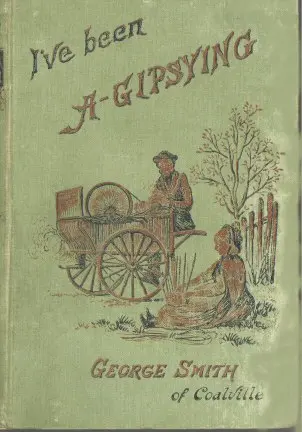
I’ve been a Gipsying or, Rambles among our Gipsies and their children in their tents and vans
George Smith
THE CLASSIC COLLECTION · 1880
"Gipsy Life" by George Smith is an account written in the late 19th century that examines the lives, origins, and social conditions of the Gipsy population in England. The book delves into the challenges faced by Gipsies, particularly women and children, highlighting themes of neglect and societal misunderstanding. The opening reveals the author's dedication to raising awareness about the plight of Gipsies and the need for educational intervention in their lives. Smith outlines the historical treatment of Gipsies across Europe, touching on their origins and the stigma associated with their lifestyle. He paints a vivid picture of the struggles they have endured, from persecution in various countries to their current state in England, emphasizing the importance of understanding their story to foster compassion and potential improvement in their circumstances.
Introduction adapted from the source catalogue; source summaries may be automatically generated.
Free to read · English · 108,927 words · No account needed
MAKE TIME FOR A GOOD BOOK
On by default. Untick to stop anonymous reading totals. Each page counts after 10 seconds in view. How this works.
Anonymous counting is on unless you have switched it off.
"F. G. S." writes:--"One of your correspondents suggests that the silence of the Gipsies concerning their dead is carried so far as to consign them to nameless graves. In my churchyard there is a headstone, 'to the memory of Mistress Paul Stanley, wife of Mr. Paul Stanley, who died November, 1797,' the said Mistress Stanley having been the Queen of the Stanley tribe. In my childhood I remember that annually some of the members of the tribe used to come and scatter flowers over the grave; and when my father had restored the stone, on its falling into decay, a deputation of the tribe thanked him for so doing. I have reason to think they still visit the spot, to find, I am sorry to say, the stone so decayed now as to be past restoration, and I would much like to see another with the same inscription to mark the resting-place of the head of a leading tribe of these interesting people."
[Picture: Gipsies Camping among the Heath near London]
To these letters I replied as under, on August 21st:--"The numerous correspondents who have taken upon themselves to reply to my letter that appeared in your issue of the 14th inst., and to show up Gipsy life in some of its brightest aspects, have, unwittingly, no doubt, thoroughly substantiated and backed up the cause of my young clients--i.e., the poor Gipsy children and our roadside arabs--so far as they have gone, as a reperusal of the letters will show the most casual observer of our hedge-bottom heathens of Christendom. At the same time, I would say the tendency of some of the remarks of your correspondents has special reference to the adult Gipsies, roamers and ramblers, and, consequently, there is a fear that the attention of some of your readers may be drawn from the cause of the poor uneducated children, living in the midst of sticks, stones, ditches, mud, and game, and concentrated upon the 'guinea buttons,' 'black-haired Susans,' 'red cloaks,' 'scarlet hoods,' the cunning craft of the old men, the fortune-telling of the old women, the 'sparkling eyes' and 'clapping of hands,' and 'twopenny hops' of the young women, who certainly can take care of themselves, just as other un-Christianised and uncivilised human beings can. I do not profess--at any rate, not for the present--to take up the cause of the men and women ditch-dwelling Gipsies in this matter; I must leave that part of the work to fiction writers, clergymen, and policemen, abler hands than mine. I may not be able, nor do I profess, to understand the singular number of the masculine gender of dad, chavo, tikeno, moosh, gorjo, raklo, rakli, pal palla; the feminine gender dei, tikeno, chabi, joovel, gairo, rakle, raklia, pen penya, or the plural of the masculine gender dada, chavi, and the feminine gender deia, chavo; but, being a matter of fact kind of man--out of the region of romance, fantastical notions, enrapturing imagery, nicely coloured imagination, clever lying and cleverer deception, beautiful green fields, clear running rivulets, the singing of the wood songster, bullfinch, and wren, in the midst of woodbine, sweetbriar, and roses--with an eye to observe, a heart to feel, and a hand ready to help, I am led to contemplate, aye, and to find out if possible, the remedy, though my friends say it is impossible--just because it is impossible it becomes possible, as in the canal movement--for the wretched condition of some eight to ten thousand little Gipsy children, whose home in the winter is camping half-naked in a hut, so called, in the midst of 'slush' and snow, on the borders of a picturesque ditch and roadside, winterly delights, Sunday and week day alike. The tendency of human nature is to look on the bright side of things; and it is much more pleasant to go to the edge of a large swamp, lie down and bask in the summer's sun, making 'button-holes' of daisies, buttercups, and the like, and return home and extol the fine scenery and praise the richness of the land, than to take the spade, in shirt-sleeves and heavy boots, and drain the poisonous water from the roots of vegetation. Nevertheless, it has to be done, if the 'strong active limbs' and 'bright sparkling eyes' are to be turned to better account than they have been in the past. It is not creditable to us as a Christian nation, in size compared with other nations not much larger than a garden, to have had for centuries these heathenish tribes in our midst. It does not speak very much for the power of the Gospel, the zeal of the ministers of Christ's Church, and the activity of the schoolmaster, to have had these plague spots continually flitting before our eyes without anything being done to effect a cure. It is true something has been done. One clergyman, who has 'had opportunities of observing them,' if not brought in daily contact with them, tells us that some eight or nine years since he publicly baptised two Gipsy children. Another tells us that some time since he baptised many Gipsy children, as if baptism was the only thing required of the poor children for the duties and responsibilities of life and a future state. Better a thousand times have told us how many poor roadside arabs and Gipsy children they have taken by the hand to educate and train them, so as to be able to earn an honest livelihood, instead of 'cadging' from door to door, and telling all sorts of silly stories and lies. How many poor children's lives have been sacrificed at the hands of cruelty, starvation, and neglect, and buried under a clod without the shedding of a tear, it is fearful to contemplate. The idlers, loafers, rodneys, mongrels, gorgios, and Gipsies are increasing, and will increase, in our midst, unless we put our hand upon the system, from the simple fact that by packing up with wife and children and 'taking to the road,' he thus escapes taxes, rent, and the School-board officer. This they see, and a 'few kind words' and 'gentle touches' will never cause them to see it in any other light. The sooner we get the ideal, fanciful, and romantic side of a vagrant's and vagabond's life removed from our vision, and see things as they really are, the better it will be for us. For the life of me I cannot see anything romantic in dirt, squalor, ignorance, and misery. Ministers and missionaries have completely failed in the work, for the simple reason that they have never begun it in earnest; consequently, the schoolmaster and School-board officer must begin to do their part in reclaiming these wandering tribes, and this can only be done in the manner stated by me in my previous letter."
Your reading position is saved on this browser. Take it to another device with a library code. Reading pages adapt to text, rather than matching a printed edition.
George Smith
George Smith
BEHIND THE BOOK
This eBook is for the use of anyone anywhere in the United States and most other parts of the world at no cost and with almost no restrictions whatsoever. You may copy it, give it away or re-use it under the terms of the Project Gutenberg License included with this eBook or online at www.gutenberg.org. If you are not located in the United States, you will have to check the laws of the country where you are located before using this eBook. Read the source licence.
The original source file, including credits and licence, is retained by this library. Request an original-format copy at no charge. Please include the book title and Project Gutenberg identifier #28548.
KEEP YOUR CURIOSITY GOING
Cécile Tormay

Moritz Busch
John L. Ransom
Frances Wright
Cécile Tormay

Mabel Potter Daggett