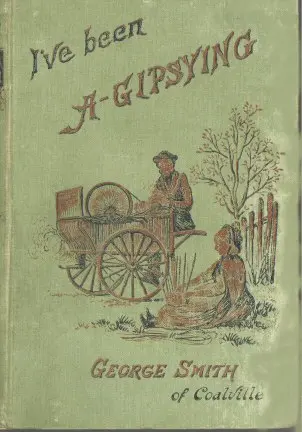
I’ve been a Gipsying or, Rambles among our Gipsies and their children in their tents and vans
George Smith
THE CLASSIC COLLECTION · 1880
"Gipsy Life" by George Smith is an account written in the late 19th century that examines the lives, origins, and social conditions of the Gipsy population in England. The book delves into the challenges faced by Gipsies, particularly women and children, highlighting themes of neglect and societal misunderstanding. The opening reveals the author's dedication to raising awareness about the plight of Gipsies and the need for educational intervention in their lives. Smith outlines the historical treatment of Gipsies across Europe, touching on their origins and the stigma associated with their lifestyle. He paints a vivid picture of the struggles they have endured, from persecution in various countries to their current state in England, emphasizing the importance of understanding their story to foster compassion and potential improvement in their circumstances.
Introduction adapted from the source catalogue; source summaries may be automatically generated.
Free to read · English · 108,927 words · No account needed
MAKE TIME FOR A GOOD BOOK
On by default. Untick to stop anonymous reading totals. Each page counts after 10 seconds in view. How this works.
Anonymous counting is on unless you have switched it off.
ringing in my ears, and at times when busily engaged upon other things, "In the days we went a-gipsying" would be running through my mind. In meditation and solitude; by night and by day; at the top of the hill, and down deep in the dale; in the throng and battle of life; at the deathbed scene; through evil report and good report these words, "In the days we went a-gipsying," were ever and anon at my tongue's end. The other part of the song I quickly forgot, but these words have stuck to me ever since. On purpose to try to find out what fortune-telling was, when in my teens I used to walk after working hours from Tunstall to Fenton, a distance of six miles, to see "old Elijah Cotton," a well-known character in the Potteries, who got his living by it, to ask him all sorts of questions. Sometimes he would look at my hands, at other times he would put my hand into his, and hold it while he was reading out of the Bible, and burning something like brimstone-looking powder--the forefinger of the other hand had to rest upon a particular passage or verse; at other times he would give me some of this yellow-looking stuff in a small paper to wear against my left breast, and some I had to burn exactly as the clock struck twelve at night, under the strictest secrecy. The stories this fortune-teller used to relate to me as to his wonderful power over the spirits of the other world were very amusing, aye, and over "the men and women of this generation." He was frequently telling me that he had "fetched men from Manchester in the dead of the night flying through the air in the course of an hour;" and this kind of rubbish he used to relate to those who paid him their shillings and half-crowns to have their fortunes told. My visits lasted for a little time till he told me that he could do nothing more, as I was "not one of his sort." Like Thomas called Didymus, "hard of belief." Except an occasional glance at the Gipsies as I have passed them on the road-side, the subject has been allowed to rest until the commencement of last year, when I mentioned the matter to my friends, who, in reply, said I should find it a difficult task; this had the effect of causing a little hesitation to come over my sensibilities, and in this way, between hesitation and doubt, matters went on till one day in July last year, when the voice of Providence and the wretched condition of the Gipsy children seemed to speak to me in language that I thought it would be perilous to disregard. On my return home one evening I found a lot of Gipsies in the streets; it struck me very forcibly that the time for action had now arrived, and with this view in mind I asked Moses Holland--for that was his name, and he was the leader of the gang--to call into my house for some knives which required grinding, and while his mate was grinding the knives, for which I had to pay two shillings, I was getting all the information I could out of him about the Gipsy children--this with some additional information given to me by Mr. Clayton and several other Gipsies at Ashby-de-la-Zouch, together with a Gipsy woman's tale to my wife, mentioned in my "Cry of the Children from the Brick-yards of England," brought forth my first letter upon the condition of the poor Gipsy children as it appeared in the Standard, Daily Chronicle, and nearly every other daily paper on August 14th of last year:--"Some years since my attention was drawn to the condition of these poor neglected children, of whom there are many families eking out an existence in the Leicestershire, Derbyshire, and Staffordshire lanes. Two years since a pitiful appeal was made in one of our local papers asking me to take up the cause of the poor Gipsy children; but I have deferred doing so till now, hoping that some one with time and money at his disposal would come to the rescue. Sir, a few weeks since our legislators took proper steps to prevent the maiming of the little show children, who are put through excruciating practices to please a British public, and they would have done well at the same time if they had taken steps to prevent the warping influence of a vagrant's life having its full force upon the tribes of little Gipsy children, dwelling in calico tents, within the sound of church bells--if living under the body of an old cart, protected by patched coverlets, can be called living in tents--on the roadside in the midst of grass, sticks, stones, and mud; and they would have done well also if they had put out their hand to rescue from idleness, ignorance, and heathenism our roadside arabs, i.e., the children living in vans, and who attend fairs, wakes, &c. Recently I came across some of these wandering tribes, and the following facts gleaned from them will show that missionaries and schoolmasters have not done much for them. Moses Holland, who has been a Gipsy nearly all his life, says he knows about two hundred and fifty families of Gipsies in ten of the Midland counties and thinks that a similar proportion will be found in the rest of the United Kingdom. He has seen as many as ten tents of Gipsies within a distance of five miles. He thinks there will be an average of five children in each tent. He has seen as many as ten or twelve children in some tents, and not many of them able to read or write. His child of six months old--with his wife ill at the same time in the tent--sickened, died, and was 'laid out' by him, and it was also buried out of one of those wretched abodes on the roadside at Barrow-upon-Soar, last January. When the poor thing died he had not sixpence in his pocket. In shaking hands with him as we parted his face beamed with gladness, and he said that I was the first who had held out the hand to him during the last twenty years. At another time later on I came across Bazena Clayton, who said that she had had sixteen children, fifteen of whom are alive, several of them being born in a roadside tent. She says that she was married out of one of these tents; and her brother died and was buried out of a tent at Packington, near Ashby-de-la-Zouch. This poor woman knows about three hundred families of Gipsies in eleven of the Midland and Eastern counties, and has herself, so she says, four lots of Gipsies travelling in Lincolnshire at the present time. She said she could not read herself, and thinks that not one Gipsy in twenty can. She has travelled all her life. Her mother, named Smith, of whom there are not a few, is the mother of fifteen children, all of whom were born in a tent. A Gipsy lives, but one can scarcely tell how; they generally locate for a time near hen-roosts, potato-camps, turnip-fields, and game-preserves. They sell a few clothes-lines and clothes-pegs, but they seldom use such things themselves. Washing would destroy their beauty. Telling fortunes to servant girls and old maids is a source of income to some of them. They sleep, but in many instances lie crouched together, like so many dogs, regardless of either sex or age. They have blood, bone, muscle, and brains, which are applied in many instances to wrong purposes. To have between three and four thousand men and women, and fifteen thousand children classed in the census as vagrants and vagabonds, roaming all over the country, in ignorance and evil training, that carries peril with it, is not a pleasant look-out for the future; and I claim on the grounds of justice and equity, that if these poor children, living in vans and tents and under old carts, are to be allowed to live in these places, they shall be registered in a manner analogous to the Canal Boats Act of 1877, so that the children may be brought under the Compulsory Clauses of the Education Acts, and become Christianised and civilised as other children."
Your reading position is saved on this browser. Take it to another device with a library code. Reading pages adapt to text, rather than matching a printed edition.
George Smith
George Smith
BEHIND THE BOOK
This eBook is for the use of anyone anywhere in the United States and most other parts of the world at no cost and with almost no restrictions whatsoever. You may copy it, give it away or re-use it under the terms of the Project Gutenberg License included with this eBook or online at www.gutenberg.org. If you are not located in the United States, you will have to check the laws of the country where you are located before using this eBook. Read the source licence.
The original source file, including credits and licence, is retained by this library. Request an original-format copy at no charge. Please include the book title and Project Gutenberg identifier #28548.
KEEP YOUR CURIOSITY GOING
Cécile Tormay

Moritz Busch
John L. Ransom
Frances Wright
Cécile Tormay

Mabel Potter Daggett